
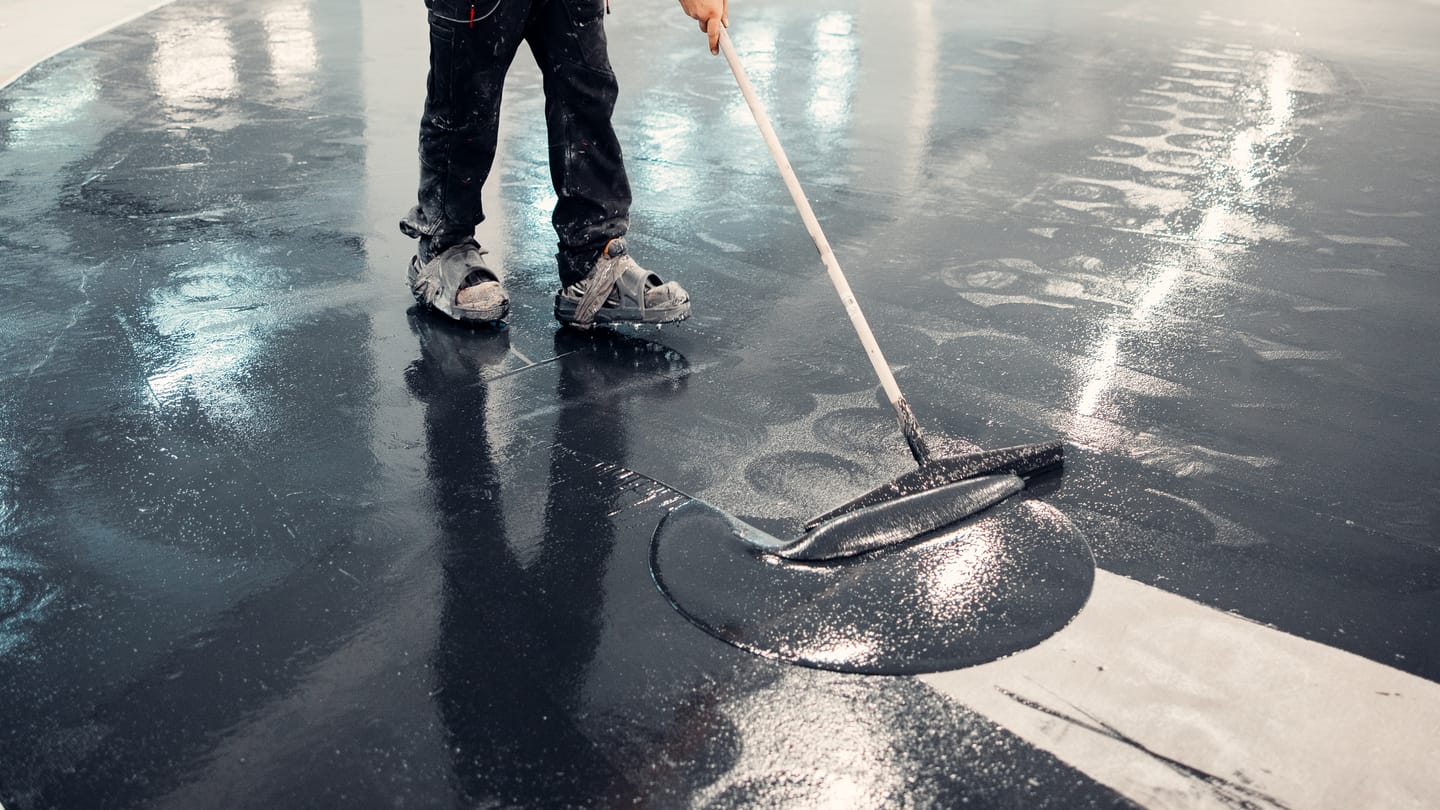
Comp for an Ohio coating crew is bought from a state-run fund, so the epoxy flooring business insurance cost in Ohio that we quote leaves comp out and turns on what remains: the floors you coat, the solvents you thin, the city certificates you need, the grinders and trucks you haul, and the limits your contracts set.
Statutes, city rules and the air chapter behind this guide are laid out on our Ohio epoxy flooring insurance page. Here they are read for price, and the epoxy flooring business insurance overview shows how the separate lines join into a program.
Premium paid to Ohio Bureau of Workers’ Compensation, outside the quote we write
Ohio routes a private employer’s comp premium into the state insurance fund that Ohio Bureau of Workers’ Compensation administers, and the premium and self-insurance statute allows a way around the fund only through bureau-approved self-insurance. That makes Ohio a monopolistic state. Your insurance spending splits accordingly: a bureau premium you pay directly, and a private program we place for the rest.
Ohio law treats a private contract insuring the comp obligation as void, so no agent can sell a substitute for the fund on Ohio payroll, and a quote that claims to is a warning sign. Workers’ compensation in Ohio is still a real cost, and a bureau premium can follow payroll and the class of work. Ask the bureau how it classes the people who grind, the people who coat and the people who estimate, and keep office wages reported where they belong.
Stop-gap questions a monopolistic system leaves open
Employers liability is the piece a fund-only system can leave unsettled. The Ohio statutes behind this guide never use the stop-gap term, so whether a private employers liability endorsement can be added for an Ohio coating crew is NOT CONFIRMED. Ask us, and ask Ohio Bureau of Workers’ Compensation, before you assume an answer.
Ohio’s void-contract section reaches past comp itself: an agreement to cover an employer for its own willful act, or for ignoring a lawful safety requirement, is void too. Read any stop-gap wording against that section before you rely on it. Where an endorsement is offered, it can add a charge to the liability side of the program. Where none is offered, the gap belongs in front of whoever reviews your contracts, before you sign a plant or warehouse subcontract that asks about it.
A sub’s unpaid bureau premium as a cost you inherit
Under the same premium statute, a hiring contractor can be billed for bureau premium its subcontractor leaves unpaid on the contracted work. That turns subcontracting into a pricing question. Hand the grinding on a large warehouse floor to another crew, and that crew’s bureau account becomes part of your exposure.
Get a current coverage certificate from each sub’s bureau account before mobilizing, file it with the job, and make continuous coverage a written term the sub must meet to get paid. Helpers raise the mirror-image problem. For construction work, Ohio’s comp statute treats a helper as staff once enough of its listed control factors fit, set hours and tools supplied by the hirer among them. Ask the bureau to weigh in on any helper whose status you are unsure of, before the floor rather than at the first injury.
Certificates for City of Columbus and the limits they pull in
No state card is issued for floor coating. Ohio Construction Industry Licensing Board stops at heating and cooling, refrigeration, electrical, plumbing and hydronics work, and the licensing guide by state compares that picture with other states.
Price enters through the city instead. City of Columbus requires any contractor working inside its limits to hold the fitting city license or registration before permits, and its general contractor registration wants a bond plus a liability certificate that lists the city’s building department as holder, issued by an Ohio-licensed insurer. Which city registration fits coating work is NOT CONFIRMED, since the city’s contractor page does not address coatings; ask the city’s building department about your scope before you bid. The page as we read it shows no bond amount and no insurance limit, so ask the city what it expects, then have us quote that limit and any umbrella liability it takes to reach a contract’s demand. Other Ohio cities were not read, so phone each city’s permit desk ahead of your opening job there.
Thinning, closed lids and the Architectural and Industrial Maintenance (AIM) Coatings chapter
Ohio’s coatings chapter, kept by Ohio Environmental Protection Agency, reaches the applicator directly. It names floor coatings, including garage floors, as a category with its own limit, bars thinning a product past that limit, and requires thinner and cleanup containers to stay closed between uses; the chapter text is the place to read it. Whether the chapter sits in Ohio’s federally approved air plan is NOT CONFIRMED: the federal table of approved Ohio rules lists no such chapter. Ask Ohio Environmental Protection Agency if a customer’s specification cites federal approval.
For the liability quote, the chapter works as a signal. A pollution exclusion in general liability can reach fumes, so an underwriter can ask which solvent-borne products you apply inside occupied buildings and how your crew handles thinner. A crew that mixes to the data sheet, caps its cans and ventilates an occupied space gives a cleaner answer. Contractors pollution cover beside the liability deserves a conversation before commercial work.
Real-World Scenario: A garage crew working out of Akron, OH lands a plant floor in Cleveland, OH from a general contractor who wants additional insured status, a waiver of subrogation and a certificate before mobilizing. The owner plans to hand the grinding to another crew. Before signing, the owner pulls that crew’s bureau coverage proof, has us quote the endorsements and an umbrella, and asks the supplier which category of the coatings chapter the topcoat is sold under, so the bid carries the real cost.
Grinding-dust answers when Occupational Safety and Health Administration holds the private jobsite
On a privately owned Ohio slab the federal agency holds jurisdiction, because the federal list of approved plans names no Ohio plan. Public Employment Risk Reduction Program is a state program aimed at government workplaces, and the state also delivers the federal consultation service to smaller private firms in hazardous work. For a private crew grinding slabs, the silica rule is the federal construction standard on respirable crystalline silica, and Occupational Safety and Health Administration enforces it. The state-run consultation service can look over a crew’s shrouds, vacuums and respirator records ahead of any inspection, and a written dust plan gives an underwriter something to read.
Comp premium for an Ohio crew flows to the bureau, yet dust practice still reaches the private side of the price. A lung claim can test employers liability wording, and the reviewer for a plant or school contract can read your safety program before awarding the floor. An Ohio dust file showing grinder shrouds, a matched collection vacuum, wet cutting where it suits the slab, and fit-tested respirators under a written program gives that reviewer, and the underwriter, something concrete to rate.
Coating routes from Columbus, OH to Youngstown-Warren, OH
Ohio road miles move the auto and tools lines. The Census metros we track in Ohio run from Columbus, OH and Cleveland, OH through Dayton-Kettering-Beavercreek, OH, Akron, OH and Toledo, OH to Youngstown-Warren, OH. An Ohio rig dividing its week between plant floors in Cuyahoga County and garage jobs in Summit County piles up miles on commercial auto. List every driver, and tell us where each truck is parked overnight. A crew that bases itself in Dayton-Kettering-Beavercreek, OH and drives to plant work around Cleveland, OH runs a different auto exposure from a crew that stays inside Franklin County, and the quote can reflect that difference only if you describe it.
Equipment left on a plant floor in Lucas County overnight (grinders, shot blasters, dust collectors) belongs on inland marine for contractors’ tools and equipment, scheduled at what it is worth. Commercial floors across these metros bring the contract demands covered on our commercial epoxy coverage page: additional insured wording, waivers and limits above a garage program.
Crossing into Michigan, Indiana or Pennsylvania on the other-states exception
Ohio’s void-contract statute carves out comp protection for out-of-state work, and that carve-out is what a crew needs before it works across the line. Tell us before a Toledo, OH crew takes a floor in Michigan, before a Youngstown-Warren, OH crew bids across the Pennsylvania line, and before any job in Indiana. The other-states piece can be priced on its own, so arrange it with us before the job, while general liability can be written to list each state you enter.
Payroll by role, your bureau account, the city registrations you hold, product data sheets, your vehicle and equipment lists, and the contract terms you are bidding against are what we need to quote your Ohio program.