
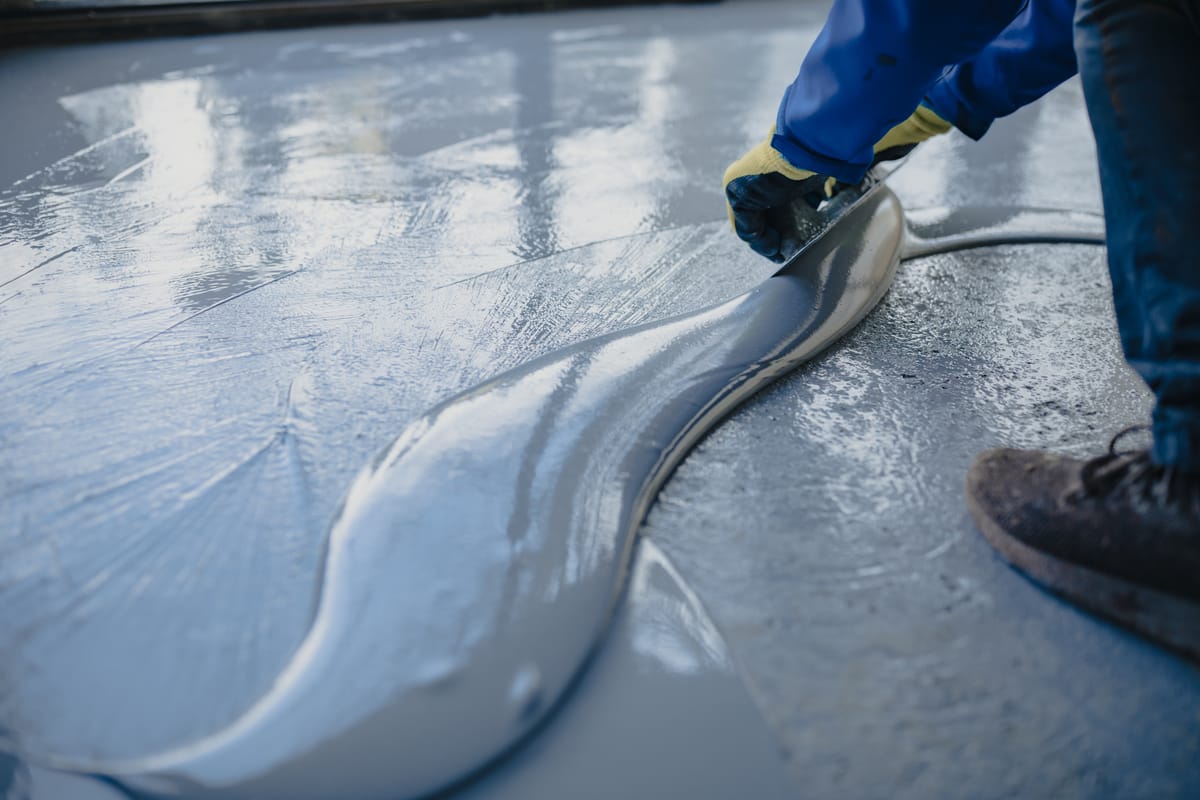
General liability is the policy an epoxy flooring contractor needs first. It answers when someone who does not work for you is hurt by your work, when the customer’s property is damaged while you work, and when a finished floor fails and causes damage after you have packed up. It also pays to defend those claims, which on its own can be the largest part of a bad one.
What makes it specific to this trade is timing and chemistry. A claim against a coating contractor can arrive after the job is done, when a floor lifts, blisters or turns slick. And the materials themselves, resins, hardeners, solvents and the vapors they give off, sit close to the line of an exclusion a liability policy can carry. The sections below take both in turn, with the residential and commercial sides of the work, and what an underwriter will ask before quoting. Part of the epoxy flooring business insurance program.
A two-column comparison. The first column holds what general liability is generally about for an epoxy flooring business: someone who does not work for you hurt on a job, including a slip on a floor that has not cured; damage to the customer’s property around the work; a finished coating that fails and damages something else after you leave; and the defense of the claim. The second column holds what it generally hands off or leaves with you: the cost of redoing the coating itself, which can stay with you; your grinders and vacuums, which belong to inland marine; your trucks and trailers, which belong to commercial auto; and an injury to your own employee, which belongs to workers compensation. Your own policy wording decides any real claim. No figures are shown.
What general liability answers for on an epoxy job
The policy’s subject is injury and damage to people and property that are not yours. On a coating job that means three groups of claims. First, bodily injury to someone who does not work for you: a homeowner who steps onto a floor before it has cured, a tenant who slips on a finish that was laid too smooth for a wet area, a student in a school hallway where the coating was still tacky. Second, property damage around the work: a door, a wall or a water heater scuffed while equipment comes in, or contents in a garage or storeroom damaged by dust or splatter. Third, property damage after you finish, which the policy treats as its own category.
Alongside those sits the defense. When a claim is made, the policy generally pays the lawyers to defend it, and that duty can begin before anyone decides whether the claim is good. For a small coating business, the defense can be what makes the policy worth having even when a claim goes nowhere.
What it is not is a policy about your own business’s property or people. Your grinders and vacuums belong on inland marine, your trucks and trailers on commercial auto, and an injury to someone on your crew is a workers compensation claim.
Your work and completed operations: when the floor fails after you leave
Coating work fails late. A floor laid over a slab that was not ground deep enough, or over moisture that was never tested, can look perfect on the day you hand it over and lift months later. The completed operations part of general liability is written for exactly this: injury or damage that happens after your work is finished and in use.
The distinction that matters is what failed and what it damaged. If a delaminating coating causes someone to fall, or lets moisture and chemicals reach stored inventory, equipment or another part of the building, those are the kinds of losses completed operations is about. Grinding off the failed coating and putting down a new one is different. A liability policy can treat the cost of fixing your own faulty work as yours, not the carrier’s, through a part of the policy known as the “your work” exclusion. The line between the two is where a coating claim can be argued.
Two details change how that line falls. Work done on your behalf by a subcontractor is generally treated as your work, so the installer you bring in for a weekend counts. And a policy can carry an exception for damage that arises from a subcontractor’s work, which can matter a great deal on a failed floor. Whether your policy keeps that exception, and whether it applies to residential work, is one of the first things we read.
A written warranty you give a customer is a separate promise. It is a promise about your own work, and the policy is not a warranty program, so a callback to fix a floor under warranty can be your cost even when no one is hurt.
Damage to the customer’s property while you grind and coat
During the job the risk is physical. Diamond grinding throws dust and debris, propane equipment runs in enclosed spaces, coatings drip and splatter, and crews move heavy equipment through finished homes and occupied buildings. Damage to the property around the work, such as cabinets, doors, vehicles left in a garage, or stock on a warehouse shelf, is the kind of claim general liability is built for.
The floor you are working on is treated differently. A liability policy can limit coverage for property in your care, custody or control and for the particular part of a building you are working on at the time, which on an epoxy job can be the slab itself. A slab cracked by grinding, or a coating ruined because the space was opened before it cured, can sit inside those limits. How a given policy words them, and whether the program adds coverage back, is part of choosing the right form for a coating business.
A top-to-bottom flow. It begins with a coating applied in an occupied building, where solvent or resin vapors drift into rooms that are in use. A tenant, student or employee of the customer says the vapors made them ill, or a business says it had to close while they cleared. The claim is made against your business. A liability policy can carry a pollution exclusion that can apply to vapors and fumes, so the claim may be argued under that exclusion rather than paid as ordinary bodily injury. Where the program carries contractors pollution coverage, written separately or added by endorsement, that coverage is built to answer this kind of claim. Your own policy wording decides any real claim. No figures are shown.
When vapors from a coating job become a claim
Epoxy work puts chemicals in the air. Solvent-based primers and topcoats, resin and hardener vapors, and the volatile organic compounds some products release can drift through a house or into the rest of a commercial building while the floor cures. When someone says those vapors made them ill, or a business says it had to close until the air cleared, the claim can come to your general liability policy, and the pollution exclusion on that policy may be raised against it.
Depending on how your policy defines a pollutant, fumes and vapors can fall inside that exclusion, and a policy that carries a total pollution exclusion may leave no room for them at all. Read the policy and each endorsement that mentions pollution before a job in an occupied space. A separate pollution liability policy, offered on some programs as contractors pollution coverage, may provide coverage better suited to this kind of release; ask what it would answer for when vapors linger in an occupied building and how it fits with your liability policy. Low-odor and water-based products, ventilation plans and work done outside occupied hours are risk controls an underwriter may ask about, but they do not change what the exclusion says. Our guide to contractors pollution liability insurance for epoxy fumes walks through how that wording and its exceptions read on a coating job.
Where you work and what your contracts ask can shape whether you want pollution coverage. A contractor who coats empty garages may decide differently from one who coats kitchens in operating restaurants or classrooms during the school year. You can ask us to look for quotes with pollution coverage and without it, and to show you the pollution wording on each, so the choice rests on the policy language.
Residential garages versus kitchens, schools and warehouses
On the residential side, the claims are about homeowners and their property: someone walking onto a floor too early, a car or a workbench damaged while the garage was cleared, a flake system that peels in the first winter. Certificates are rarer and contracts are simple, but the volume of small jobs means a steady exposure to completed operations.
On the commercial side the contract does more of the talking. Owners and general contractors may require you to name them as additional insureds, sometimes for completed operations as well as ongoing work, to make your policy primary, and to waive your right to recover from them. They also tend to set minimum limits that are higher than a residential contractor carries, which is where umbrella liability comes in. Kitchens and pool houses add wet, slick floors; warehouses add forklift traffic and long cure windows; schools add occupied buildings and summer deadlines. See residential and commercial epoxy flooring contractor insurance for the rest of each program.
What underwriters ask before they quote general liability
A carrier pricing general liability for a coating business will want to know how the work is done, not only how much of it there is. Expect questions about your split between residential and commercial work and the kinds of buildings you coat; how you prepare the slab, and whether you test for moisture and keep the results; which systems you install, from standard epoxy to polyaspartic, urethane, flake and metallic; whether you use solvent-based products indoors; whether you use subcontractors and collect their certificates; and your claims history. Clear answers, especially on prep and moisture testing, tend to earn better terms than a vague description of “flooring”.
Claims epoxy flooring contractors bring to this policy
The patterns repeat. A homeowner’s guest slips on a garage floor finished with too little grit and is hurt; the claim comes to completed operations. A warehouse floor laid over a damp slab delaminates under forklift traffic and the owner says stock and equipment were damaged; the argument is over what is damage to other property and what is the cost of redoing the floor. A restaurant says vapors from a weekend job kept the kitchen closed on Monday; the pollution exclusion is raised. A school hallway coated in the summer is opened early and a student falls; the general contractor tenders the claim to your policy as an additional insured. Each turns on wording, which is why we read the policy before the job, not after the claim.
Limits a school district asks for, not just a homeowner
General liability is written with a limit for each occurrence and an aggregate across the policy period, and completed operations can carry an aggregate of its own. The right limits depend on your contracts more than on anything else: commercial owners and general contractors set minimums, and the limits that satisfy a homeowner rarely satisfy a school district. Where a contract asks for more than the policy carries, an umbrella layer above general liability and auto is the usual answer. We do not publish typical limits or prices, because the right ones are set by the jobs you take.
What we read in a general liability quote before you sign
We place one trade. That means we describe your operation the way you run it, with the grinding, the chemistry and the cure times an underwriter needs to understand, and we read the parts of the policy that matter to a coating contractor: completed operations, the “your work” exclusion and its subcontractor exception, the care, custody or control limits and the pollution exclusion. We work with several carriers that write this class, compare what comes back and walk you through the differences, and we handle the certificates and additional insured endorsements commercial jobs require.