
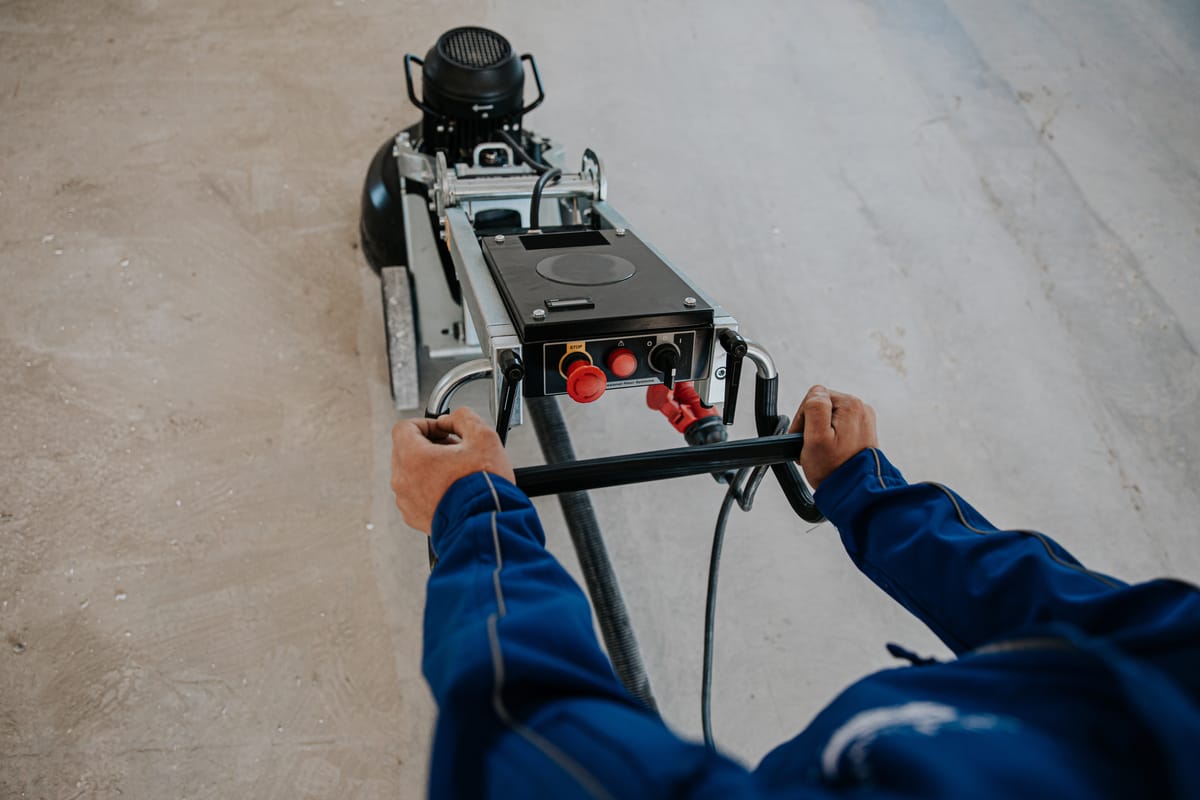
Epoxy flooring equipment insurance can be written as an inland marine contractors equipment floater. It covers the grinders, vacuums, blasters, mixers and meters an epoxy flooring business owns, and, where the floater adds them, the ones it rents or borrows, against theft, fire, vandalism, collision and similar physical loss. “Inland marine” is an old name for coverage of property that moves, and that is exactly what a coating crew’s equipment does every working day.
The reason it matters is concentration. A small crew’s ability to work rests on a handful of expensive machines, and losing a planetary grinder or a dust collection vacuum can stop jobs until it is replaced. A property policy built around a building, or a vehicle policy built around a truck, generally does not follow that equipment. This page covers what the floater protects, how values and settlement are chosen and where its limits sit, as one part of the insurance program for an epoxy coating crew.
Planetary grinders, shot blasters and the rest of the rig
The core of an epoxy contractor’s equipment is surface prep. Planetary diamond grinders take the cream off a slab and open it for the primer coat; edge grinders reach the walls and corners; shot blasters prepare large commercial floors; and a dust collection vacuum runs alongside all of them to keep silica out of the air and off the finish. Behind those sit mixers and paddles, moisture meters and test kits, propane-powered grinders and burnishers with their tanks, generators, and the squeegees, rollers and spike shoes used in the coating itself.
A floater can be written to cover nearly all of it. The questions are how each piece is listed, what value it carries and what happens if it is lost. Those choices shape both what a claim pays and what the policy costs.
Covered at the shop, on the road and on the slab
Equipment of this kind spends its life in three places. It sits in a shop or storage unit between jobs, it rides in a truck bed or an enclosed trailer, and it stays on the jobsite for one day or several while a floor is ground, primed and coated. A contractors equipment floater is designed to follow the property through all three, rather than covering it only at one address.
That is the main difference from commercial property coverage, which is written for a building and its contents at a stated location and may reach off-premises property only in a limited way. It is also why the equipment sits apart from commercial auto: the auto policy covers the truck and the trailer as vehicles, and generally excludes what is carried in them. A trailer pulled away from a gas station with the grinder inside is two claims under two policies.
Theft from a locked trailer or an unattended jobsite
Theft is a loss a floater is built to answer. Enclosed trailers left at a hotel overnight on an out-of-town job, gear staged in an open garage while the crew goes for material, a vacuum left inside a commercial building that other trades can walk into: each is a familiar setting. A floater can cover theft, but it may attach conditions. Some require that a vehicle or trailer be locked and that there be visible signs of forced entry; some limit coverage for equipment left unattended in an open vehicle or at an unsecured site; some exclude mysterious disappearance, where gear is simply found missing with no evidence of how.
Hitch locks, wheel locks, alarmed trailers, GPS trackers on the larger machines and an up-to-date list of serial numbers all help, both with an underwriter and after a loss. They do not change what the theft wording says, which is why that wording is one of the first parts of a floater we read.
A stack of layers, read from the top. The top layer is scheduled machines: planetary grinders, shot blasters, large dust collection vacuums and generators, each listed with its own description and value. Below it is the unscheduled blanket, which covers hand tools, mixers, moisture meters and smaller pieces as a group with a cap on any single item. Below that is rented and borrowed equipment, which is reached only where the floater adds it, sometimes under a separate limit. Next is diamond tooling and spare stock, which some floaters cover with the machine, some cap and some exclude. The bottom layer is wear, breakdown and used-up consumables, which a floater generally leaves with the business. Your own policy wording decides any real claim. No figures are shown.
Scheduled machines and the blanket for smaller tools
A floater can split equipment into two groups. Scheduled items are listed one by one, each with a description, a serial number where there is one and a value you supply. Planetary grinders, shot blasters, large vacuums and generators can go here, because their value is high enough that each one deserves its own line. Unscheduled equipment is covered as a group under a single blanket amount, with a cap on any one item. Hand tools, meters, mixers and smaller pieces generally sit here.
Both groups depend on accurate numbers. A schedule that still lists the grinder sold last year, or misses the new one bought this spring, will pay according to the list, not according to what was actually in the trailer. Some policies also give a short window to add newly acquired equipment automatically before it must be reported.
A cascade read from the top. It starts with the cost of a comparable new grinder to replace the grinder stolen from a trailer. If the policy settles on replacement cost, that cost carries forward; if it settles on actual cash value, an amount for age and wear is taken away first. What remains is then measured against the value you listed on the schedule, since the policy pays according to the list. From that, the deductible you chose is taken away. What is left is the payment the floater makes. Your own policy wording decides any real claim. No figures are shown.
Replacement cost or actual cash value: choosing how a loss is paid
Every floater settles a loss on a stated basis, and the choice is made when the policy is written, not after the theft. Replacement cost pays toward a comparable new machine without a deduction for age. Actual cash value starts from that same figure and subtracts for depreciation, so a grinder with years of floors behind it pays out less than it costs to replace. Some policies use a third approach for older equipment, paying the lesser of a set amount or the actual cash value.
Replacement cost costs more to insure and pays more in a loss; actual cash value costs less and leaves more with you. An epoxy contractor can choose replacement cost for newer, high-value machines and accept actual cash value on older pieces they would not replace like for like. The deductible you choose works alongside the basis, and the right mix depends on how much of a loss the business can absorb without stopping work.
Rented machines and equipment borrowed from another crew
A commercial job can call for gear a contractor does not own: a larger ride-on grinder for a warehouse, an extra shot blaster for a deadline, a propane burnisher for a single floor. A rental agreement can make the renter responsible for the machine from pickup to return, and the rental counter’s damage waiver may not cover theft or may carry its own conditions. Equipment borrowed from another contractor can be in the same position, with no agreement at all.
Floaters can extend coverage to rented and borrowed equipment, sometimes under a separate limit, and some add coverage for the rental charges you keep paying while a damaged machine is out of service. The time to confirm that is before the machine leaves the rental yard.
Diamond tooling, pads and the consumables question
Diamond segments, grinding plates, polishing pads, blast media and squeegee blades are used up by the work, and floaters do not pay for that wear. Where tooling becomes an underwriting question is the large stock a crew may keep on hand to match different slabs: a box of metal-bond and resin-bond tooling stolen with the grinder, or lost in a shop fire, is a real loss. Some floaters cover tooling as part of the machine it is fitted to, some cap it, some exclude spare stock. Underwriters will ask how much you carry, where it is kept and whether you want it named.
Breakdown, wear and the losses a floater leaves out
A floater covers physical loss from an outside event. It generally does not cover a grinder motor that burns out from use, gradual wear, rust or a machine damaged because it was overloaded. Equipment loaned or leased to others, property that is part of a finished floor and loss discovered only on inventory are common exclusions. Some programs offer mechanical breakdown as an added option; where they do not, maintenance records and a service schedule are the protection.
The floater pays only for your own equipment. Damage the equipment does to a customer’s property belongs to general liability. See residential and commercial epoxy flooring contractor insurance for how the floater fits each program.