
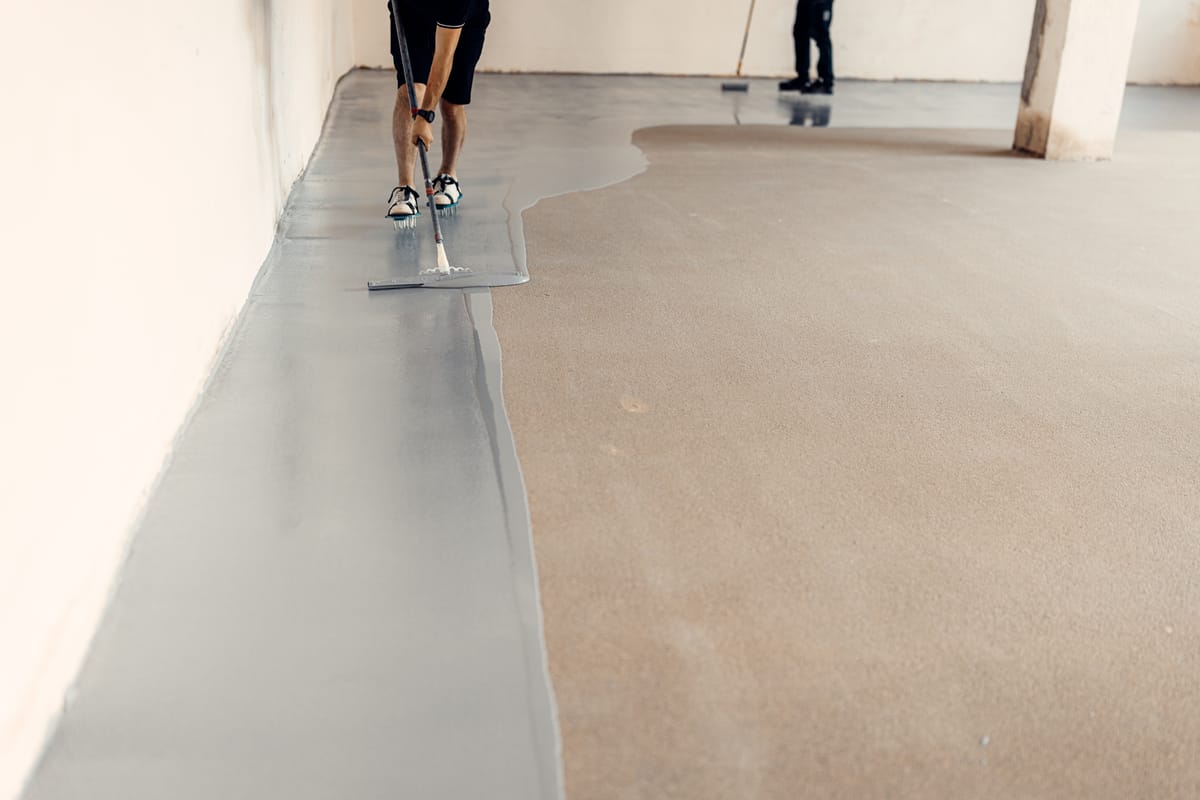
Florida’s contractor licensing does not reach epoxy flooring: state law names flooring among the job scopes for which a local government may not require a license, even to pull a permit, and a scope that matches none of the state’s licensing categories needs no registration with the state board. That holds for a garage floor in a subdivision and a coated floor in a warehouse or restaurant alike, with an edge to watch where a coating is sold to protect or waterproof a roof. What does reach a Florida coating business is the workers’ compensation law, which treats construction more strictly than other work, federal OSHA on private jobsites, and an air plan whose approved coating rules stop at factory lines.
Freedom from licensing does nothing for a floor that peels, a crew member’s chemical burn or a customer’s car scraped during the job. The rest of this page lines up each Florida rule with the policy that handles what it leaves exposed, quoting the state’s own words where we can.
Why a Florida city or county cannot license your floor work
Florida’s contractor licensing does not reach epoxy floor coating, on homes or on commercial buildings: state law names flooring among the job scopes for which a local government may not require a license, and a job scope that matches none of the state’s licensing categories needs no registration with the state board. The same law bars a city or county from requiring a state or local license for that work or to pull a permit for it. The statute’s list reads this way:
“job scopes for which a local government may not require a license include, but are not limited to, painting; flooring; cabinetry;”
Its following sentence takes the permit counter off the table as a way to require one:
“A local government may not require a state or local license to obtain a permit for such job scopes.”
An epoxy business feels that rule at the building department. Whether a particular job needs a permit at all is a question for the local office; what the statute settles is that a state or local license cannot be the condition for that permit when the work is flooring. If a permit clerk asks for a certificate of competency before you coat a floor, politely ask which provision applies, and keep a copy of the statute section with your permit paperwork.
What Florida licenses instead is the defined contractor trades and the specialty categories set by the Construction Industry Licensing Board, part of the Department of Business and Professional Regulation. A floor-coating crew stays outside that system unless the job takes in a licensed trade’s work: coating a roof to protect or waterproof it, for one, falls inside the roofing contractor’s scope. The state’s construction licensing page draws the roofing line in these words:
“roofing, waterproofing, and coating, except when coating is not represented to protect, repair, waterproof, stop leaks, or extend the life of the roof”
Garage, showroom and kitchen floors therefore stay outside the board’s categories, while a coating sold as a roof waterproofer does not. If a customer wants a balcony or a flat deck coated where that surface serves as the roof over living space or a shop, ask the Construction Industry Licensing Board where the job falls before you price it, and ask us how roof work would change your insurance program.
A resin manufacturer’s applicator certification still earns its keep when a specifier writes that maker’s system into a commercial job. It is a private arrangement between you and the manufacturer, though, and the Florida sources on this page give it no licensing weight.
With no license card and no registration in the way, the certificate requests a Florida coating business answers will mostly come from customers, property managers and general contractors. Keep your general liability bound before the first bid that asks for proof, and expect to send a fresh certificate when the policy renews.
Homeowner jobs and commercial contracts in Florida
The residential side of Florida epoxy work is garages, lanais and the occasional workshop or patio, sold to homeowners who seldom ask for a certificate. Those jobs tend to produce their claims later. Hot tires lift a coating laid over a slab that was not ground enough, an aromatic epoxy left without a UV-stable topcoat yellows where the garage door lets the sun in, and vapor rising through a slab-on-grade floor pushes up blisters. Each of those is a completed-operations claim under general liability, and our residential epoxy flooring contractor insurance page explains how those claims are handled.
Commercial work in Florida puts the contract ahead of the floor. A condominium association in a coastal tower, a restaurant group or a warehouse operator will want to be named as an additional insured, want your policy to answer before theirs, and set limits well past anything a homeowner mentions. The coating may go down overnight in a kitchen that reopens for breakfast or across a parking deck while residents still drive through, which is where fume complaints, slip claims and early-traffic damage begin. Those contract terms get a fuller treatment on our commercial epoxy flooring contractor insurance page.
Plenty of Florida crews mix garage and commercial work. Let us know roughly how your jobs divide, because a program shaped around garages can come up short against a property manager’s insurance clause, and a program shaped around commercial contracts can carry endorsements a residential crew pays for and never uses.
Construction employers and comp coverage in Florida
Workers’ compensation is required in Florida, and the construction rule is stricter than the general rule: a construction employer must carry it as soon as it has an employee, and owners who are corporate officers or LLC members count unless they hold a state exemption. Only a limited number of officers in a construction business can elect out, and the Florida Division of Workers’ Compensation issues those exemptions to the person, not the business. The Florida Division of Workers’ Compensation puts the general rule in plain terms:
“Employers conducting work in the State of Florida are required to provide workers’ compensation insurance for their employees.”
Plan on the construction rule applying to floor work, and confirm your classification with the Division before you hire. Its coverage page sets the construction threshold this way:
“Employers with one or more employees, including the owner of the business who are corporate officers or Limited Liability Company (LLC) members, must have workers' compensation coverage.”
Read that with an owner’s eye. If you formed an LLC or a corporation to run the business and you grind floors yourself, you are counted unless you hold an exemption, so ask the Division whether you need one on file before the first job, and keep its paperwork where a general contractor can see it. The statute caps the number of officers who may step out:
“no more than three officers of a corporation or of any group of affiliated corporations may elect to be exempt from this chapter”
Because the Division issues exemptions to the person and not to the business, ask about each officer separately, and revisit the question whenever ownership changes.
Calling a helper an independent contractor does not take that helper out of the system on a construction job. The statute’s definition of an employee includes this line:
“An independent contractor working or performing services in the construction industry.”
Florida’s comp law counts an independent contractor working in the construction industry, and a construction sole proprietor or partner, as an employee; outside construction a worker must meet a set of statutory criteria to be treated as an independent contractor. Before an outside installer or a day helper picks up a grinder, settle whose policy covers that person. If the answer is their own policy, get proof in writing and keep it in the job file; if the answer is unclear, assume it is yours and talk to us before the job.
We place Florida workers’ compensation with insurers that write floor-coating crews, and the price will follow how they read your dust control, your respirator program, your training and the way you pay the people on your crew. Plan on binding the policy before the first shift, not after the first payroll, so no day of work goes uncovered.
Federal OSHA holds jobsite authority over private Florida crews
On jurisdiction, the answer is settled: Florida has no OSHA-approved state plan for private employers: the federal list of approved state plans names none for Florida, and a Florida House bill analysis describes federal OSHA as the only body with authority over safety and health for private employees in the state. On an epoxy job it is federal OSHA that inspects the crew’s work. The House analysis puts the authority point in these words:
“OSHA has remained the only entity having authority over safety and health issues for private employees in the state”
That federal list names no Florida plan in its private-sector part or its public-employee part. The list carries this title:
“List of Approved State Plans for Private-Sector and State and Local Government Employees”
Public employees sit outside OSHA in Florida, and the House analysis notes where they turn instead:
“While OSHA does not cover government employees in this state, government employees do receive the protections and benefits available through the workers’ compensation system.”
That note concerns the public employer’s own staff. When your crew coats a floor in a county building, a fire station or a school, your crew is still a private employer’s crew, and the authority over its safety and health is the Occupational Safety and Health Administration.
Epoxy work hands an inspector plenty to look at. Grinding a slab raises fine dust, resins and hardeners can burn and sensitize skin, solvent-borne primers and urethanes put vapor into a closed garage, and a Florida garage in summer adds heat to all of it. The silica rule is settled as well: with no Florida plan on the federal list, the Occupational Safety and Health Administration enforces its own construction standard on respirable crystalline silica at a private Florida jobsite, a standard that sits in the chapter of federal rules that agency issues. Run each site as if someone will ask to see the dust plan and the respirator fit records, and have the consultation program look over your grinding setup, shrouds, vacuum and wet methods included, before a large job.
The University of South Florida’s SafetyFlorida program, which calls itself the state’s safety and health consultation program, offers small, high-hazard private employers free and confidential compliance assistance. The program describes itself in these words:
“USF SafetyFlorida, the state's safety and health Consultation program, provides free, confidential compliance assistance to Florida's small, high-hazard, private-sector employers”
A visit from USF SafetyFlorida is a sensible step before a large commercial job, and the answers it gives you are the same ones an insurer asks about. Silica in a crew member’s lungs, resin on the skin, a grinder that bucks, heat exhaustion in a closed garage: those are the losses workers’ compensation exists to pay, and better controls mean fewer of them.
What Florida’s approved air plan covers, and what it leaves to the label
On coatings, the short version reads like this: As approved into Florida’s federal air plan, Florida’s coating rules reach factory and plant coating lines, such as can, coil, paper and metal-parts coating at emitting facilities, and the table of approved rules lists no rule for architectural or floor coatings. Nothing in Florida’s approved plan sets a coating VOC limit for the crew applying a floor system. The rules sit under this heading in the federal table:
“Reasonably Available Control Technology (RACT)—Volatile Organic Compounds (VOC) and Nitrogen Oxides”
The coating rules listed beneath it are named for factory and plant lines, like this one:
“Surface Coating of Miscellaneous Metal Parts and Products”
The listed coating rules sit under the plan’s control-technology requirements for emitting facilities; none names architectural, maintenance or floor coatings. The state agency behind Florida’s air rules is the Florida Department of Environmental Protection.
That still leaves the product itself to manage. Federal limits on architectural coatings that apply in every state are outside what this page covers, so ask your supplier whether each product in your system is sold as compliant, keep the data sheet in the job file, and follow the label’s thinning and ventilation directions rather than stretching a batch to chase a cure time.
The insurance question runs alongside the air rules. A coating that breaks no rule can still carry odor through a condominium hallway, a medical office or a restaurant dining room, and a fume complaint is where the pollution exclusion in a general liability policy comes into play. Find out before the job whether your policy has a pollution endorsement written for the products you apply, or whether a separate contractors pollution policy suits your commercial work better.
The license is not the coverage — the program is.
- A license or registration is a condition the state sets on the work or its permits, not insurance, so no line is drawn from it.
- No line is drawn from the coatings row: ask whether your general liability excludes pollution, and about a pollution endorsement.
A panel for Florida in rows. Each row sets a requirement of the state beside the exposure that requirement leaves open and the coverage line that answers it. Contractor licensing: No state license or registration found that reaches floor coating. It leaves open a coating that fails, or damage to the customer’s property, which General Liability and Umbrella Liability answer. Workplace safety: Federal OSHA inspects private jobsites. It leaves open a crew member hurt by silica, chemicals or the grinder, which Workers Compensation answers. Coatings VOC rules: No state VOC rule found that reaches floor coatings. No connector is drawn for this row. Workers’ compensation: Compulsory; bought from an authorized insurer. It leaves open an injured employee, which Workers Compensation answers. Notes: A license or registration is a condition the state sets on the work or its permits, not insurance, so no line is drawn from it. No line is drawn from the coatings row: ask whether your general liability excludes pollution, and about a pollution endorsement. The conclusion reads: The license is not the coverage — the program is. No figures are shown.
From these rules to your insurance program
Florida’s rules leave open exposures that only insurance answers. Below, the policies in an epoxy flooring program meet them, with the Florida detail that shapes each line.
Start with general liability, the policy behind the certificate a property manager or general contractor asks for, and the one that answers a floor that fails after you leave: a coating that lifts, a slick finish someone falls on, a customer’s car or cabinets damaged during the job. On Florida commercial work it is also where a fume complaint gets decided, so read the pollution wording before any job in an occupied building.
For Florida construction work, workers’ compensation is required once you have an employee, and owners who are officers or members count unless they hold an exemption. We place it with private insurers, and we can help you sort out which people on a job your policy covers and which carry their own.
Contract limits above your general liability come from umbrella liability, which sits over general liability, commercial auto and the employers liability part of workers’ compensation. A condominium association, a hospital or a school district sets its limits in the contract, not in Florida law, and an umbrella is one way a coating business can meet them.
On the road, commercial auto covers the trucks and trailers that carry the rig between coastal condominiums, inland warehouses and subdivisions spread across the peninsula. Insuring a work truck on a personal auto policy leaves a gap that tends to surface on the day of an accident.
Your grinders, shot blaster, dust collector and mixing station are scheduled under inland marine — contractors tools and equipment, which follows the gear on the trailer, in a customer’s garage or left overnight on a commercial site. Losing a grinder halts the schedule, and this line replaces it.
The shop or warehouse unit you own or lease, along with the resin, hardener and flake stock inside, belongs on commercial property. Working out of your home garage? Mention it to us, because a homeowner’s policy can exclude business property, and coatings inventory is precisely that kind of property.
To see how the whole program fits together and what insurers ask before they quote, read our overview of business insurance for epoxy flooring.
Florida’s largest metros for floor coating work
Below are the largest metropolitan areas in Florida by the Census Bureau’s population estimates. Each note names the counties involved and what shifts for an epoxy business working there.
Miami-Fort Lauderdale-West Palm Beach, FL
Broward County, Miami-Dade County and Palm Beach County, running up the Atlantic coast from Biscayne Bay. Should you bid floors in condominium towers, parking garages or restaurant rows in Miami-Dade or Broward County, expect an association or a property manager to write the insurance clause, and send us the contract before you sign it, so the additional insured wording on your general liability matches what the association actually asks for.
Tampa-St. Petersburg-Clearwater, FL
Hernando County, Hillsborough County, Pasco County and Pinellas County, wrapped around Tampa Bay with Pinellas on the peninsula and Pasco and Hernando reaching north. If your trucks cross the bay bridges between Pinellas and Hillsborough County jobs every week, list each vehicle on the commercial auto policy at the address where it really parks overnight, because the garaging location is part of how that line gets rated.
Orlando-Kissimmee-Sanford, FL
Lake County, Orange County, Osceola County and Seminole County, with the chain of lakes country running out toward Lake County. Hotels, attraction back-of-house areas and commercial kitchens in Orange and Osceola County may need a floor coated while the property stays open. If your crews take that work, read the pollution wording on your general liability before the job, since a guest’s complaint about fumes is where that wording gets tested.
Jacksonville, FL
Baker County, Clay County, Duval County, Nassau County and St. Johns County, along the St. Johns River, with Nassau County at the northern edge of the metro. If a Jacksonville crew takes a floor in Georgia, settle how your workers are covered for Georgia work before that job starts, and ask us to confirm that your general liability lists Georgia.
North Port-Bradenton-Sarasota, FL
Manatee County and Sarasota County, on the Gulf side between Tampa Bay and Charlotte Harbor, with barrier islands reached by causeway. If your crews coat garages and lanais out on those islands, the grinder and the mixing gear spend long days in salt air and on a trailer crossing open water, so schedule the tools on inland marine and keep the trailer on the auto policy.
Cape Coral-Fort Myers, FL
Lee County, split by the Caloosahatchee River, with a grid of residential canals on the Cape Coral side. If much of your work is garage floors in canal-front homes, test every slab for moisture before you quote it. Vapor moving up through a slab that sits close to the water table can lift a finished system, and that failure comes back as a completed-operations claim after the crew has left.
Coating floors in a part of Florida not listed here? The licensing statute, the comp rules, federal OSHA and the air plan above all apply statewide. What varies by county is the permit process, so check with the local building department before the first job in a new county. Ready to talk it through? Request a quote.