
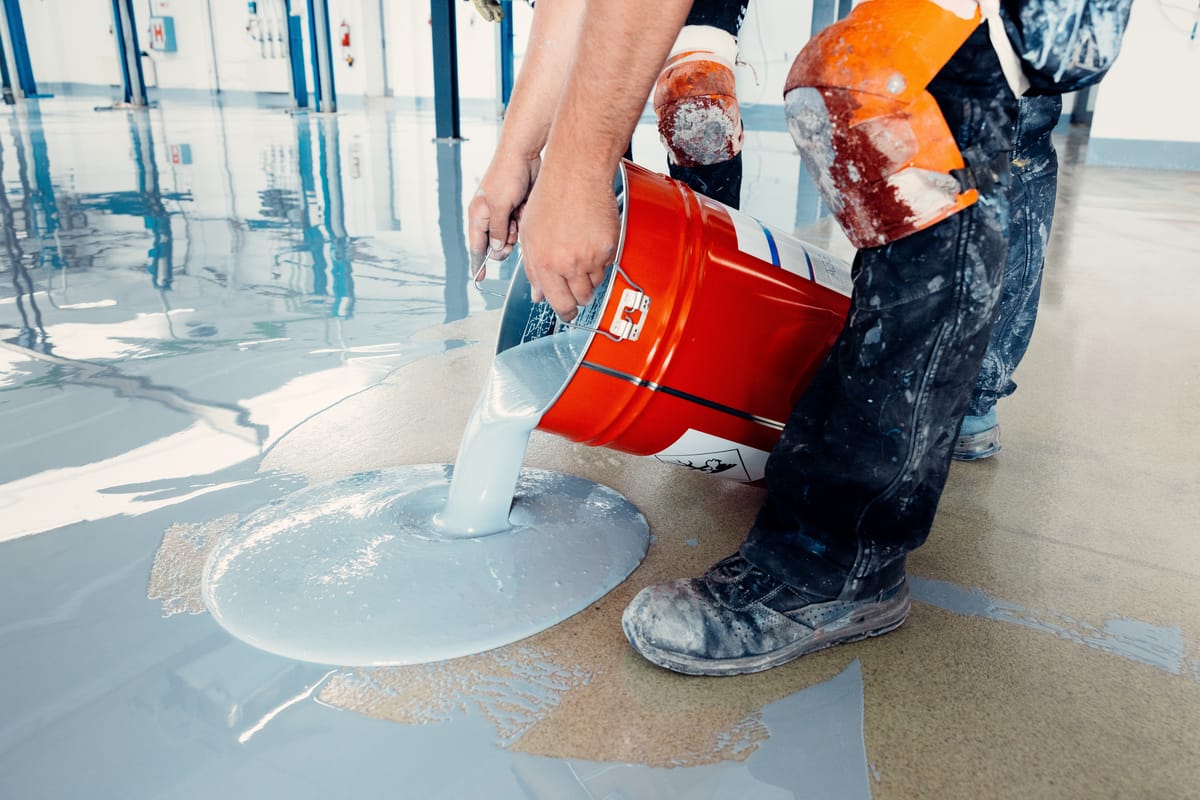
Epoxy flooring business insurance is the set of policies that protects a contractor who grinds, primes and coats concrete for a living. For a coating business that can mean general liability, workers compensation, commercial auto, coverage for the grinders and vacuums, an umbrella for larger contracts and, for a business with its own shop, commercial property. Each one answers a different part of the work, and the gaps between them are where coating claims tend to go wrong.
The trade is narrower than flooring in general, and the insurance should be too. A coating contractor’s risk is set by the slab prep, the chemistry and the cure, and by what happens to a finished floor months after the crew has left. This page maps those exposures to the policies that answer them, explains how residential garage work and commercial jobs differ, and sets out what a carrier will ask before it quotes. Each coverage has its own page, and so do the two kinds of contractor we insure.
The six policies in an epoxy contractor’s program
General liability is the foundation. It answers when someone who does not work for you is hurt by your work or when their property is damaged, during the job and after it, and it pays to defend those claims. For a coating contractor the important parts are completed operations and the pollution wording.
Workers compensation covers your own crew: an injury on the jobsite, a back strained moving equipment, a chemical burn from a hardener, or a lung problem tied to years of silica dust. Your state may require it once you have employees, and the audit at the end of the year looks hard at who was really an employee.
Commercial auto covers the trucks and trailers that carry the rig and the material from job to job, along with rented trucks and the cars your crew drives on business errands. Inland marine covers the grinders, dust collection vacuums, shot blasters and other equipment wherever they are, on the trailer, at the jobsite or at the shop, including theft.
Umbrella liability sits above the liability and auto policies and adds the higher limits commercial contracts ask for. Commercial property covers an owned or leased shop, the resins and coatings stored there, and the income a fire or shutdown would take away from booked work.
A top-to-bottom flow through the stages of an epoxy flooring job. First the slab is ground and prepped, which throws dust and noise and puts heavy equipment in someone else’s building; the crew’s health leans on workers compensation and the equipment on inland marine. Next the primer, body coat and topcoat go down, which brings resins, hardeners and solvent vapors into the space; a complaint about fumes meets general liability and its pollution wording. Then the floor cures, the stage where someone walks on it too early or a space is opened before it is ready; that is general liability’s injury and property damage. Last the finished floor is in use, sometimes for years, and a coating that lifts or turns slick is a completed operations question. Your own policy wording decides any real claim. No figures are shown.
Grinding, coating, curing and the finished floor
An epoxy job moves through stages, and each stage brings a different kind of claim. Grinding comes first. Planetary grinders and edge grinders cut the surface of the slab, dust collection vacuums pull the dust, and the crew moves heavy equipment through a garage, a kitchen or a warehouse that belongs to someone else. The exposures here are mostly your own: the crew’s lungs, backs and hands, and the equipment that makes the work possible. A cracked wall or a scuffed door during prep is a liability question, but the bigger day-to-day risks sit with workers compensation and inland marine.
Coating comes next. Primers, body coats, flake broadcasts and polyaspartic or urethane topcoats bring resins, hardeners and sometimes solvents into the space. In an empty garage that is a ventilation question. In an occupied building, a restaurant, a school wing or an office, it can become a complaint that the vapors made people ill or forced a business to close for a day. That kind of claim meets general liability and the pollution wording a liability policy can carry, which is why the program matters as much as the policy.
Then the floor cures. This is the stage contractors underestimate. Someone walks across a garage floor before it is ready, a tenant moves furniture back too soon, or a school opens a hallway a day early, and the floor or a person is damaged. Cure-time instructions in writing, and a record that you gave them, help a claim as much as any endorsement.
Last, the floor is in use, sometimes for years. A coating that lifts because the slab was never tested for moisture, blisters over a crack that was not repaired, or turns slick in a wet area is the long tail of epoxy work. That is completed operations territory, and it is why a contractor who has stopped doing a kind of work may still need coverage for the floors already in place.
A two-column comparison. The residential column describes garage and barn floors for homeowners: a run of small jobs, few written contracts or certificate requests, small crews and helpers, a truck and trailer carrying the rig from house to house, and claims that can come from the finished floor. The commercial column describes kitchens, warehouses, schools, pool houses and bathrooms: fewer and larger jobs, contracts that ask to be named as an additional insured and for higher limits, work at night and on weekends in occupied buildings, and claims that tend to come from vapors, early openings and the general contractor’s contract. Your own policy wording decides any real claim. No figures are shown.
Residential garages and commercial buildings carry different risks
A coating business may start in garages and barns, and may stay there. Residential work means a steady run of small jobs for homeowners, little paperwork, small crews and a lot of driving. The insurance questions are about completed operations, who is on the crew and how they are paid, and the truck and trailer that carry the rig from house to house. Our page on residential epoxy flooring contractor insurance covers that program in detail.
Commercial work changes the paperwork more than the chemistry. Kitchens, warehouses, schools, pool houses and bathrooms come with contracts that ask to be named as an additional insured, to have your policy answer first, to waive your right to recover from the owner, and to see limits a residential contractor rarely carries. The work can happen at night and on weekends, in buildings that stay open. The details are on our page on commercial epoxy flooring contractor insurance.
Plenty of businesses do both. A program can be written for a contractor who coats garages during the week and a restaurant kitchen on Sunday night, as long as the carrier knows about both and the commercial contract demands are set up before the job, not after a certificate request lands.
The contract is worth reading before you sign it, not only for the price. Indemnity clauses can make a coating contractor responsible for more than its own work, and insurance requirements can ask for endorsements a policy does not carry by default. Sending the insurance section of a contract to your agent before the bid is accepted costs nothing and avoids the scramble of discovering, the week the job starts, that the certificate cannot say what the general contractor needs it to say.
Where a coating claim meets the liability policy
The general liability policy has two parts that can decide an epoxy claim. The first is the line between damage your work causes to other property and the cost of redoing your own work. If a delaminating floor ruins stored inventory, that is the kind of loss the policy is about; grinding off the failed coating and recoating it can stay with you. Work done by a subcontractor on your behalf is generally treated as your own, which makes the subcontractor’s certificate as important as your own policy.
The second is the pollution wording. Fumes and vapors from a coating job can fall inside the pollution exclusion a liability policy can carry, which is why a coating contractor who works in occupied buildings may add contractors pollution coverage, either as a separate policy or by endorsement where a carrier offers it. Our general liability page goes through both in detail, with the claims that tend to test them.
State licensing and the rules that vary
Epoxy flooring sits in different places in different states’ licensing rules. Some states license specialty or flooring contractors directly, some only license work above a size or for a type of customer, and some leave licensing to cities and counties. Residential and commercial work can fall under different rules in the same state. A licensing board may ask for proof of general liability and workers compensation before it issues or renews a license, so the program and the license can move together. Our guide to whether you need a license to do epoxy flooring compares the states. A license pays no claim, and neither does an LLC; see our guide to whether an LLC needs business insurance.
Workers compensation is the other area where states differ. Each state runs its own system, a few require employers to buy from a state fund, and the rules on who must be covered and how a helper paid by the job is treated are not the same everywhere. Air-quality agencies in some states and cities also limit the solvent content of coatings, which affects the products a contractor can use and the vapor exposure a carrier sees. We write epoxy flooring businesses across the licensed states, and each state’s page will set out its own rules as those pages are published.
This page refers to state rules in general terms. It is general information, not legal advice and not a statement of coverage. Each state sets its own requirements and they change; verify the current rules with your state’s agency before relying on them.
What carriers ask before they quote an epoxy contractor
Underwriters who write coating contractors want to understand how the work is done. They ask how much of your work is residential and how much commercial, and what kinds of buildings you coat. They ask which systems you install, from standard epoxy to polyaspartic, urethane cement, flake and metallic, and whether you use solvent-based products indoors. They ask how you prep the slab, whether you test for moisture and keep the results, and how you handle cracks and joints.
They ask about people: how many employees you have, whether you use subcontractors or helpers paid by the job, and whether you collect certificates from anyone who works on your jobs. They ask about vehicles and drivers, about the value of your grinders, vacuums and other equipment, and whether you have a shop and what you store there. And they ask about claims. A contractor who can answer clearly, especially on prep, moisture testing and subcontractors, gives an underwriter what it needs to quote the business as an epoxy coating operation rather than as general flooring.
What moves the cost of insuring a coating business
We do not publish premiums, because the number depends on the operation in front of the underwriter. What moves it is predictable. Commercial work, especially in occupied buildings, costs more to insure than residential work, and solvent-based products indoors cost more than water-based systems. Payroll drives workers compensation, and the classification your crew falls under matters as much as the total. Vehicles, drivers and their records drive the auto cost. The value of your equipment and whether it is stored securely drive inland marine. The limits your contracts require drive the umbrella. A clean claims history and good written procedures move every part of the program in your favor.
Claims that reach an epoxy flooring program
The same patterns come up across the trade. A homeowner’s guest slips on a garage floor that was laid too smooth for a wet climate, and the claim lands on completed operations. A crew member develops a lung condition after years of grinding without good dust collection, and workers compensation answers. A trailer carrying a grinder and a dust collector is stolen from outside a motel overnight, and the equipment is an inland marine claim while the trailer itself is an auto question. A warehouse floor laid over a damp slab delaminates under forklift traffic, and the dispute is over what is damage to the owner’s property and what is the cost of the coating itself. A restaurant says vapors from a weekend job kept it closed on Monday, and the pollution wording is tested.
None of these claims is unusual, and each one turns on a different policy. That is the case for treating epoxy flooring business insurance as one program rather than six separate purchases.
When the business also installs other kinds of flooring
Some coating contractors also install wood, tile, vinyl or carpet. That work brings its own risks, from adhesives and moisture to the finish carpentry around a floor, and it can be written on a different footing from coatings. If general flooring installation is a large part of what you do, a program written for general flooring installers may fit better, and we can tell you which way your work leans.
How we put an epoxy flooring program together
We insure one trade, and we start with how your crews actually work. We ask about the slab prep, the systems you install, the buildings you coat and who is on the crew, and we describe your operation to the carriers in those terms. We work with several insurance companies that write coating contractors, compare what comes back, and walk you through the differences in the parts that matter: completed operations, the pollution wording, how subcontractors are treated, the equipment coverage and the limits your contracts require. When a general contractor or property manager asks for a certificate, an additional insured endorsement or a waiver, we handle it before the job starts.
A program also has to keep up with the business. A contractor who adds a second crew, buys a larger grinder, takes on a first school contract or moves from a home garage into a leased shop has changed the risk the carriers priced. Those changes are easiest to handle when they happen, not at renewal, and some of them, a new vehicle or a contract that needs a higher limit, cannot wait. At renewal we look at the year that just ended, the payroll the audit will see and the jobs on the calendar, and we market the program again when the business has outgrown it.