
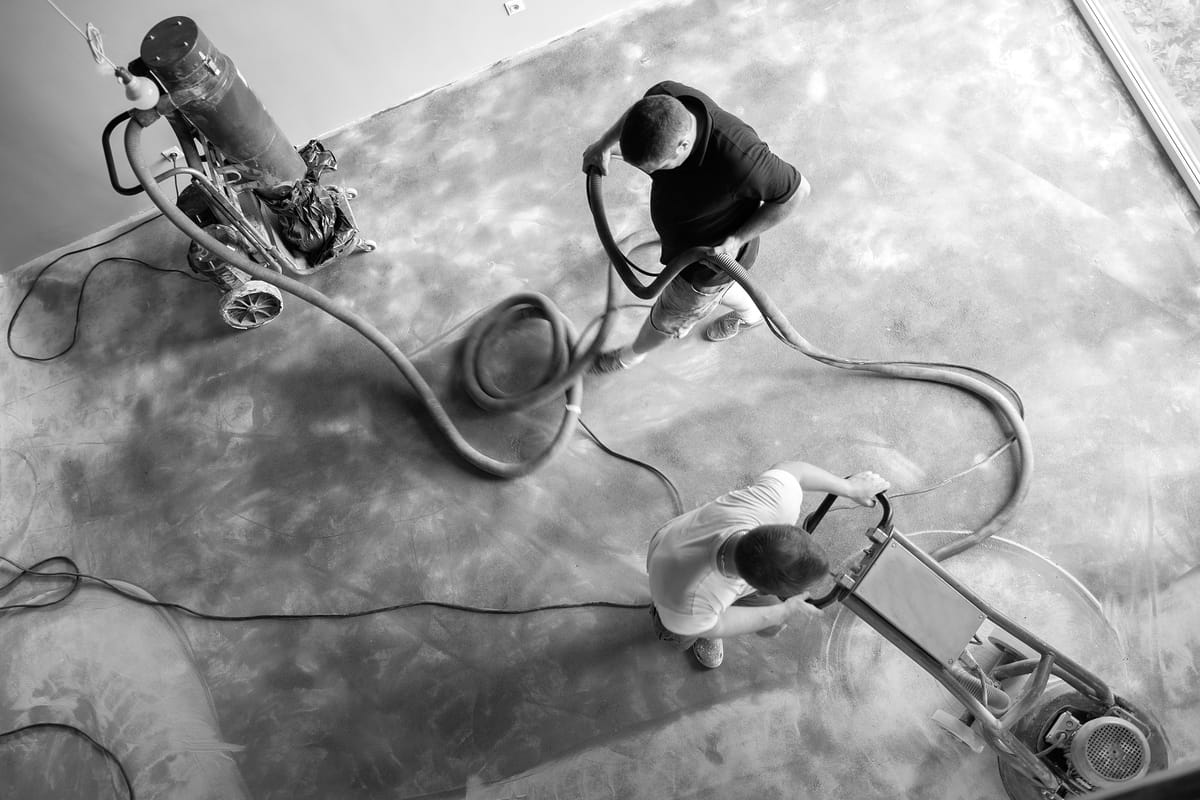
Workers compensation is the policy that takes care of your own crew. When someone who works for you breathes in grinding dust, burns a hand on mixed resin, wrenches a back hauling a grinder up a driveway or slips on a wet primer coat, it pays for their medical treatment and replaces part of the wages they lose while they recover. In exchange, the injured worker’s remedy against the business can run through this policy rather than a lawsuit.
For coating contractors, the exposures are unusual for a trade that looks light from the outside. The dust is fine and mineral, the chemistry can injure skin and lungs over time, and a crew can include installers who are paid as independent contractors. Underwriters price all three, and the states write the rules differently. This page walks through each, as part of an insurance program for an epoxy flooring business, built around the work.
Silica dust when the slab is ground
Concrete contains crystalline silica. When a diamond grinder or shot blaster opens up the slab before a primer coat, it can put the respirable fraction of that silica into the air, fine enough to reach deep into the lungs. Long exposure is linked to silicosis, lung disease and other serious illness, and federal regulators treat it as one of the central hazards of concrete surface prep.
For a workers compensation underwriter, the question is control. Grinders connected to a dust collection vacuum with a proper filter, wet methods where the job allows them, keeping other people out of the grinding area and cleaning up with a vacuum rather than a broom all lower the exposure. Crews that dry grind in a closed garage without collection look very different on paper. Silica illness can take years to appear, which is one reason a carrier asks how the work is done now and not only what claims have been filed.
Resins, hardeners and skin that reacts
The second hazard comes in the buckets. Epoxy resins and their amine hardeners can burn skin and eyes on contact, and repeated contact can sensitize a worker, so that after months or years of handling them a small splash brings on a rash, swelling or breathing trouble. Once someone is sensitized, the reaction tends to stay with them, which can end their time in the trade. Solvent-based primers and topcoats add vapors that cause dizziness and headaches in rooms without enough air moving through them.
These are occupational illnesses as well as injuries, and workers compensation is built to answer both. Gloves matched to the chemistry, sleeves, eye protection, clean mixing stations and a rule against wiping resin off with solvent all reduce claims, and an underwriter reading your application will notice when they are described.
Respirators, fit testing and medical clearance
Where dust or vapor cannot be controlled at the source, crews wear respirators, and a respirator only works when it fits. Underwriters do not expect a coating contractor to hand over a full written safety manual with the application, but they do ask a short set of questions. Which respirators the crew wears for grinding and which for solvent work. Whether each wearer has been fit tested for the model they use. Whether each has been cleared by a medical provider to wear one, since breathing through a respirator strains the heart and lungs. And whether cartridges and filters are changed on a schedule.
A contractor who can answer those questions plainly, and who keeps records of the fit tests and clearances, gives the underwriter a reason to treat the account as a managed risk rather than an unknown one.
A hub-and-spoke diagram. At the center is an installer you pay as an independent contractor. Spokes lead out from it. The first, labeled control, points to who sets the hours and supplies the grinder, which states look at when they decide who is an employee. The second, labeled proof, points to the installer’s own certificate of workers compensation, which can keep that pay off your policy. The third, labeled year-end review, points to the premium audit, where pay to an installer without a certificate can be added to your payroll. The fourth, labeled if hurt, points to a claim that can come back to your policy or your business when the installer has no coverage of their own. The fifth, labeled the rules, points to the state’s own test for employment, which differs from state to state. Your own policy wording decides any real claim. No figures are shown.
The installer you pay as an independent contractor
An epoxy business may run a small crew and bring in extra hands for big jobs: a flake installer for the weekend, a grinder operator for a warehouse, a friend in the trade during the busy season. If you pay that person as an independent contractor, the workers compensation question does not go away.
States decide who counts as an employee, and the tests can look at control: who sets the hours, who supplies the grinder, whether the person works for anyone else, whether they carry their own business insurance. A helper who works only for you, on your schedule, with your equipment, may be treated as your employee no matter how they are paid. If that person is hurt on your job without coverage of their own, the claim can come back to your policy, or to your business directly.
The audit is where this can show up. At the end of the policy term, the carrier reviews what you paid. Pay to an installer who gave you a current certificate of their own workers compensation is generally left out. Pay to an installer without one can be added to your payroll, and the premium for it is billed after the fact. Collecting certificates before anyone touches the floor is the simplest protection.
How the premium audit looks back at the year
A workers compensation premium starts as an estimate. You tell the carrier what you expect to pay your crew and how that work divides between classifications, and the policy is written on that estimate. After the term ends, an auditor compares it with your actual payroll records, tax filings and payments to helpers. Payroll that grew, work that was classified differently, or uncovered installers can each produce a bill, while a slower year can produce a return.
Keeping payroll records by job type, holding certificates for every installer you pay as an independent contractor and telling us when the business changes mid-term all make the audit shorter and the result less surprising.
One crew, separate state systems
Workers compensation is regulated state by state, and the systems are not alike. Each state sets its own benefits, its own rules about which employers must carry coverage, its own treatment of owners and corporate officers, and its own test for who is an employee rather than an independent contractor. A few states do not allow private carriers to write the coverage at all and require employers to buy it from a monopolistic state fund, which also changes how employers liability is handled there.
For a coating contractor who crosses a state line for a commercial job, this matters before the trucks leave. The policy’s other states part needs to name where the crew might work, and a job in a state with its own fund may need coverage arranged there directly. Your state’s workers compensation agency and department of insurance are the authorities on what applies to your business.
This page refers to state rules in general terms. It is general information, not legal advice and not a statement of coverage. Each state sets its own requirements and they change; verify the current rules with your state’s agency before relying on them.
A stack of layers, top first. The top layer is the workers compensation part, which pays the medical care and lost wages the state’s system sets for a crew member hurt or made ill by the work. Below it is employers liability, which defends the business when a work injury still leads to a lawsuit, such as a suit by a family member or by another company. Below that is the other states part, which addresses a crew that works across a state line, with the caution that some states require coverage through their own fund. The bottom layer is the endorsements a commercial contract asks for, such as a waiver of subrogation in favor of the owner or general contractor. Your own policy wording decides any real claim. No figures are shown.
Employers liability, the second half of the policy
A workers compensation policy can come in two parts. The first pays the benefits the state sets. The second, employers liability, defends the business when a work injury still produces a lawsuit: a spouse who sues over a death, a claim that an injury was caused by a hazard you knew about, or a suit brought by another company that was itself sued by your employee and wants you to share the cost. A commercial contract can ask for a minimum employers liability limit, and that limit is one of the layers an umbrella liability policy can sit over.
Injuries to people who are not on your crew, such as a homeowner who slips on your fresh floor, belong to general liability, not here.
Garage crews, commercial crews and what the contract demands
A residential crew coating garages and basements may grind in tight, enclosed spaces, which raises the dust and vapor questions. A commercial crew works larger slabs, sometimes at night or on weekends, and under contracts that require proof of workers compensation, a waiver of subrogation in favor of the owner or general contractor, and sometimes coverage for every installer on site. See residential and commercial epoxy flooring contractor insurance for the rest of each program.
Putting your crew in front of an underwriter
We place coating work, so we describe your crew the way it actually operates: how the slab is ground and how dust is collected, which products go down indoors, how respirators are fitted and cleared, and how every installer is paid. We set the payroll estimate with you so the audit holds fewer surprises, list the states where the crew could work, and add the waivers and certificates your commercial jobs require.