
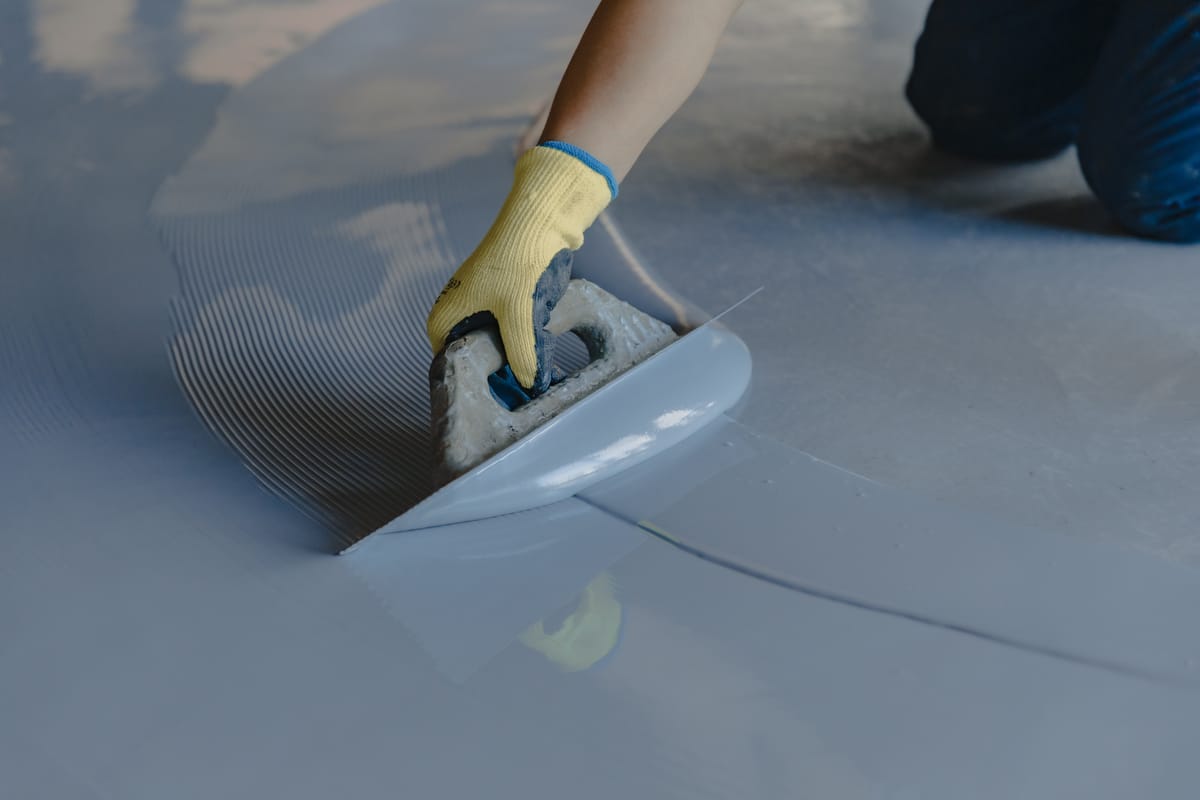
Over the dollar lines set by law, yes: Mississippi requires a commercial license from the Mississippi State Board of Contractors for contractors and subcontractors on commercial jobs above the commercial line, and the Board’s Floor Covering specialty names resinous flooring in its scope. On homes, a separate residential license reaches new construction above its line and remodeling or additions above a lower one, though the Board’s pages do not say whether a floor coating job alone counts as remodeling. Alongside the licenses come proof of general liability at every license and renewal, compulsory workers’ comp at an employee floor, federal OSHA on private jobsites, and an approved air plan with no coatings rule in it.
A license card is not a policy. It will not regrind a showroom floor whose topcoat clouded, the certificate on file with the Board pays nothing when a helper breathes in concrete dust, and an air plan without a coatings rule does not stop solvent odor from reaching an occupied office. From here, each Mississippi rule is taken in turn and set beside the coverage that answers what it leaves with you.
Mississippi’s commercial license and the Floor Covering specialty
Contractor licensing in Mississippi runs through the Mississippi State Board of Contractors, with separate commercial and residential licenses, each starting above a dollar line set by law. On the commercial side, its frequently asked questions page puts the rule in these words:
“All contractors and subcontractors performing work on commercial jobs over $50,000, including equipment installation, are required to have a commercial license issued by MSBOC.”
The weight of that rule, for an epoxy business, falls on the classification. The Board’s commercial specialty called Floor Covering names resinous flooring in its scope, and its classifications page describes it like this:
“A specialty classification that involves preparation, installation, finishing, maintenance and repair of flooring and floor coverings including carpet, resilient sheet goods, resilient tile, wood floors, resinous flooring”
That quotation is not the classifications page’s sole mention of floor resins: its Painting specialty’s scope names epoxy and urethane high performance coating systems, and which classification fits a given floor job is the Board’s call. Its scope runs past the pour itself to preparation, finishing, maintenance and repair, so ask how the Board treats the grinding before the coat and a later recoat. Ask the Board whether Floor Covering or Painting is the classification it expects for your work, and get the answer before you bid a job near the line.
Licensing in Mississippi also reaches the subcontractor, not just the firm holding the prime contract. If a general contractor hires you to coat a warehouse or a retail floor above the commercial line, plan on showing your own commercial license, and expect the general contractor to ask for your insurance certificate at the same time.
Home floors and the residential license lines
Homes follow their own license and their own lines. The Board’s FAQ page states them this way:
“All contractors performing new residential construction over $50,000, residential remodeling or additions over $10,000, or residential roofing over $10,000, are required to have a license issued by MSBOC.”
What the Board’s pages leave unsaid is whether a floor coating job alone counts as remodeling. Its residential list carries a Residential Remodeler classification for remodeling, repair or improvement of a home, and no residential classification names floor coating.
That leaves an open question with a known place to send it. Describe the work to the Board as you do it, from diamond grinding and crack fill through primer, flake broadcast and topcoat, say whether you contract with homeowners directly or work under a builder, and ask whether the job falls under the Residential Remodeler classification. File the written answer with your business records.
Claims on homes and on commercial floors rarely look alike. A residential job brings flake that sheds, a topcoat that lifts from a slab that held moisture, or a car tracked across a floor before it cured; a commercial job brings a tenant who lost a weekend of trade to odor, or a forklift that slid on a finish the contract promised would grip. Ways a program meets each are laid out on our residential epoxy flooring contractor insurance and commercial epoxy flooring contractor insurance pages.
Insurance proof at every Mississippi license and renewal
Mississippi’s license carries an insurance condition: every applicant for a license or a renewal must provide proof of general liability insurance, the Board must be listed on the policy to be told of a cancellation, commercial applicants must show minimum limits, and active license holders must keep proof of that insurance to stay in good standing. The FAQ page says it plainly:
“All applicants for a license or renewal must provide proof of general liability insurance coverage.”
Residential licensing carries a comp condition of its own, quoted from the Mississippi Code in the Board’s laws and rules:
“Proof of workers compensation insurance, if required by applicable law”
Read together, those conditions tie your license to your policy. Because the Board must be listed on the policy so it hears of a cancellation, a lapse in general liability does not stay a private matter between you and the insurer. Pay attention to renewal dates, and ask us to add the Board as a certificate holder when we bind so the notice reaches the right office.
The commercial minimum limits are what the Board accepts on an application, not a measure of what a coating claim can cost. A blistered floor in a food plant or a slip in a retail lobby can reach well past them. Choose limits by the jobs you take and the contracts you sign, and keep the declarations page ready for the license file.
Commercial contracts pile on paperwork of their own: additional insured status for the general contractor or property manager, coverage that answers ahead of theirs and limits above what a homeowner would ask about. Let us read the insurance section before you sign, so we can confirm the endorsements sit on the policy itself and not only on the certificate.
Mississippi comp and the employee floor in the Code
Coverage becomes compulsory once the headcount an employer regularly keeps reaches the small-employer floor set in the comp law. Our source here is a workers’ comp claims guide that the Mississippi Insurance Department hosts on its site; the guide describes itself as not an official publication of the Mississippi Workers’ Compensation Commission, and we rely on it for its quotations of the Mississippi Code. It quotes the coverage test like this:
“has in service five or more workmen or operatives regularly in the same business or establishment under any contract of hire, express or implied.”
The Board of Contractors draws the same line at licensing time, on its page for license applicants:
“If you have 5 or more employees, please submit proof of workers compensation coverage.”
Every regular worker counts, including the helper who mixes batches on weekend jobs. Near the floor? Call us before you decide you are under it, because the guide sets out what follows a failure to secure coverage:
“An employer who fails to secure workers’ compensation payments under the Act, when required to do so, faces statutory criminal and civil penalties.”
As for where coverage comes from, an employer buys a policy from an insurer, qualifies with the Mississippi Workers’ Compensation Commission as a self-insurer, or joins a group self-insurance fund the Commission regulates. The guide describes the routes in these words:
“by either purchasing a workers’ compensation insurance policy, qualifying as a self-insurer before the Mississippi Workers’ Compensation Commission”
The Commission administers the law and approves self-insurers, but it is not where claims are paid from, as the guide puts it:
“The Commission does not pay claims.”
Insurers that write the trade are where we place workers’ compensation for floor coating crews. The comp assigned risk plan is administered by the Commissioner of Insurance, so if a young business struggles to find a policy, ask us about that plan before going without.
Owners who run the grinder themselves have a decision to make as well. Ask us whether to put yourself on the comp policy, since an owner’s own injury is otherwise a cost the business carries out of pocket.
Pay-by-the-job helpers raise their own question. The claims guide says a variety of things are weighed in deciding whether a person doing work for a business is an employee or an independent contractor, among them whether the employer has the right to control the work, such as setting the hours, directing how the work is done and providing the tools. Settle each helper’s status with the Commission or your own counsel before the work starts, not after someone is hurt. If another crew takes part of a large slab, ask for its comp certificate before it begins, keep that copy in the job file and make in-force coverage a term of the subcontract.
No state plan: federal OSHA on Mississippi epoxy jobs
Private employers in Mississippi answer to federal OSHA rather than a state plan, because the federal list of approved state occupational safety and health plans carries no Mississippi plan. The list is published under this title:
“List of Approved State Plans for Private-Sector and State and Local Government Employees”
Its pages skip Mississippi entirely, whether among the plans for private employers or the plans for public employees alone. The agency a crew on a private epoxy job should expect is the Occupational Safety and Health Administration.
Silica belongs to that agency too. The Occupational Safety and Health Administration issues the federal construction standard on respirable crystalline silica, which applies to silica exposure in construction work, and with no Mississippi plan in the picture it is that federal agency enforcing it on a private construction site in the state.
Run every site as if an inspector could arrive mid-grind: shrouded grinders on a dust collection vacuum, fitted respirators with fit-test records on file, and a written exposure plan for the job. Underwriters ask about the same controls before they quote comp.
Epoxy injuries follow a familiar pattern: lungs irritated by concrete dust, skin reactions to hardener, a hand caught when a grinder bites, a back strained lifting drums into the trailer. Those losses fall to workers’ compensation, which is why a written dust and chemical program shows up in the comp conversation.
Air rules in Mississippi’s federal plan and floor coatings
As approved into Mississippi’s federal air plan, Mississippi’s air rules carry no architectural coatings rule: the federal table of the state’s approved air rules lists general emission, permit, emergency-episode, air-quality and nonattainment-area rules, and no rule limiting volatile organic compounds in coatings. The table carries this heading:
“EPA-Approved Mississippi Laws and Regulations”
Its core air chapter goes by this name:
“Air Emission Regulations for the Prevention, Abatement, and Control of Air Contaminants”
Nothing in the approved rule list reaches the person applying a floor coating; the listed rules govern permitted emission sources and air-quality planning. For the state agency’s side, the Mississippi Department of Environmental Quality describes its Air Division’s job like this:
“The Air Division is responsible for ensuring that air quality within Mississippi is protective of public health and welfare.”
That reading leans on the federal table of Mississippi’s approved rules, which lists the state’s air chapters rule by rule; we did not read the state’s own air rule text. To rely on that for a particular product, first ask the Mississippi Department of Environmental Quality whether any state rule outside the federal plan reaches it, and keep the maker’s data sheet in every job file.
Inside an industrial plant, ask its environmental manager whether the facility’s permit puts any condition on the products you bring in, and get the answer before anyone opens a kit.
Odor and fumes stay a liability question whatever the air plan holds. A Saturday install can push solvent smell into an office above a garage or a school wing that reopens on Monday, and a fume claim is where the pollution exclusion in a general liability policy gets tested. For work in an occupied building, let us check whether your policy carries a pollution endorsement for the products you apply, or whether a contractors pollution policy suits your commercial work better.
The license is not the coverage — the program is.
- A license or registration is a condition the state sets on the work or its permits, not insurance, so no line is drawn from it.
- No line is drawn from the coatings row: ask whether your general liability excludes pollution, and about a pollution endorsement.
A panel for Mississippi in rows. Each row sets a requirement of the state beside the exposure that requirement leaves open and the coverage line that answers it. Contractor licensing: A state contractor license for some of the work, issued by the Mississippi State Board of Contractors. It leaves open a coating that fails, or damage to the customer’s property, which General Liability and Umbrella Liability answer. Workplace safety: Federal OSHA inspects private jobsites. It leaves open a crew member hurt by silica, chemicals or the grinder, which Workers Compensation answers. Coatings VOC rules: No state VOC rule found that reaches floor coatings. No connector is drawn for this row. Workers’ compensation: Compulsory; bought from an authorized insurer. It leaves open an injured employee, which Workers Compensation answers. Notes: A license or registration is a condition the state sets on the work or its permits, not insurance, so no line is drawn from it. No line is drawn from the coatings row: ask whether your general liability excludes pollution, and about a pollution endorsement. The conclusion reads: The license is not the coverage — the program is. No figures are shown.
From these rules to your insurance program
Whatever the Mississippi rules above leave with you, an epoxy flooring program picks up line by line.
The Board asks for proof of general liability at every license and renewal, and a general contractor will want it on a certificate too. That policy answers a finished floor that fails after the crew leaves, a slip on a fresh coat, and the customer’s car, shelving or stock damaged during the job. Its pollution wording deserves a read before commercial work in occupied buildings.
At the comp law’s employee floor, workers’ compensation is compulsory in Mississippi, and the Board asks license applicants at that size to prove it. Placements go to insurers that write floor coating crews, and we keep certificates moving to the Board and the general contractors who ask.
Where a hospital, school or distribution contract calls for limits above what general liability carries alone, umbrella liability is how a coating business meets them. That umbrella layers over general liability, commercial auto and the employers liability part of workers’ compensation.
Trucks and trailers carrying grinders between DeSoto County, Jackson and Harrison County belong on commercial auto, rated where they park overnight. Rating a work truck as a family car leaves a gap that tends to show up on the day of an accident.
Mixing gear, grinders, shot blasters and dust extractors travel from job to job, and inland marine — contractors tools and equipment follows them onto the trailer, into a customer’s garage or into a locked room on a commercial site. A prompt payout on a stolen machine keeps the schedule on track.
Stock on the shelf, whether resin, hardener or flake in a shop, a leased bay or a storage unit, is what commercial property protects. Running the shop from your own garage? Say so early, and ask whether your homeowner’s policy covers business property at all.
Want to see how the lines fit together and what insurers ask before they quote? Start with our overview of business insurance for epoxy flooring.
Memphis to Hattiesburg: Mississippi metros for coating crews
The metropolitan areas that take in Mississippi counties, as the Census Bureau draws them, are listed below, largest first. Each card gives the metro’s Mississippi counties and what changes for a coating business working there.
Memphis, TN-MS-AR
Benton County, DeSoto County, Marshall County, Tate County and Tunica County are Mississippi’s share of a metro that also reaches into Tennessee and Arkansas. If a DeSoto County crew takes a floor across the state line, ask us how that state’s licensing and comp rules apply to the job, and ask us to confirm that your policies list Tennessee or Arkansas before the crew sets out.
Jackson, MS
Copiah County, Hinds County, Holmes County, Madison County, Rankin County, Scott County, Simpson County and Yazoo County sit inside this metro. If your crews spread from Hinds and Rankin County out to Yazoo or Simpson County, list every truck and trailer on commercial auto, and tell us which county each vehicle parks in overnight so the rating follows the garage address rather than a guess.
Gulfport-Biloxi, MS
Hancock County, Harrison County, Jackson County and Stone County form this metro. If an owner in Harrison or Jackson County hires you directly for a commercial floor, send us the contract’s insurance section before you sign, and ask us whether its terms call for additional insured status or limits above a residential program.
Hattiesburg, MS
Forrest County, Lamar County and Perry County make up this metro. If your Forrest or Lamar County work mixes homeowner garages with commercial floors, sort each job under the residential or the commercial license question before bidding, and tell us how the work divides, since a garage-sized program can fall short of a commercial contract.
Away from these metros, the licensing, insurance proof, comp, safety and air findings above apply across the state. What shifts is the customer, the contract and the size of the job, so check the license line for each project before a crew starts, and once the details are together, ask for a quote.