
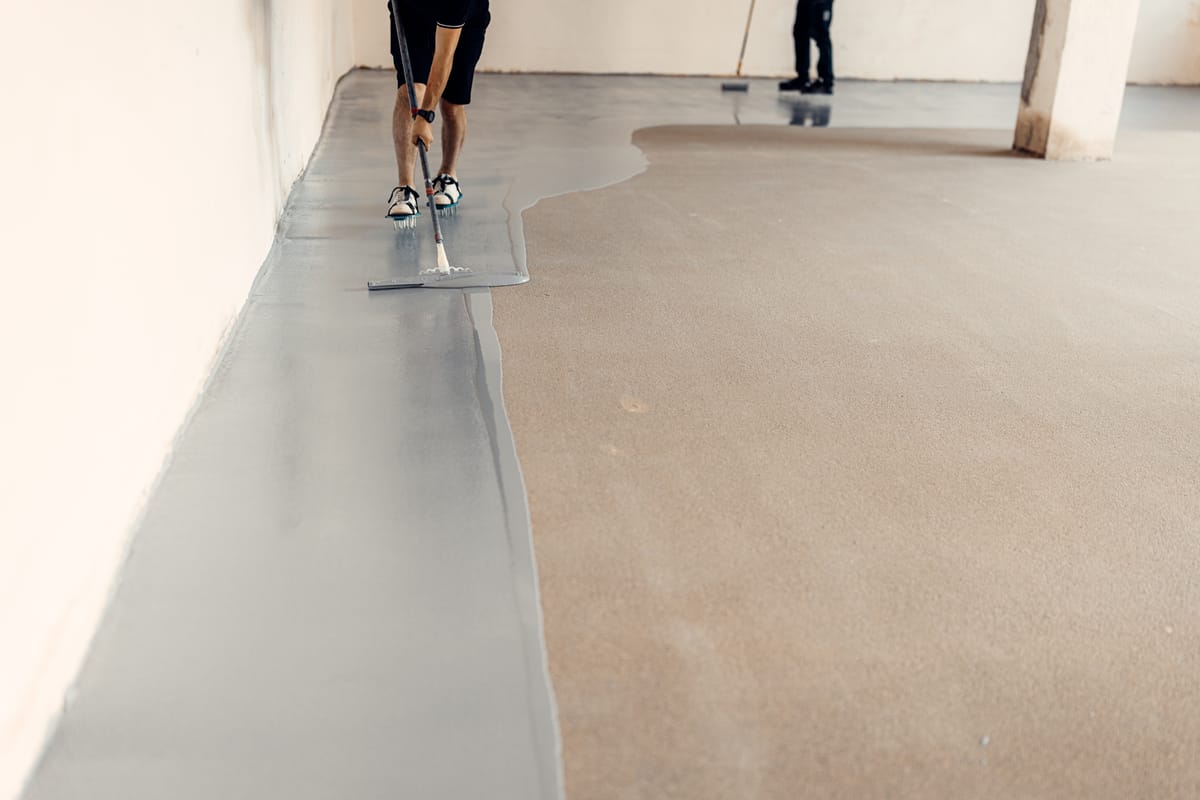
Coating a floor at a New Jersey home calls for a state registration rather than a trade license: a home improvement contractor registers with the New Jersey Division of Consumer Affairs before making or selling home improvements, and the state’s definition takes in painting, garages, basements and attached floor coverings. For commercial buildings, the state sources we read name no state license, so ask the municipal clerk what a town wants for a given job. Layered over those credentials are a liability-insurance condition that lasts as long as the registration, a workers’ compensation law that can reach out-of-state employers working in New Jersey, a coatings rule that names the paid applicator, and federal OSHA on private jobsites, public buildings included.
A registration certificate is a permission, not a claim fund. It will not refinish a basement floor that blistered, pay a crew member’s bills after a grinder kicks back, or answer a tenant who smelled fumes through a shared wall. The sections ahead pair each New Jersey rule with the policy that picks up where the rule stops.
New Jersey’s home improvement registration and the floors it covers
Registration comes before the first sale. A home improvement contractor in New Jersey registers with the New Jersey Division of Consumer Affairs before making or selling home improvements, and the rule that creates the duty reads:
“No person shall engage in the business of making or selling home improvements in this State unless registered with the Division in accordance with this subchapter”
Its definition of a home improvement lists the kinds of work it reaches:
“painting, repairing, renovating, restoring, moving, demolishing, or modernizing of residential or non-commercial property”
The projects it names include the rooms where epoxy jobs gather:
“garages, basements and basement waterproofing”
Garages and basements on that list, with painting in the definition, put a coated garage or a basement floor at a house inside the registration. The rule defines residential or non-commercial property as a structure used, in whole or in substantial part, as a home or place of residence, so a building that mixes a residence with other uses is worth raising with the New Jersey Division of Consumer Affairs before you treat a floor there as commercial.
The New Jersey Department of Banking and Insurance reminded insurers writing commercial liability coverage of the same duty:
“such contractors are required to be registered with the New Jersey Division of Consumer Affairs in the Department of Law and Public Safety”
Register before the first home job, not after a customer asks for your number, and keep the registration details at hand for contracts and customer questions.
The liability policy New Jersey ties to registration
Registration carries an insurance duty for its whole term. A registered contractor keeps a commercial general liability policy in force, written on an occurrence form at the rule’s minimum, and files the insurer’s certificate with the New Jersey Division of Consumer Affairs; a replacement certificate is due before a canceled or nonrenewed policy lapses. The rule states the duty in these words:
“Every registered home improvement contractor shall secure and maintain in full force and effect during the entire term of registration a commercial general liability insurance policy”
The state’s business guide for home improvement contractors gives the minimum a registrant must prove:
“Proof of commercial general liability insurance in a minimum amount of $500,000 per occurrence.”
Treat that amount as the registration’s threshold, not a measure of what a failed garage floor, a stained driveway or a damaged car can cost. Set your general liability limits by the homes and jobs you take, and ask whether a larger residential customer wants more than the rule does.
Several practical points follow from the rule’s wording. The policy has to be written on an occurrence form, so ask us to confirm the form before you file the certificate. It has to stay in force for the whole registration term, so a missed payment is a registration problem as well as a coverage problem. And a replacement certificate is due before a canceled or nonrenewed policy lapses, so tell us early when you plan to change insurers and we will line up the new certificate ahead of the gap.
Residential claims in New Jersey arrive after the crew has gone. Hot tires can lift a garage coating laid over a slab that was not ground enough, and a basement coated without a moisture test can blister over vapor rising through the concrete. Claims like these fall under completed operations, and our residential epoxy flooring contractor insurance page explains how the program answers them.
Commercial floor work and local licenses in New Jersey
Commercial floor work brings no state credential in the sources we read. The state’s business guide for home improvement contractors lists construction permits and local mercantile or business licenses among the local requirements a business checks for its own location, and for a particular job the municipal clerk is the person to ask what the town wants. The guide puts the local piece this way:
“Many towns require certain businesses to obtain Mercantile or other local business licenses.”
Before bidding a warehouse, a showroom or a restaurant kitchen, call the clerk in the municipality where the building sits and ask which business license, construction permit and inspections the job needs. Have your certificates ready, since a town office or a general contractor may ask for them at the same time.
Commercial owners write their own conditions into the contract. Look for clauses asking for additional insured status, coverage that responds ahead of the owner’s own, limits above anything a homeowner asks for, and work scheduled while the building stays open. Those terms are where fume complaints and early-traffic damage turn into claims, and our commercial epoxy flooring contractor insurance page sets them out.
If your New Jersey business coats garages and warehouses alike, let us know how the work divides, because the registration and its liability condition follow the home side, while the commercial side brings contract endorsements and higher limits, and the program has to fit the mix you really do.
Workers’ comp in New Jersey reaches crews from out of state
Comp is compulsory in New Jersey, and the Division of Workers’ Compensation states the rule broadly:
“New Jersey law requires that all New Jersey employers, not covered by Federal programs, have Workers’ Compensation coverage or be approved for self-insurance.”
The reach extends past the state’s own businesses:
“Even out-of-state employers may need Workers’ Compensation coverage if a contract of employment is entered into in New Jersey or if work is performed in New Jersey.”
For a coating contractor based in Pennsylvania, New York or Delaware who takes a floor in New Jersey, that sentence is the reason to call us before the crew crosses. Confirm in writing how your comp responds to work performed in New Jersey, and check what the customer’s contract asks you to show.
The penalty for going without is set out plainly:
“Specifically, the law provides that failing to insure is a disorderly persons offense and, if determined to be willful, a crime of the fourth degree.”
The state’s pages add that a corporation’s officers can be personally liable, so the risk of an uninsured injury lands on the people running the business, not just on the company.
Coverage comes from the private market. The Division describes the ways to buy it:
“You can purchase a policy directly from an insurance carrier, an insurance agent, or an insurance broker.”
Its employer page names no state fund for private employers, and an employer may instead be approved to self-insure. For epoxy crews, we write workers’ compensation through private insurers that know the trade, and we keep certificates moving to the towns and general contractors that ask for them.
Payroll questions deserve attention before you hire. The Division of Workers’ Compensation pages we read set out no test for independent contractors, though they say a sole proprietor’s own work does not trigger the requirement while anyone else who works for the business for pay does, and the state’s business guide adds that corporate stockholders who work in the business must be covered. So working alone is different from working with a helper you pay: once someone else works for the business for pay, bind the policy before that person starts. When another crew takes part of a large floor, ask for its comp certificate before it begins, keep the copy with the job file, and make coverage in force a condition of the subcontract.
New Jersey’s architectural coatings rule and the paid applicator
VOC content in coatings applied on site to buildings, pavements and curbs is capped by a state rule that reaches makers, sellers and anyone who applies a coating for pay, with separate categories for floor coatings and industrial maintenance coatings. Its applicability section names the paid applicator directly:
“Applies an architectural coating for compensation within the State of New Jersey”
Floor coating is defined widely enough to reach work outside the garage:
“"Floor coating" means an opaque coating that is formulated and recommended for application to flooring, including, but not limited to, decks, porches, steps, and other horizontal surfaces, that may be subjected to foot traffic.”
Decks, porches and steps are named in that definition. Whether a product belongs in the category turns on how it is formulated and recommended, and the definition says opaque, so ask the maker which category each product in your system is sold under and which limit it carries.
The VOC content ban does not reach a paid applicator who bought the coating in New Jersey or in a state the rule lists as having equal or stricter limits; in that case the seller answers for compliance. The thinning ban and the closed-container rule apply regardless, and aerosols and small containers are exempt. That purchase exception turns on where the coating was bought, so keep the receipt and the data sheet for each product in the job file, and if you buy from a supplier outside New Jersey, ask the maker in writing whether the product meets the New Jersey limit before you apply it.
The thinning ban reads:
“No person, who applies an architectural coating for compensation, shall apply an architectural coating that has been thinned to the extent that it exceeds the applicable VOC limit”
And the container provision reaches the cleanup bucket as well:
“Containers of VOC-containing materials used for thinning and cleanup shall also be closed when not in use.”
On site, mix to the manufacturer’s ratio, keep lids on coating, thinner and cleanup containers between uses, and teach each crew member who handles solvent why. The rule text we read is the Legal Information Institute’s reproduction of the state code, since the New Jersey Department of Environmental Protection copy could not be read for this page; check a product’s category with its maker and, where the answer matters, with the department.
Odor complaints can follow a compliant coating. Fumes from a coating in a basement or an attached garage can drift into living space, and in a strip-mall unit they can reach the shop next door. A fume claim is where the pollution exclusion in a general liability policy gets read closely, so ask us whether your policy carries a pollution endorsement for the products you use, or whether a contractors pollution policy suits your commercial work.
Federal OSHA on New Jersey jobsites, public buildings included
Federal OSHA has the private side of New Jersey, public buildings included, because the state’s approved plan is listed for state and local government employees alone. Private-sector plans and public-employee plans are listed separately on the federal list:
“List of Approved State Plans for Private-Sector and State and Local Government Employees”
“List of Approved State Plans for State and Local Government Employees”
New Jersey’s entry falls under the public-employee heading:
“The New Jersey State plan for State and local government employees received initial approval from the Assistant Secretary”
On the state side, the Office of Public Employees Occupational Safety and Health handles public employers, and its page notes that the law behind it is shared:
“The Public Employees Occupational Safety and Health Act is administered by two departments”
For private employers, the state labor department points to the Occupational Safety and Health Administration:
“OSHA also exercises authority over private sector employers throughout the state, and federal OSHA standards apply to these workers.”
And it defines the private sector to include a contractor on a public job:
“The private sector includes businesses, charities, and contractors that do work for public entities”
So a floor in a school, a town hall or a county garage does not move your crew under the state program. The public staff there come under it; your crew stays with federal OSHA. Ask the public owner what safety plan and training records it expects from a contractor on its premises.
Silica on a grinding job sits on the same federal side. It is federal OSHA that enforces the construction standard on respirable crystalline silica at private New Jersey jobsites, while PEOSH covers the state’s public employees. The standard’s scope paragraph reads:
“This section applies to all occupational exposures to respirable crystalline silica in construction work, except where employee exposure will remain below…”
A private crew grinding a slab in a New Jersey school is therefore working under the federal silica rule, not the state program. Treat dust control as something you will be asked to prove, with shrouded grinders on a vacuum, wet methods where they suit the slab, fitted and documented respirators, and a written plan for each site.
Lungs irritated by grinding dust, eyes splashed with hardener, a hand caught by a grinder, a back strained loading a machine: those are the claims workers’ compensation pays. Underwriters quoting a New Jersey crew will ask about dust collection, respirator fit and training, because the answers shape how often those claims arrive.
The license is not the coverage — the program is.
- A license or registration is a condition the state sets on the work or its permits, not insurance, so no line is drawn from it.
- No line is drawn from the coatings row: ask whether your general liability excludes pollution, and about a pollution endorsement.
A panel for New Jersey in rows. Each row sets a requirement of the state beside the exposure that requirement leaves open and the coverage line that answers it. Contractor licensing: State contractor registration for some of the work, with the New Jersey Division of Consumer Affairs. It leaves open a coating that fails, or damage to the customer’s property, which General Liability and Umbrella Liability answer. Workplace safety: Federal OSHA for private jobsites; a state plan for public employers. It leaves open a crew member hurt by silica, chemicals or the grinder, which Workers Compensation answers. Coatings VOC rules: A state limit on VOCs in architectural and industrial maintenance coatings. No connector is drawn for this row. Workers’ compensation: Compulsory; bought from an authorized insurer. It leaves open an injured employee, which Workers Compensation answers. Notes: A license or registration is a condition the state sets on the work or its permits, not insurance, so no line is drawn from it. No line is drawn from the coatings row: ask whether your general liability excludes pollution, and about a pollution endorsement. The conclusion reads: The license is not the coverage — the program is. No figures are shown.
From these rules to your insurance program
Rules set conditions; policies pay losses. Below, the epoxy flooring program runs line by line, with the New Jersey point that bears on each.
The registration itself requires general liability, on an occurrence form and in force for the whole term. Beyond that duty, it answers the garage floor that peels, the glossy finish someone slips on, and the customer’s car or stock damaged on the job; for occupied commercial buildings, read the pollution wording before you sign.
Private insurers sell workers’ compensation in New Jersey, and the requirement can follow an out-of-state crew that works in the state. We write it through private insurers that know floor-coating crews, and we send certificates to the towns and general contractors that ask.
School districts, distribution centers and hospitals write limits into their contracts that general liability does not reach by itself. Umbrella liability fills that space, sitting above general liability, commercial auto and the employers liability part of workers’ compensation.
Every pickup and trailer hauling grinders between Bergen County garages and Camden County warehouses belongs on commercial auto, garaged where they really park overnight. Keeping a work truck on a personal auto policy invites a denied claim after a crash.
Planetary grinders, shot blasters, dust extractors and mixers ride from job to job, and inland marine — contractors tools and equipment rides with them, on the trailer, in a customer’s garage or in a building under construction. Getting a stolen grinder replaced fast keeps the schedule whole.
Stored resin, hardener and flake in a rented bay or a shop behind the house fall under commercial property. If you run the work out of your home garage, raise it with us, because a homeowner’s policy might exclude business property.
For the whole program and what insurers ask before they quote, see our page on insurance for an epoxy flooring business.
New Jersey metro areas and what each asks of a coating crew
These are the metropolitan areas, as the U.S. Census Bureau names them, that take in New Jersey counties. Under every card is a note naming the New Jersey counties involved and what shifts for a coating business there.
New York-Newark-Jersey City, NY-NJ
Bergen County, Essex County, Hudson County, Hunterdon County, Middlesex County, Monmouth County, Morris County, Ocean County, Passaic County, Somerset County, Sussex County and Union County. A home floor anywhere in these counties sits inside the state registration, and for a commercial floor the municipal clerk is the person to ask what the town wants for that job. Crews that split their weeks between New Jersey jobs and jobs across the line in New York should tell us before quoting, because that state sets its own rules and your comp and liability need to answer in each.
Philadelphia-Camden-Wilmington, PA-NJ-DE-MD
Burlington County, Camden County, Gloucester County and Salem County. For shops in Pennsylvania, Delaware or Maryland that book jobs in Camden or Burlington County, New Jersey’s comp page says an out-of-state employer may need New Jersey coverage when work is performed in the state, so settle the comp question with us before the crew drives over, and register before taking any home job.
Allentown-Bethlehem-Easton, PA-NJ
Warren County. Warren County is the New Jersey part of a metro shared with Pennsylvania, and a contractor based on the Pennsylvania side who takes a home job here is still under New Jersey’s rule that no person makes or sells home improvements in the state without registering. Line up the registration and its liability policy, and settle the comp question with us, before the first Warren County garage.
Trenton-Princeton, NJ
Mercer County. If your Mercer County work includes floors in state, county or municipal buildings, the state labor department counts a contractor working for a public entity as private sector, so your crew answers to federal OSHA while the public staff there fall under the state program. Ask the public owner what safety plan, certificates and additional insured wording it wants before you sign.
Atlantic City-Hammonton, NJ
Atlantic County and Cape May County. If your Atlantic and Cape May County jobs include porches, decks and steps at homes, the coatings rule’s floor-coating definition names those surfaces, so ask the maker whether each porch or deck product is formulated and recommended as a floor coating, and keep the purchase records, since the rule’s content limit does not reach a paid applicator who bought the coating in New Jersey or in a state the rule lists. Exterior walking surfaces also raise the slip-and-fall side of general liability, so ask us how completed-operations coverage responds to a deck coating that wears early.
Vineland, NJ
Cumberland County. If you run a Cumberland County coating business by yourself, the state’s comp pages say a sole proprietor’s own work does not trigger the requirement, while anyone else who works for the business for pay does. Bind a policy before the first helper starts, and keep the home improvement registration and its liability policy in force for every house you coat.
Across New Jersey, the registration, comp, coatings and safety rules above stay the same. What changes by municipality is the local business license and the permit office’s paperwork, so call the clerk before a crew starts in a new town. With those answers together, ask for a quote.