
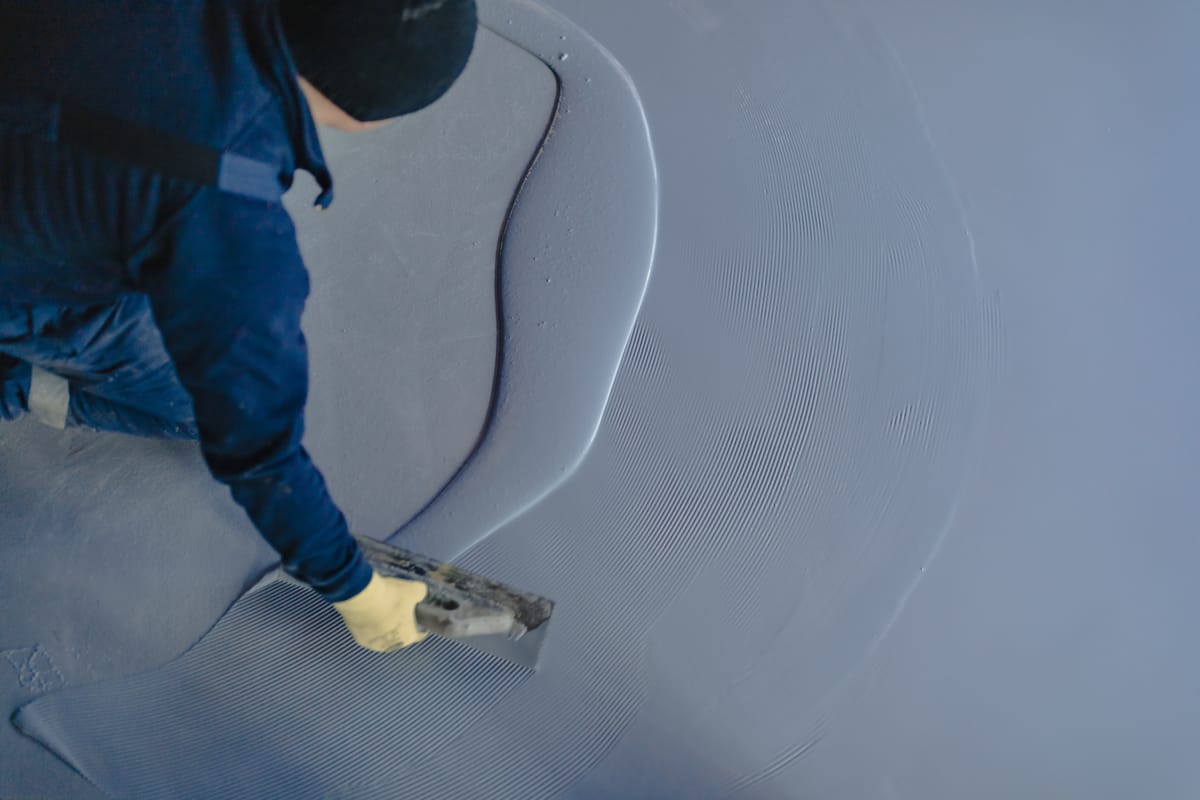
Coating floors for pay in Oregon calls for a license from the Oregon Construction Contractors Board, and an epoxy floor coater needs that license in hand before bidding a job or starting work. The requirement reaches paid construction work on real property, homes and commercial buildings alike, and the license carries an endorsement that matches the kind of building, with its own surety bond and general liability insurance behind it. Around the license, an Oregon coating business meets compulsory workers’ compensation, a state safety plan with silica rules for construction employers, and air rules aimed at coating lines in named areas rather than at floors laid on a jobsite.
Holding a license settles who may do the work; it does not settle who pays when the work goes wrong. A garage coating in Salem that blisters over a damp slab, a slip on a glossy showroom floor in Portland, a hardener splash on an installer’s wrist, a grinder taken from a trailer outside Eugene: those are insurance questions. Below, each Oregon requirement is paired with the policy that covers what the requirement leaves open, quoting the state’s own words where we have them.
What the construction board asks of an Oregon floor coater
Oregon’s contractor statute frames the requirement around an endorsement as well as a license:
“must have a current license issued by the Construction Contractors Board and possess an appropriate endorsement as provided in this section”
On its own license page, the board states the general rule in plainer language:
“Generally, Oregon law requires anyone who works for compensation in any construction activity involving improvements to real property to be licensed.”
Read for an epoxy contractor, the path to a license runs as follows. The Board’s licensing page lists painting and floor covering among the work that requires a license. Before the Board issues a license, the applicant files a surety bond and a certificate of general liability insurance naming the Board as certificate holder, completes pre-license training and an exam, and buys workers’ compensation coverage if it will hire employees.
Treat grinding, crack repair, priming, broadcasting flake and a clear topcoat as part of that construction work, whatever the building, and have the license issued before you bid any of it. Allow room in your plans for the pre-license training and the exam, and line up the bond and the liability policy early, because the board looks for them with the application rather than after it.
No Oregon city or county page was among the sources behind this page, so it states no local requirement. Ask the permit or business license office in each city where you work whether it keeps a registration of its own, and write down what it told you along with the name of the person you spoke to.
Holding a resin maker’s installer certification can still help on a commercial bid that names a particular product system. Keep it current if your customers ask for it, but treat it as an arrangement between you and the manufacturer; it is not a credential the state issues and it does not stand in for the board’s license.
Homes, small shops and large commercial buildings under the endorsement system
Oregon is a state where the split between residential and commercial floor work is written into the license. The residential endorsement covers work on homes, the commercial endorsement covers larger commercial buildings, and a small commercial structure may be worked under a residential or a commercial endorsement. Each endorsement brings a surety bond and general liability insurance of its own, and a contractor that works homes as well as larger commercial buildings files a bond for each endorsement it holds.
The statute sets out the residential specialty tier’s bond this way, with words of the statute’s list elided where the quotation shows it:
“A residential specialty contractor shall: … surety bond under ORS 701.068 in the amount of $20,000”
The bond and the insurance required rise with the endorsement, residential or commercial. What our sources do not say is where a floor coating business belongs among those tiers: whether the board treats epoxy work as a specialty or a general contractor’s trade, and at which level, is not stated for coatings. We treat that as unconfirmed. Lay out your work for the Oregon Construction Contractors Board ahead of the application and ask which endorsement and tier it expects; then tell us the answer, because the liability insurance the license requires follows that choice.
Beyond the paperwork, homes and commercial floors bring different claims. A residential customer buying a garage, basement or shop floor rarely asks for a certificate, and the losses tend to surface after the crew has left: a flake system that releases where the slab was too smooth or still sealed, hot tires lifting a coating that never cured fully, or moisture pushing up through an older slab and raising blisters. General liability treats them as completed operations claims, and our residential epoxy flooring contractor insurance page explains how that coverage responds.
Commercial buyers set terms on paper before anyone grinds. A distribution warehouse near Portland, a restaurant kitchen in Eugene or a dealership service bay in Medford may ask to be named as an additional insured, require your policy to answer ahead of theirs and write limits around their own exposure. Overnight and weekend jobs in buildings that reopen in the morning are where odor complaints and early foot traffic on a soft finish become claims. Those contract demands are worked through on our commercial epoxy flooring contractor insurance page.
Selling to homeowners and to businesses at the same time? Send us a rough revenue split between them with the application, and tell us which endorsements you hold. Coverage sized for garages can come up short against a warehouse contract, and coverage sized for warehouses can carry endorsements a garage crew pays for without using.
Liability insurance as a condition of the Oregon license
Insurance here is not something added after licensing; the board asks for it to issue the license and to keep it. Every licensed contractor must keep public liability, personal injury and property damage insurance in force, including products and completed operations coverage, and must show the Board proof of it at licensure and at every renewal. The insurance and bond required rise with the endorsement, residential or commercial.
The statute puts the proof requirement in these words:
“The contractor shall provide satisfactory evidence to the Construction Contractors Board at the time of licensure and renewal that the insurance required by subsection (1) of this section has been procured and is in effect.”
The board’s steps to licensure add a detail about the certificate itself:
“Make sure it names Construction Contractors Board as the Certificate Holder.”
In practice, bind your general liability policy before the application goes in, ask us for a certificate in the exact name on the license with the board shown as holder, and put the renewal date on the calendar so fresh proof of insurance reaches the board with each renewal. The law’s list includes products and completed operations coverage, and for a coating business that is the part that carries the weight, since a floor can fail after the job is closed out.
Bond and policy are separate filings with the board. When a customer asks whether you are bonded and insured, send each document the customer asks for, and if you are unsure what the bond answers for, ask the board or ask us before you rely on it.
Compulsory comp and the hiring-out clause
An Oregon employer with subject workers must carry workers’ compensation, and the board’s licensing steps include buying it if you will hire employees. The chapter states the employer’s duty this way:
“Every employer subject to this chapter shall maintain assurance with the Director of the Department of Consumer and Business Services that subject workers of the employer and their beneficiaries will receive compensation for compensable injuries”
An employer meets that duty by insuring through an insurer and having proof of coverage filed with the state, or by qualifying to self-insure. The chapter describes the insured route like this:
“As a carrier-insured employer by causing proof of coverage provided by an insurer to be filed with the director”
Plan on an insured policy as your route, and that is the coverage we arrange. The insurers writing comp in Oregon include a public corporation the Legislature created, alongside other insurers; ask us how each prices a floor coating payroll. For the self-insured route, put the question to the Oregon Workers’ Compensation Division, which administers comp, keeps an employer coverage lookup and handles self-insurance, and ask what qualifying would take for a business like yours.
The clause that catches coating contractors concerns work they hand to someone else. When a business awards a contract for work that is a normal part of its own trade, it answers for the crew’s coverage, unless:
“unless the person to whom the contract is awarded provides such coverage for those individuals before labor under the contract commences”
So when another outfit grinds, shot blasts or lays a broadcast for you, get its proof of comp before its people pick up a tool on your job, check that the dates cover the work, and keep the copy with the job file. Make current coverage a written condition of the subcontract, and send us the subcontract form so we can look at the insurance wording in it.
Helper status is the other trap for an owner. Oregon’s comp law excludes an independent contractor from its definition of worker and takes the meaning of independent contractor from a separate Oregon statute, which was not read here. That separate statute sets the test, and this page does not apply it to anyone. Settle each helper’s status in writing before the work starts, put every employee’s payroll on your comp policy, and if a relationship sits close to the line, take it to the Oregon Workers’ Compensation Division or to an employment lawyer before an injury forces the question.
Insurance companies in Oregon answer to the Division of Financial Regulation, the state’s insurance regulator. Should an insurer’s handling of a policy trouble you, start with us and we will help you sort out where the question belongs.
Silica dust and Oregon’s own safety plan
Expect Oregon OSHA on a private Oregon job: it is a division of the Department of Consumer & Business Services, and it sets and enforces the workplace safety rules on Oregon jobsites under an OSHA-approved state plan. The plan appears in the federal list kept under this title, which carries it as covering private-sector employers with several notable exceptions:
“List of Approved State Plans for Private-Sector and State and Local Government Employees”
On that list, the Oregon entry reads:
“The Oregon State plan received final approval on May 12, 2005.”
Silica is where that plan meets an epoxy business head-on, because surface preparation means grinding concrete. The silica rules sit in Oregon OSHA’s own administrative rules, and its fact sheet describes who they reach:
“The rules apply to general industry and construction industry employers whose employees may be exposed to crystalline silica dust.”
The same fact sheet names the tools a coating crew runs every week:
“Exposures can also occur during construction tasks that require masonry saws, grinders, drills, jackhammers, and hand-held powered chipping tools”
Grinding a slab before a primer goes down is the exposure those rules are written around. Ask Oregon OSHA what it expects from a small coating employer: which control methods it accepts for walk-behind and hand grinders, what written exposure plan it wants on file, and what respirator program and records an inspector would ask to see. Until those answers come back, run shrouded grinders on a vacuum with a filter suited to fine dust, fit-test and document respirators for anyone near the grinder, and keep a short dust plan in each job folder.
Lung damage from silica, a burn from an amine hardener, a grinder that kicks on a rough joint, a back strained wheeling a machine up a ramp: those are the injuries workers’ compensation pays for. An insurer pricing an Oregon epoxy crew will ask about dust collection, respirator fit and training, and good answers help the price.
Air rules for coating lines in named areas, and none for floors
Oregon has no state rule limiting the volatile organic compounds in architectural or floor coatings: the federal table of Oregon’s approved air-plan rules lists none. The state’s volatile organic compound rules for coatings govern coating lines and other point sources in the Portland, Medford and Salem areas, not a coating rolled onto a floor on a jobsite. Oregon’s coating rules are filed in the federal table under this heading:
“Division 232—Emission Standards for VOC Point Sources”
Inside that division, the rule on coatings applied in manufacturing is aimed at a line, not at a job:
“No person may operate a coating line which emits into the atmosphere VOCs in excess of the limits in section (5)”
And the division limits itself by place:
“VOC sources located outside the areas cited in section (1) are exempt from the requirements in this division.”
Nothing in the Oregon rules read reaches a contractor applying a floor coating on site. The coating rules in the state’s point-source division apply to the operator of a coating line in the named areas, and sources outside those areas are exempt. The only architectural term in those rules, a high performance architectural coating, is defined as a coating applied to aluminum panels away from the place of installation, which makes it a factory category rather than field floor work.
That leaves product questions with the maker. The national standard for architectural coatings that applies to manufacturers and importers was not among our sources, so this page makes no claim about it. Have your supplier state which limits each product in your system is sold under, keep the technical data sheet and the safety data sheet in the job folder, and mix and thin only as the manufacturer directs. If a commercial customer runs its own permitted coating equipment in the building, ask its environmental contact whether your work touches its paperwork, and send any questions about state air rules to the Department of Environmental Quality.
Air rules aside, fumes stay an insurance question. Even a low-odor resin can push vapor into an office over a garage, a classroom wing or a restaurant dining room, and a claim from that vapor is where the pollution exclusion in a general liability policy is tested. Before any occupied-building job, let us review your policy for a pollution endorsement that fits the products you apply, and ask whether a separate contractors pollution policy suits your commercial work better.
The license is not the coverage — the program is.
- A license or registration is a condition the state sets on the work or its permits, not insurance, so no line is drawn from it.
- No line is drawn from the coatings row: ask whether your general liability excludes pollution, and about a pollution endorsement.
A panel for Oregon in rows. Each row sets a requirement of the state beside the exposure that requirement leaves open and the coverage line that answers it. Contractor licensing: A state contractor license, issued by the Oregon Construction Contractors Board. It leaves open a coating that fails, or damage to the customer’s property, which General Liability and Umbrella Liability answer. Workplace safety: Its own OSHA-approved state plan, run by the Department of Consumer & Business Services. It leaves open a crew member hurt by silica, chemicals or the grinder, which Workers Compensation answers. Coatings VOC rules: No state VOC rule found that reaches floor coatings. No connector is drawn for this row. Workers’ compensation: Compulsory; bought from an insurer. It leaves open an injured employee, which Workers Compensation answers. Notes: A license or registration is a condition the state sets on the work or its permits, not insurance, so no line is drawn from it. No line is drawn from the coatings row: ask whether your general liability excludes pollution, and about a pollution endorsement. The conclusion reads: The license is not the coverage — the program is. No figures are shown.
From these rules to your insurance program
Licensing, comp, safety and air rules set the terms of Oregon work; insurance decides who pays when the work goes wrong. Under each line is the Oregon detail behind it.
General liability is a condition of the license here: the application calls for a certificate naming the board as holder, the statute asks for satisfactory evidence of the insurance at licensure and at each renewal, and the law asks for products and completed operations coverage to be kept in force. That policy also answers the floor that lifts after you leave, a slip on a finish that cured slick, and a customer’s car or shelving damaged mid-job. Its pollution wording is worth reading before you work in an occupied building.
Compulsory workers’ compensation in Oregon reaches an employer with subject workers, through an insurer with proof of coverage filed or through self-insurance. We arrange the insured route for a coating crew, keep each helper’s classification straight on the policy, and help you collect proof of coverage from any crew you hire, which matters because the comp law can put a subcontracted crew’s coverage on you.
Contract limits above your base policies are met with umbrella liability, layered over general liability, commercial auto and the employers liability part of your comp policy. If a hospital or a large general contractor writes higher limits into a contract, ask us before you sign whether an umbrella is the cleanest way to meet them.
Pickup trucks and trailers hauling grinders, vacuums and resin between Portland, Salem, Eugene and Medford ride on commercial auto. Leaving the work truck on a personal auto policy invites a gap, so move it over, and list any vehicle that crosses into Washington for jobs on the far side of the metro.
Walk-behind grinders, shot blasters, dust collectors and mixers belong on inland marine — contractors tools and equipment, which follows that gear on the trailer, in a customer’s garage or parked overnight at a commercial site. When a grinder goes missing the schedule halts, and this coverage pays to replace it.
Owned or rented, your shop and the resin, hardener and flake stored there fall under commercial property. Operating from a home garage? Note it on the application, because your homeowners policy might leave business property out.
For the whole picture, our page on business insurance for epoxy flooring shows how these lines fit together and what an insurer asks before quoting.
Oregon metro areas and the counties inside them, Portland to Corvallis
Listed from largest down, the largest metropolitan areas the Census Bureau draws around Oregon counties appear below. Each note gives the Oregon counties in the metro and what changes for an epoxy business working there.
Portland-Vancouver-Hillsboro, OR-WA
The metro’s Oregon counties are Clackamas County, Columbia County, Multnomah County, Washington County and Yamhill County, and the Census Bureau draws the rest of it into Washington. Before a crew crosses the state line for a Vancouver garage or warehouse, call us and ask how Washington handles contractor registration and comp before you bid, so a program built for Oregon licensing can be adjusted ahead of the job.
Salem, OR
This metro is Marion County and Polk County. The state’s point-source coating rules name the Salem-Keizer area, so if a customer inside that area runs a coating line in the building where you lay a floor, ask the plant what its air permit covers and tell us about that setting, since an insurer prices a production floor with solvents nearby differently from a garage.
Eugene-Springfield, OR
Here the metro is Lane County, drawn around that county alone. If your Lane County book leans toward homeowner garages and basements, the residential endorsement and its bond are the paperwork to keep current, and the completed operations part of your liability policy is what answers a coating that lets go after the crew has left.
Medford, OR
Jackson County makes up this metro on its own. If your Jackson County work mixes homes with small shops, plan which endorsement carries each kind of job: a small commercial structure can sit under a residential or a commercial endorsement, but a larger commercial building calls for the commercial side, so ask the board before you bid such a job and tell us, since the liability insurance the license requires changes with it.
Albany, OR
The metro is Linn County. Hiring another outfit to grind or shot blast a large Linn County slab? Remember the comp clause on contracts for work in your own trade: get that crew’s proof of coverage in hand before its labor starts, along with a liability certificate, because the comp law can make the business awarding the work answer for that crew’s coverage.
Corvallis, OR
This market covers Benton County. If a Benton County customer asks to be named as an additional insured, wants your policy to answer ahead of its own or sets limits in the contract, send us the contract before you sign it, because those terms come from the customer and an endorsement may be needed to meet them.
Coating floors somewhere outside these metros? The board license, the comp duty and the safety plan above apply statewide, while the air rules reach coating lines only in the areas they name. What varies from town to town is the local paperwork, so ask each new city’s permit office before your crew arrives. Want the program priced? Request a quote.