
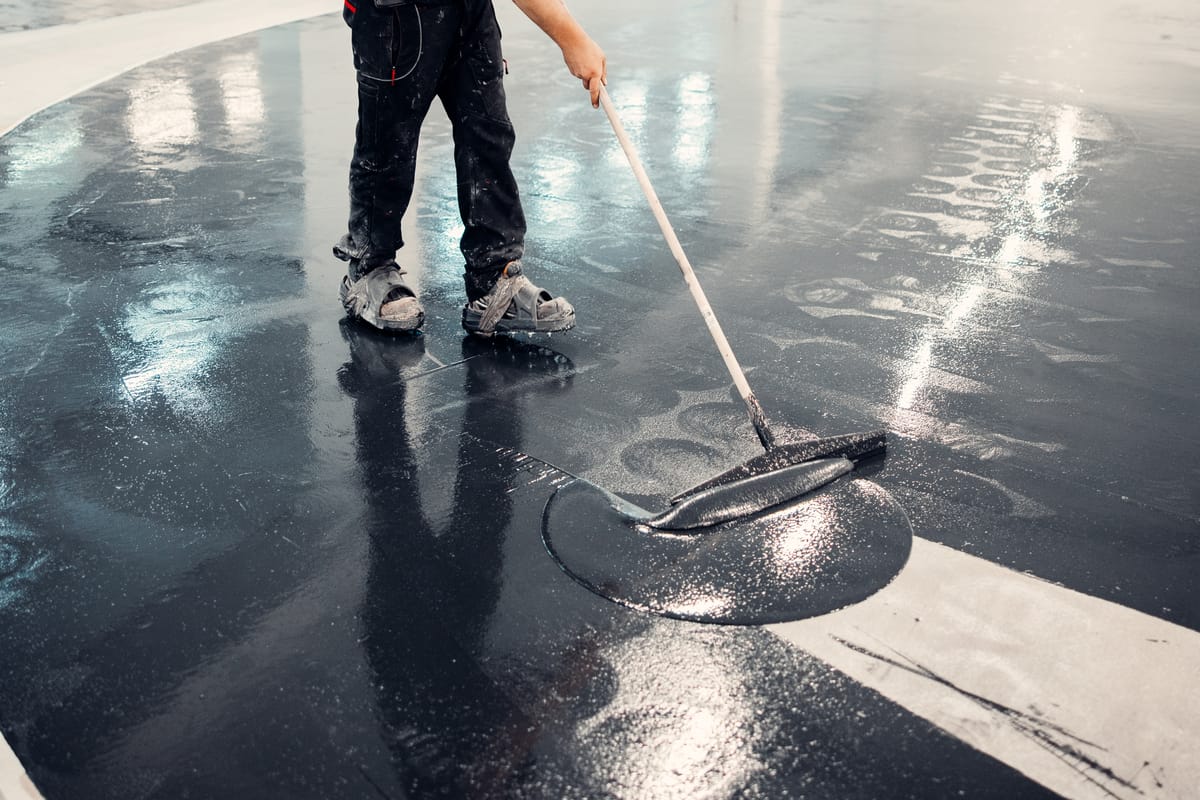
Yes. Before engaging in a licensed construction trade in Utah, a contractor needs a license from the Division of Professional Licensing, and that holds for floors in homes and commercial buildings alike. Licenses come by classification, and no classification names resin floor coating as such, so which license fits your work is a question to settle with the division before you bid. The license comes with liability and comp conditions, and an epoxy business here also answers to UOSH on silica and, in a set of northern counties, to an architectural coatings rule that reaches the applicator.
Holding the right license does not pay for a floor that peels after you leave, a slip on a fresh finish in a showroom, a hardener splash on a helper’s arm or a grinder stolen off a trailer. In the sections below, each Utah rule we could source is quoted where we have the state’s words and set next to the policy that answers what it leaves open.
Utah’s contractor license comes before the job
Utah’s contractor chapter puts the duty on anyone engaged in a construction trade it licenses, who:
“shall become licensed under this chapter before engaging in that trade or contracting activity in this state unless specifically exempted from licensure under Section 58-1-307 or 58-55-305”
That reach is statewide and does not split residential from commercial work. For an epoxy business, plan on holding the license before engaging in contracting, and confirm the classification first, since the classification decides what scope of work the license covers.
State law also limits what a town can ask. It says the state license and a business license from the city or county where the contractor has its principal place of business are the licenses needed to work in the trade anywhere in Utah. Ask your home city or county what its business license requires, and keep a copy with your state license.
The law also carves out small jobs, in these words:
“a person engaged in the alteration, repair, remodeling, or addition to or improvement of a building with a contracted or agreed value of less than $7,000, including both labor and materials”
Above a lower line set in the same section, a contractor relying on that exemption must affirm to the division that it carries:
“public liability insurance in coverage amounts and form established by division rule”
and workers’ compensation where it applies. The section also carves certain trades back out of the exemption. Read the wording against each job, and ask the division before you build a garage business on the exemption alone.
Liability and comp conditions on a Utah license
The license carries an insurance condition from the day it is issued. The division’s application for every classification states it plainly:
“All contractors are required to maintain active general liability insurance with the Utah Division of Professional Licensing listed as the certificate holder.”
That coverage must stay in force for as long as the license is active. Applicants with employees also submit a workers’ compensation certificate, while a business with no employees that does not intend to hire may submit a coverage waiver from the Utah Labor Commission instead. The division may also require a bond before it issues a license, so ask whether it will want a bond from you.
For a floor business, the condition turns an insurance lapse into a licensing problem. Keep general liability renewing without a gap, ask us to list the division as certificate holder on every renewal, and keep the comp certificate or the waiver current as your crew changes. Customers ask for certificates too: general contractors, homebuilders and property managers may want a certificate naming them before your trailer arrives.
Installer programs from resin makers are a separate matter. A product maker’s certification can help on a commercial bid that specifies its system, and a buyer may ask for it, but it is a private arrangement with the manufacturer, not a license Utah issues.
Which Utah classification fits a resin floor
The division’s classification rule sets scopes for the trades it licenses, and its scopes touch floor coating without naming it. The carpentry and flooring scope covers:
“laminate, tile, cement, wood, synthetic wood, or similar flooring product, including prefinished and unfinished material, sanding, staining and finishing of new and existing flooring”
The drywall, paint and plastering scope covers:
“paints, varnishes, shellacs, stains, waxes and other coatings or pigments”
And the scope of a classification for concrete work covers coatings and sealants on concrete. None of those scopes names resin floor coating as such, and our sources do not say which of them the division expects for a flake, metallic or quartz system on a slab. We treat the classification as unconfirmed.
Write to the Division of Professional Licensing with the question. Describe the work step by step (grinding or shot blasting the slab, repairing cracks, priming, the resin body coat, broadcast and topcoat), say whether you work on homes, commercial buildings or a mix, and keep the division’s answer with your license file. Correct a mismatched classification before a customer or the division raises it, and your insurance application should describe the same scope of work as your license.
Selling to homeowners versus contracting with businesses in Utah
Utah’s license applies to homes and commercial buildings alike, so the residential and commercial divide in a Utah epoxy business shows up in contracts, certificates and claims rather than in the license.
Homeowner work, mostly garages, basements and shops, seldom comes with a certificate request. Its losses tend to arrive months later: a flake system that lifts because the slab was not profiled, a topcoat that hot tires pull up before it fully cured, or moisture rising through an older slab and lifting blisters. Liability coverage handles those as completed operations claims, and our residential epoxy flooring contractor insurance page explains how that coverage responds.
Businesses set terms before the grinder runs. Owners of warehouses, restaurants, dealership service bays and clinics may ask to be named as an additional insured, want your policy to respond ahead of theirs, and set limits by contract. Night jobs in buildings that reopen in the morning are where odor complaints and early foot traffic on a soft coating become claims. Those demands are worked through on our commercial epoxy flooring contractor insurance page.
Sketch for us how your revenue divides between homes and businesses, because garage-sized coverage can fall short of a warehouse contract, while warehouse-sized coverage can carry endorsements a garage crew does not use.
How Utah employers cover comp benefits
Utah’s comp statute opens the employer’s duty with this sentence:
“An employer shall secure the payment of workers' compensation benefits for its employees by:”
Its routes are insurance with an authorized insurer or approval from a division of the Utah Labor Commission to pay benefits directly as a self-insured employer. The insurance route reads:
“insuring, and keeping insured, the payment of this compensation with an insurer authorized under Title 31A, Insurance Code”
The commission puts the reach of the duty simply:
“With few exceptions, all employers must provide workers’ compensation coverage for their employees.”
A policy from an authorized insurer is what we arrange. Approval to self-insure is also in the statute; ask the commission what it would ask of a small employer.
Utah’s statute also created a workers’ compensation insurer of its own, and the Legislature’s materials describe its form as:
“a nonprofit, self-supporting, quasi-public corporation”
That makes it an insurer of corporate form rather than a government fund, and the statute’s methods for securing benefits name no state fund.
Before a helper paid by the job steps onto a slab, settle whether that helper is an employee. The commission’s definition of an independent contractor begins:
“Independent of the employer in all that pertains to the execution of the work; Not subject to the routine rule or control of the employer”
It goes on to require someone engaged only for a definite job and subordinate to the employer only in producing the result. The definition lists criteria; it does not hand anyone a label. Make the status call for every helper ahead of the job, carry employees on your comp payroll, and get a comp certificate from any crew you hire. A sole proprietor, a partner or an independent contractor with no employees may apply to the commission for a coverage waiver.
Insurers doing business in Utah answer to the Utah Insurance Department, the state’s insurance regulator.
UOSH and silica on Utah jobs
Workplace safety in Utah sits with a state program approved by federal OSHA. Its entry sits on the federal list kept under this title:
“List of Approved State Plans for Private-Sector and State and Local Government Employees”
That federal entry describes the plan as covering private-sector employers with several notable exceptions, as well as state and local government. The division page of the Utah Occupational Safety and Health Division describes where authority sits:
“Since that date, occupational safety and health in the state falls under the authority of the State of Utah Labor Commission.”
Expect UOSH, the commission’s safety division, rather than federal OSHA, to inspect a private Utah job your crew is working.
Silica is covered by name. UOSH’s directive on inspection procedures says:
“UOSH incorporated, by reference, the two expanded health standards, 29 CFR § 1910.1053 (general industry) and 29 CFR § 1926.1153 (construction)”
Its resources page also lists a local emphasis program for respirable crystalline silica. Dust from grinding and shot blasting a slab before coating falls under UOSH’s enforcement of that standard. Put a vacuum shroud on every grinder, fit-test respirators and log the tests for anyone working near it, file a written exposure plan with each job, and ask UOSH which records it wants from a small crew.
Lungs irritated by dust, hardener burns, a grinder that bucks on a rough joint, a back strained loading a machine: workers’ compensation pays for those injuries, and insurers pricing a Utah coating crew will ask about dust collection, respirator fit and training.
The architectural coatings rule in northern Utah counties
In a group of northern Utah counties, the Division of Air Quality’s architectural coatings rule limits the volatile organic compounds in architectural coatings. Its applicability names the counties and the people it reaches:
“R307-361 applies to any person who supplies, sells, offers for sale, applies, or solicits the application of any architectural coating, or who manufactures, blends or repackages any architectural coating for use within Box Elder, Cache, Davis, Salt Lake, Tooele, Utah, and Weber counties.”
Within those listed counties, the rule reaches the crew as well as the seller: nobody may apply a coating over its limit there, and open containers must be closed when not in use. For coatings used in those counties, the thinning ban reads:
“No person who applies or solicits the application of any architectural coating shall apply a coating that is thinned to exceed the applicable VOC limit specified in Table 1.”
For jobs in the listed counties, floor coatings are among the rule’s categories, defined this way:
“"Floor coating" means an opaque coating that is labeled and formulated for application to flooring, including, but not limited to, decks, porches, steps, garage floors”
Industrial maintenance coatings made for floors in harsh conditions are also among its listed categories in those counties. By name, the rule appears in the federal table of approved air plan rules for Utah:
“R307-361 Architectural Coatings”
A caveat on the text: the version quoted here is the text the division published for comment, and a later notice changed it before adoption. The codified text was not read, so a change to the quoted provisions cannot be ruled out. Before a large job in a listed county, ask the Division of Air Quality how the adopted rule reads for the products you use.
For work in the listed counties, confirm with each supplier which category a product is labeled for and whether it meets the limit there, keep the technical and safety data sheets in the job folder, thin only as the maker directs, and keep containers closed between uses. A job in a county the rule does not list falls outside it.
Wherever the job sits, odor remains an insurance matter. Vapor from a low-solvent product can still drift into an office above a garage or a dining room next to a kitchen, and a claim from that odor tests the pollution exclusion in a general liability policy. Share your policy with us ahead of occupied-building work; we will check for a pollution endorsement that reaches the products you apply and talk through a contractors pollution policy for the commercial side.
The license is not the coverage — the program is.
- A license or registration is a condition the state sets on the work or its permits, not insurance, so no line is drawn from it.
- No line is drawn from the coatings row: ask whether your general liability excludes pollution, and about a pollution endorsement.
A panel for Utah in rows. Each row sets a requirement of the state beside the exposure that requirement leaves open and the coverage line that answers it. Contractor licensing: A state contractor license, issued by the Division of Professional Licensing. It leaves open a coating that fails, or damage to the customer’s property, which General Liability and Umbrella Liability answer. Workplace safety: Its own OSHA-approved state plan, run by the Utah Labor Commission. It leaves open a crew member hurt by silica, chemicals or the grinder, which Workers Compensation answers. Coatings VOC rules: A VOC rule for coatings in part of the state. No connector is drawn for this row. Workers’ compensation: Compulsory; bought from an insurer. It leaves open an injured employee, which Workers Compensation answers. Notes: A license or registration is a condition the state sets on the work or its permits, not insurance, so no line is drawn from it. No line is drawn from the coatings row: ask whether your general liability excludes pollution, and about a pollution endorsement. The conclusion reads: The license is not the coverage — the program is. No figures are shown.
From these rules to your insurance program
Each rule above leaves a loss for a policy to pay. Here is how the lines in an epoxy flooring program meet the Utah detail that shapes them.
In Utah, general liability is a license condition, kept active with the Division of Professional Licensing listed as certificate holder, and it is the policy that answers a floor that fails after you leave: a coating that lifts, a fall on a slick finish, a customer’s car or racking damaged mid-job. A fume complaint is settled by what its pollution wording says.
Utah law has an employer secure workers’ compensation for its employees through an authorized insurer or approved self-insurance, and the license application wants the comp certificate or a waiver. Ours is the insured route, plus help keeping each helper’s status straight.
When a contract calls for limits above your primary policies, umbrella liability adds a layer over general liability, commercial auto and the employers liability part of the comp policy. Ask before signing with a hospital, a school district or a large general contractor, since the contract sets that limit.
Every truck and trailer carrying grinders, vacuums and resin between Salt Lake, Provo, Ogden, Logan and St. George jobs needs commercial auto; a work truck on a personal auto policy is a gap that surfaces after the crash.
When a grinder, shot blaster, dust collector or mixer disappears from the trailer, a customer’s garage or a commercial site overnight, inland marine — contractors tools and equipment is the line that replaces it.
Commercial property is where shop space and stored resin, hardener and flake belong. Running things from a home garage? Mention it when you apply, and ask us whether your homeowners policy leaves business property out.
See how the whole program fits together, and what an insurer asks before quoting, on how an epoxy coating business is insured.
Utah metros and the counties inside them
Here, largest first, is every metro the Census Bureau draws around Utah counties. Beside each are its Utah counties, where the coatings rule reaches, and what shifts for an epoxy business working there.
Salt Lake City-Murray, UT
Salt Lake County and Tooele County, all of it inside the counties the architectural coatings rule lists. If your Salt Lake crews take commercial floors in occupied offices, stores or clinics, plan each job around the rule’s thinning ban and closed-container practice, and send us the contract before you sign, since an occupied building is where an odor complaint tests the pollution wording of your liability policy.
Provo-Orem-Lehi, UT
Juab County and Utah County. Utah County sits inside the coatings rule’s county list and Juab County sits outside it, so a crew that works on each side of that county line should keep a product plan for each. If your Provo and Orem work leans toward new homes, the builder’s subcontract can set the additional-insured and completed-work terms; send it to us before signing.
Ogden, UT
Davis County, Morgan County and Weber County. Davis and Weber counties sit inside the coatings rule’s county list and Morgan County sits outside it. If your Ogden work includes shop and warehouse floors at industrial sites, tell us what the floors see in use, since a coating chosen for chemical resistance can fall under a different rule category and brings a different completed-work exposure from a garage.
St. George, UT
Washington County, a metro drawn around that county alone and outside the architectural coatings rule’s county list. If you run crews here and in the northern metros, keep track of which jobs sit in a listed county, and tell us how your payroll splits by region so the comp and liability programs reflect where the work happens.
Logan, UT-ID
Cache County on the Utah side, a county on the coatings rule’s list, in a metro the Census Bureau draws across the line into Idaho. If your Cache County crew takes jobs on the Idaho side, tell us before the bid so the comp policy and the certificates show Idaho work, and ask Idaho’s licensing office what it requires there.
Beyond these metros, the state license, its insurance condition, the comp duty and UOSH go with you across Utah, while the coatings rule follows its county list. To see what the program costs, get a quote.