
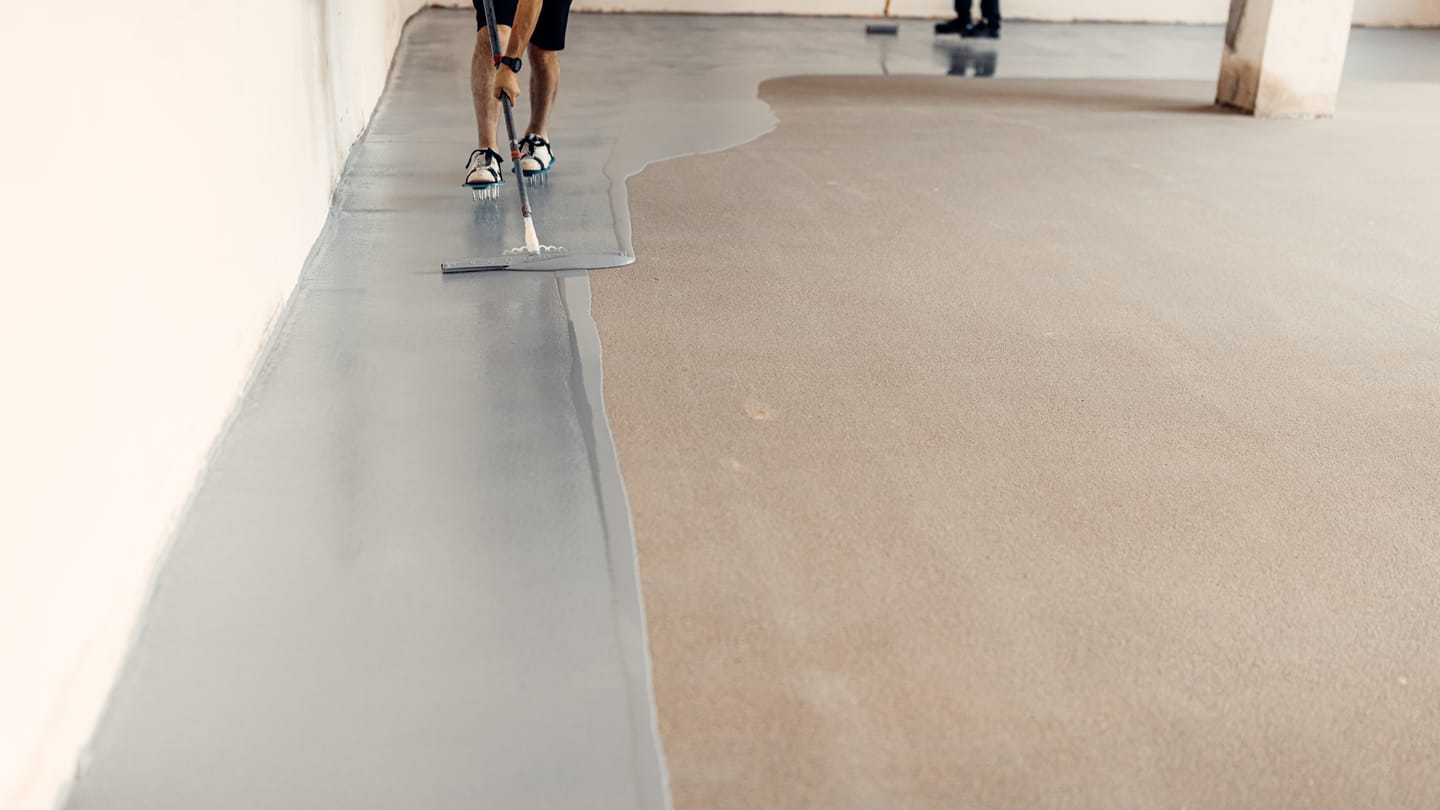
Epoxy floor failure can start in the concrete, not the coating. A federal guide specification for resinous floors traces premature failures to weak surfaces, oil and other contamination, and moisture vapor rising through the slab. For the business that installed the floor, each failure becomes a callback, and testing plus a written job record decides who pays for it.
Why epoxy floor failure lands on the installer’s desk
When the customer’s contract is with you, expect the call about a blister or a peel to come to you, whatever caused it. Be ready for the question of whether you will come back and fix it.
That makes failure a business problem before it is a technical puzzle. A floor that lets go months after the job eats the crew time, material and goodwill the job was supposed to earn. Treat every coating job as a job you may need to explain later, and build your process around being able to explain it.
The federal construction contract model makes the stakes plain. The Federal Acquisition Regulation’s warranty of construction clause has the contractor warrant that the work “is free of any defect in equipment, material, or design furnished, or workmanship performed by the Contractor or any subcontractor or supplier at any tier.” Ask how your own contracts describe the same promise. If you want to set those terms yourself, read our companion piece on writing an epoxy floor warranty.
Moisture vapor: the cause a slab test can catch
Moisture vapor coming up through the slab is a failure cause worth testing for, because it is invisible on install day. The Navy-prepared guide specification for fuel-resistant resinous flooring says it bluntly: “Improper MVE controls have produced numerous premature coating failures.” MVE is its abbreviation for moisture vapor emission.
The same specification sets its own limit for its own system. For new slabs it tells the designer to test “Approximately 60 days following the concrete pour and prior to the installation of the flooring system,” and its thin film system calls for “concrete with a rate of MVE no more than 169.0 micrograms moisture per second, square meter 3.0 pounds moisture per 24 hours, 1000 square feet (ASTM F1869)”. That is the limit of a military specification for fuel-resistant hangar and shop floors. It is not a rule for your garage jobs, and it is not a universal number for epoxy.
The useful lesson is the habit, not the number. Ask your coating manufacturer what moisture limit its system tolerates and which test it accepts, then test against that limit before the primer coat.
Weak or contaminated concrete under the primer
Concrete that is weak at the surface or soaked with oil can break the bond as surely as moisture can. The Navy guide specification describes a condition assessment meant to “identify problem floors and eliminate premature flooring failures produced by: 1) coating concrete with low surface strength, 2) coating concrete with high levels of surface contamination (such as oils, fuels, fats, and waxes), and 3) coating concrete with a high rate of Moisture Vapor Emission (MVE).”
The specification also gives its crews a simple field check for oil. It says “If the water drops bead up and do not flatten out, surfaces require additional degreasing”. Garage floors that have held a dripping car for years, and shop or kitchen floors that have absorbed grease, are where this check earns its keep.
Weak, dusty or chalky concrete is a different problem from contamination, and grinding alone may not fix it. Ask the coating manufacturer what surface strength its system expects and how it wants you to check it. If the slab will not take the system you sold, say so in writing before the job, not after the floor lifts.
Blisters, checks, softening and lifting: naming the symptom
Naming the symptom precisely is the start of finding the cause. The Navy specification’s warranty clause lists the defects its contractor must rework: “If the applied coating system develops either blisters (chemical), checks, softening, or lifting within one year following application”. Those words give you a vocabulary for your own job notes.
Ask the coating manufacturer’s technical staff what a blister, a soft patch or a lifted edge can point to on its system, and do not treat a guess as a diagnosis. Photograph the failure, note where on the floor it sits, and compare it with what your crew recorded during prep.
The same clause is just as useful for what it leaves out. Its exclusions include “concrete cracking, flooring system mirrors cracks in concrete” and “cosmetic imperfections due to scratching and gouging”. A coating that follows a crack in the slab is behaving as a coating does. Tell customers that before the job, in writing, so a crack that telegraphs through is not read later as a failure of your work.
Testing before you mix, and writing the results down
The tests that prevent callbacks only help if they happen before the material is mixed and are recorded where you can find them. The Army Corps guide specification for resinous flooring tells the installer to “Verify that the concrete substrates are dry and the moisture-vapor emissions are within acceptable levels” and names the methods: “Anhydrous Calcium Chloride Test: ASTM F1869.” and “Relative Humidity Test: Use in situ probes, ASTM F2170.”
It adds alkalinity: “Alkalinity and Adhesion Testing: Verify that concrete substrates have a pH within an acceptable range.” And it closes the loop: “Proceed with the application only after the substrates pass testing.”
Build that sequence into your own jobs:
- Ask the manufacturer which tests its system requires, and follow its instructions for placement and timing.
- Photograph each test in place with the job address visible somewhere in the frame.
- Record the readings on a job sheet the customer signs or receives.
- If a reading fails, write down what you offered: a moisture-tolerant primer, a delay, or a different system.
Old tile, mastic and other prep surprises
Some prep problems are not about the bond at all but about what your crew stirs up while removing an old floor. The Navy guide specification warns: “Where tile is to be removed prior to the application of flooring system, test both tile and mastic for the presence of asbestos.”
That is a crew-safety and liability question layered on top of the coating question. Older tile and the black adhesive under it may need testing before anyone grinds. Ask the building owner whether the material has been tested, put the answer in writing, and price the job only after you know. Your crew’s exposure belongs on your workers compensation conversation, and the owner’s building belongs on your liability conversation.
Real-World Scenario: A coating crew finishes a flake system in an older attached garage. The homeowner had mentioned a damp corner, but the crew was behind and skipped the moisture test. Months later the floor blisters along that wall, and the homeowner wants it redone. The owner has photos of the finished floor but nothing showing the slab before the primer, no reading, and no note of the damp corner. The rework comes out of the business’s own pocket, and the owner adds a moisture test and a signed prep sheet to every job after that.
A job record that answers the callback
A good job record turns a callback from an argument into a review of facts. The Navy specification asks its inspector to “Document weather conditions, job site occurrences, and report conditions and occurrences potentially detrimental to the flooring system.” After each coat, it calls for an inspection “for improperly cured material, blisters, inadequate or excessive coating thickness, and other defects.” A residential crew does not need a government inspector, but the idea scales down well.
The Army Corps specification adds a duty worth copying in spirit: “Prior to applying resinous flooring material, inspect substrate and immediately report any unsatisfactory conditions that exist and repair.” In practice, that means telling the customer, in writing, what you found before you coat over it. On home jobs, New York’s Attorney General, in its home improvement fact sheet, says “Home improvement contracts must be in writing, legible and in plain English.”
A useful job file holds:
- moisture and other test readings, with photos;
- air and slab temperature and humidity while you coated;
- the product names and batch numbers you used;
- any condition you reported to the customer, and their written choice;
- photos of the finished floor and the care sheet you handed over.
When a callback is your cost and when it is a claim
Under the federal construction model, redoing failed work falls on the contractor, while damage the failure causes to something else raises insurance questions to put to your agent. The Federal Acquisition Regulation model puts the repair on the contractor, at the contractor’s own expense, and it says the warranty on “work repaired or replaced will run for 1 year from the date of repair or replacement.” Check what your own contract says about rework.
Insurance is a different question, and your policy’s own wording answers it. Ask how your general liability policy treats your own work after you leave, and how it treats damage that work causes to other property. Our coverage piece on completed operations coverage for contractors walks through that wording. Ask your agent, before a claim, how your policy reads on a failed floor that damaged nothing else, and on a failed floor that did. If a larger loss could outgrow that policy, ask how an umbrella liability layer would sit above it.
Fit the question to your work. Garage and barn floors on the residential side bring homeowner callbacks. Kitchens, warehouses and schools on the commercial side can bring a failed floor that also shuts a business down. When you compare quotes for business insurance for epoxy flooring, ask how each policy treats each kind of claim. If you would like us to read your policy against the floors you coat, send us a few details, or read who we are first.