
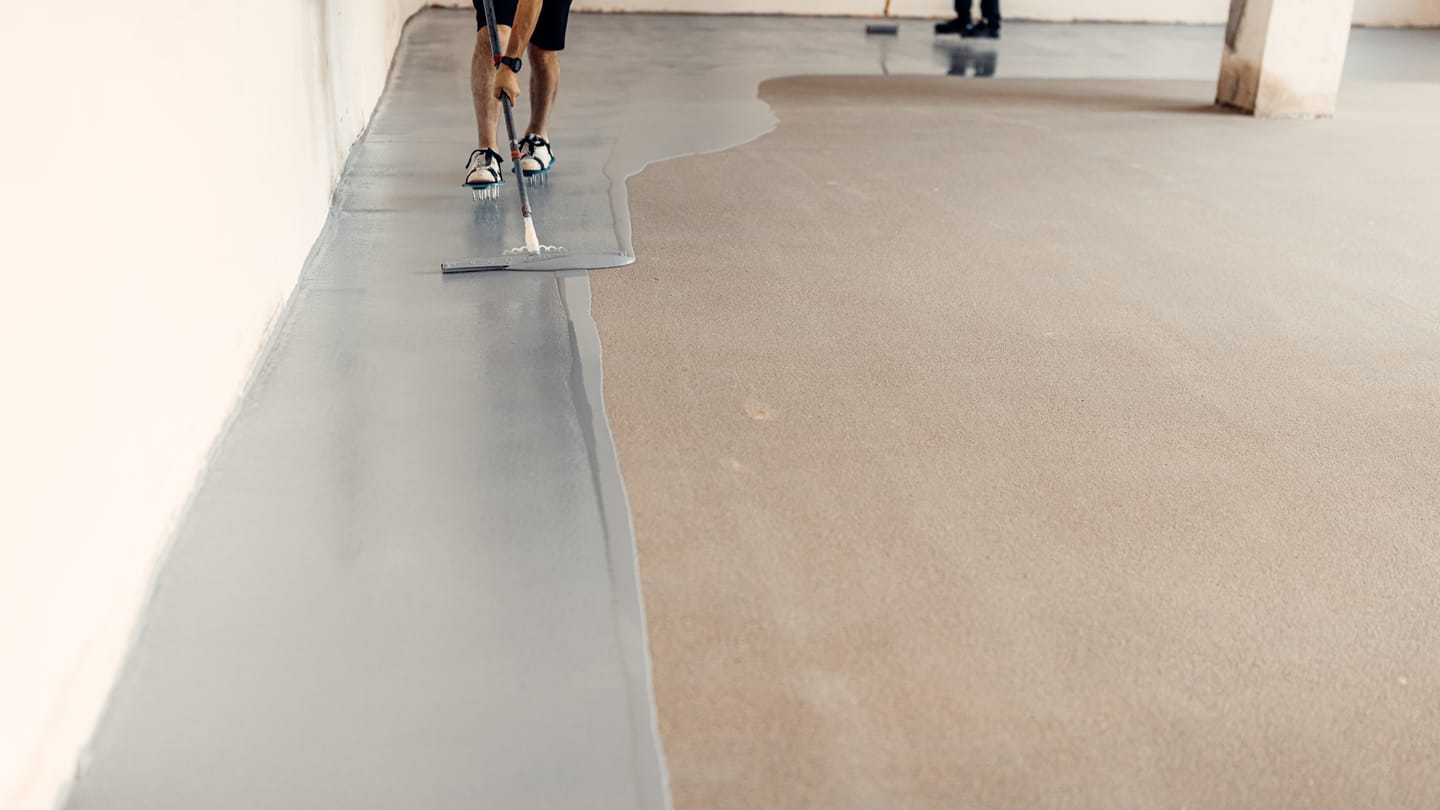
Georgia asks a residential contractor license applicant to prove general liability and workers’ compensation coverage before the license issues, so the epoxy flooring business insurance cost in Georgia starts with paperwork. From there it moves with county permit packets, a comp head count that takes in part-time workers, federal OSHA on the slab and your trailer’s metros.
None of those facts arrives as a number. Each can change the policies you need or what an underwriter reads, and the sections below follow them in the order a job meets them. The state rules themselves are on our Georgia epoxy flooring insurance page; this guide stays on price, and our page on business insurance for epoxy flooring shows how the policies combine.
Liability and comp proof on a residential license application, and the change notice
Residential work above the value line in state law calls for a residential contractor license, and the board’s rules ask every residential applicant for satisfactory proof of general liability at a minimum tied to the license category, along with proof that workers’ compensation is in place where the comp law calls for it. Any later change to those coverages has to be reported, in writing, to the board’s residential division.
That turns the license into a floor under your liability limit. A policy written below the category minimum cannot back the application, so the minimum is a starting point for the quote, not a target. Commercial customers and general contractors can then ask for more limit, additional insured status and coverage that answers first, which is where umbrella liability enters. The change notice matters at renewal: if you switch insurers or let a line lapse, the division expects to hear it from you in writing, so build that step into your renewal calendar.
An unread specialty-contractor exception and the owner-direct commercial floor
On commercial buildings, a job an owner hires you for directly belongs with a licensed general contractor, save for what the chapter carves out. Whether a business that only coats floors falls outside the license is NOT CONFIRMED: a specialty-contractor exception, and the board’s statements on long-standing specialty trades, were pointed to but could not be read. Put your scope to the contractor licensing board in the Secretary of State’s office before you bid a warehouse or clinic floor directly for its owner, and read our epoxy flooring license guide for how other states treat a coater who works in that trade alone.
The answer shapes price indirectly. A crew holding a residential license has filed the proof that license asks for; a crew working only under a licensed general contractor answers to that contractor’s subcontract. Send each subcontract’s insurance section with your submission, so the endorsements it requests are quoted before you sign.
Georgia’s Repair Rule, a written disclosure and a peeling garage coat
The board’s Repair Rule lets an unlicensed person carry out repair work for an owner after disclosing in writing that they hold no residential or general license, keeping supervision with their own employees, leaving structure and life safety untouched, and obtaining local permits and inspections. Whether recoating a lifted garage floor counts as repair is a call for the board, so confirm before treating a job that way.
Licensing and insurance part ways here. A repair job still produces the claims a liability underwriter rates: a recoat that lets go over a damp slab, a hot-tire mark the owner calls a defect, a slip on a fresh topcoat. Keep your disclosure letters and moisture readings with the job file, because a clean record of what you tested and told the owner is what an underwriter may want to see after a callback. Completed-work coverage for homes is the subject of our page on residential epoxy flooring contractor insurance.
Greene County affidavits, Rabun County Planning and Zoning and the permit-day certificate
County permit offices add their own layer. In Greene County, each firm on a permitted job, subs included, hands in a signed subcontractor affidavit, state cards where they apply, and proof of an occupational tax certificate or local business license, all ahead of the permit; the county’s building and zoning page sets that out. What Rabun County Planning and Zoning requires is NOT CONFIRMED, because its page on the state contractor law could not be read; call that office before a job in its county.
Permit paperwork reaches price through timing. A general contractor gathering a county packet can ask for your certificates the week the bid is accepted, and a certificate that shows the wrong insured name or a missing endorsement may slow the paperwork. Keep certificate wording current with your agent, and ask each county you work in what it collects before you schedule the crew.
Part-timers, officers and members in Georgia’s State Board of Workers’ Compensation head count
Peach State comp is compulsory once a business regularly employs past the small number the law sets, and Georgia’s State Board of Workers’ Compensation puts regular part-time workers into that tally. Corporate officers and company members are counted as well, while sole proprietors and partners are treated as employers rather than employees. The board’s answers set out no independent-contractor test, so ask the board or a lawyer how each helper is classed before a premium audit decides it.
Georgia comp premiums follow payroll, sorted by the kind of work each person does. Separate grinding and coating wages from estimating and office time, report officer and member payroll by real duties, and tell the underwriter when a seasonal part-timer joins the crew.
The assigned risk plan when Georgia’s private insurers pass on a coating crew
The state comp board sells no coverage, and no state fund exists here. A covered business buys privately, is placed through assigned risk, or wins approval to self-insure. The state’s insurance commissioner’s office regulates the insurers in that market.
Without a fund, the voluntary market’s appetite for grinding and resin work can shape the terms. A thin submission can push a young business toward the assigned risk plan, where terms can differ; loss runs, a payroll split by duty, certificates from every subcontracted crew and a written dust program give a private insurer reasons to quote. Ask us how a business placed through assigned risk can earn its way back to the voluntary market as its record builds.
Real-World Scenario: A coating business in Gwinnett County renews its liability policy with a different insurer in the spring. The owner forgets the board expects written notice of the change, and a general contractor’s permit packet in another county turns up the gap when the certificate and the license file disagree. The owner sends the notice, the agent reissues the certificate with the right insured name, and the permit moves forward after a lost week.
Federal inspectors, silica dust and a Georgia slab
Georgia appears on no list of OSHA-approved state plans, which leaves private jobsites with federal Occupational Safety and Health Administration. Silica enforcement on those sites is federal as well: the construction standard covering respirable crystalline silica comes from that agency’s chapter of federal rules, and federal OSHA enforces it where a private crew grinds or blasts a slab.
An underwriter can ask for the dust answer regardless. Grinder shrouds on a fine-dust vacuum, wet methods where the slab allows, fit-tested respirators and a site-by-site written plan are evidence a comp underwriter can rate. Skin contact with hardener is the other crew exposure, so note your glove and ventilation practice too.
Solvent coats under an air table written for can, coil and wire lines
In the federal table, Georgia’s approved air plan sets volatile organic compound rules for named industrial processes and lists none for architectural coatings, while its metro Atlanta entries deal with fuels, traffic and ozone planning. Peach State rule text itself went unread, so the finding is NOT CONFIRMED. Ask the Environmental Protection Division whether any state rule reaches your products, and ask your supplier for each data sheet.
Pollution wording on a liability policy turns on vapor and occupancy whatever the air rule says. A restaurant, a clinic or an office over a garage can stay open while you coat, and that is where a fume claim starts. Ask for quotes on a pollution endorsement and on separate contractors pollution coverage before your first occupied-building job.
Border metros at Chattanooga, TN-GA, Columbus, GA-AL and Augusta-Richmond County, GA-SC
Georgia shares metros with its neighbors: Walker County sits in a metro that runs into Tennessee, Muscogee County in a metro reaching Alabama, and Richmond County in a metro crossing into South Carolina. A floor across any of those lines can bring a different comp law and a different license question. Send us the address before the crew crosses, and ask whether your comp policy names that state.
Georgia trailer miles feed commercial auto, along with the trucks and their drivers; a shop that runs from the Atlanta-Sandy Springs-Roswell, GA metro to Savannah, GA jobs adds highway miles to the auto exposure, so describe those routes. Schedule grinders and extractors on inland marine for contractors’ tools and equipment. Then gather payroll by duty, license and permit papers, loss runs and contracts, and request a quote.