
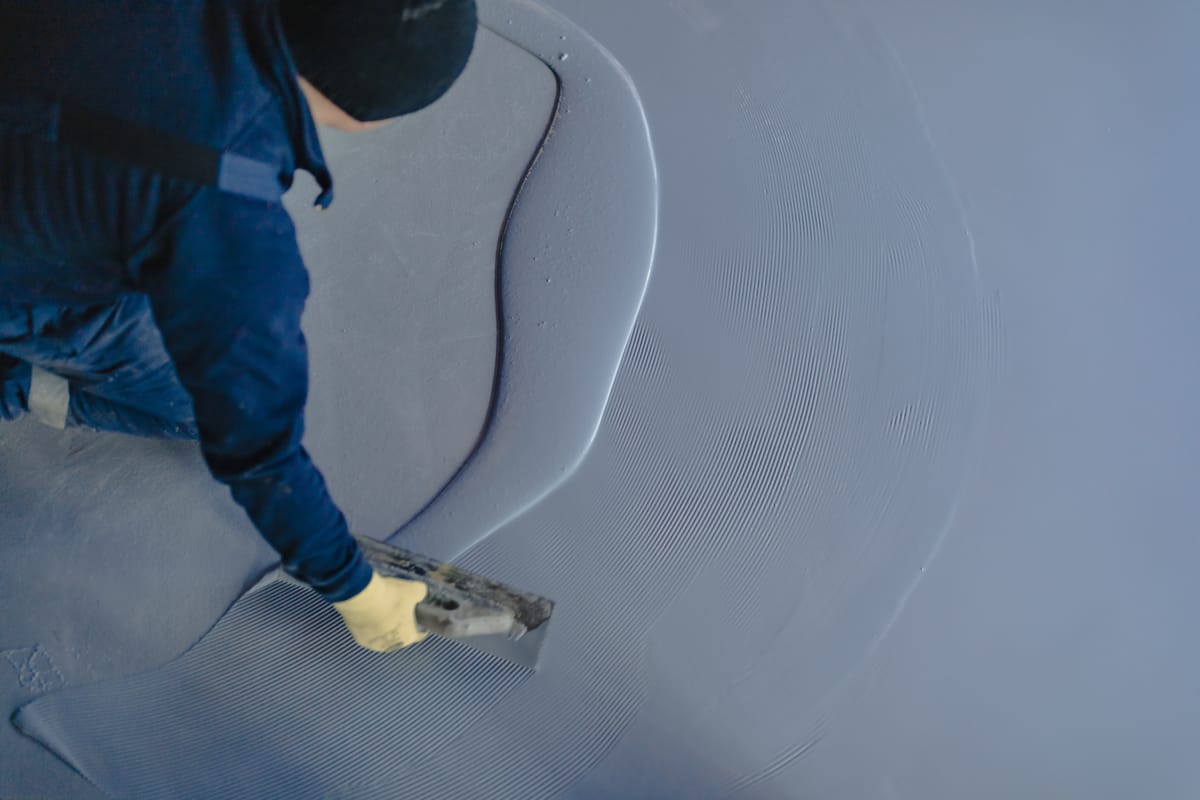
Yes, for a good share of the work: Georgia requires a residential contractor license on a home job whose value is above the threshold the law sets, and on commercial buildings, construction contracted directly with the owner is to be undertaken by a licensed general contractor. Whether a business that does nothing but coat floors falls outside those licenses is something we could not confirm, so put that question to the State Licensing Board for Residential and General Contractors before you bid. Around the licenses sit county permit paperwork, compulsory workers’ comp, federal OSHA on private jobsites, and an approved air plan that lists no rule for architectural coatings.
Credentials and permits are not coverage. A license card will not refinish a garage slab whose topcoat lifted, a signed affidavit pays nothing when a grinder kicks back into a helper’s hand, and a coating that no air rule touches can still send fumes through an occupied office. The sections that follow pair each Georgia rule with the policy that carries what the rule leaves open.
Georgia’s contractor licenses and where an epoxy job fits
Georgia licenses residential and general contractors through the State Licensing Board for Residential and General Contractors. On homes, a residential contractor license is required once the value of the job is above the threshold the law sets; on commercial buildings, work contracted directly with the owner is to be undertaken by a licensed general contractor unless the law excludes it. Whether an epoxy contractor who works only in that trade falls outside the license could not be confirmed from a source we could read. For home jobs, the line is drawn by money. The Greene County page quotes the code’s definition of a residential contractor this way:
“where the total value of the work or activity or of the compensation to be received by the contractor for such activity or work, whichever is the higher, exceeds $2,500”
Notice what gets measured: the total value of the work or the contractor’s compensation, whichever is higher, not the coating materials alone. If your garage and basement jobs land anywhere near that line, ask the board where a given contract falls before you sign it, and price jobs as they really are rather than dividing a contract to stay under a figure.
Commercial buildings run on the general contractor definition, which the same county page quotes in these words:
“construction of all private, commercial, institutional, industrial, public, and other buildings and structures under contract with or engagement directly by an owner shall be undertaken by a general contractor, except as otherwise expressly set forth in or excluded from operation of this chapter”
Read plainly, construction a building owner contracts for directly belongs to a licensed general contractor unless the chapter excludes it. Some commercial floors reach an epoxy crew through a general contractor already on the project, and others come straight from a warehouse owner or a business tenant. If you take work from owners directly, raise that with the board as its own question, because the answer may differ from what you hear as a subcontractor.
Residential and commercial jobs also bring different claims: on a home, flake that shed or a topcoat that lifted off a slab ground too lightly; on a commercial site, a tenant who lost a weekend of business to the odor or a forklift that slid on a finish the contract said would grip. How a program meets each is set out on our residential epoxy flooring contractor insurance and commercial epoxy flooring contractor insurance pages.
Is a floor-coating-only business outside Georgia’s license? Unconfirmed
A search pointed us to a specialty-contractor exception in the law and to board policy statements on traditional specialty contractors, but we could not read those sources: the board’s site and the statute hosts we tried refused our requests. This page therefore makes no claim that such an exception exists in the text, or about whether a floor-coating trade sits inside or outside the license. Treat it as an open question with a known place to send it.
When you contact the board, describe the work as you do it, from grinding the slab through flake and topcoat, say who hires you, and ask whether that work falls under the residential license, the general contractor license or any specialty exception the board recognizes. Keep the written answer with your business records.
A page from the Rabun County Planning and Zoning addresses that law, but it refused our request too, and we state nothing from it. Ask your own county building office how it applies the state law to floor coating.
A narrower route exists for repairs. The board’s Repair Rule lets an unlicensed person do repair work for an owner if the person discloses in writing that they are not licensed, does not hand supervision of the work to anyone other than employees, does not affect life safety or structural integrity, and gets the local permits and inspections. The disclosure condition reads:
“the person performing the repair work discloses in writing to the owner that such person/entity is not licensed as a residential or general contractor under this chapter”
Recoating a worn floor or patching a delaminated section can look like repair work, but whether your job qualifies is the board’s call, not ours. Ask before you rely on the rule, and if you do, keep the signed disclosure in the job file. A repair job still carries liability: if the patched area fails or a customer slips on it, that claim lands on general liability whether a license was needed or not.
What the residential license asks you to prove about insurance
The board’s rules require every residential license applicant to give satisfactory proof of general liability insurance at a minimum set for the license category, and proof of workers’ compensation insurance as state law requires; a licensee must also notify the residential contractor division in writing when its insurance coverages change. The board’s chapter on residential licensure sets the floor for the basic category in these words:
“all applicants shall provide satisfactory proof of general liability insurance of not less than $300,000 for the residential-basic category and satisfactory proof of workers´ compensation insurance as required by the laws of this state in their name”
That figure is what the board will accept on an application, not advice about what a coating business should carry; a blistered basement slab or a car damaged on an uncured floor can reach well past it. Choose your general liability limits by the homes and the jobs you take, keep the declarations page ready for the license file, and plan on notifying the residential contractor division in writing whenever your coverage changes, as the rules require.
Workers’ compensation appears in the same rule, tied to what state law requires of your business; the comp section below covers when that applies, so have proof in hand that matches your payroll.
County paperwork that comes before a Georgia permit
Greene County is an example of what a county can ask for before a permit, so check with the county where each job sits. In Greene County the requirement reaches every contractor and subcontractor on a permitted job in the county, and the Greene County Building and Zoning Department words it this way:
“Greene County requires that all Contractors and Subcontractors shall provide a Signed Sub-Contractor Affidavit for each job performed in Greene County, current state card(s), and a current business license or Occupational Tax Certificate.”
For a floor-coating subcontractor, that means an affidavit for each job, along with the state card where a license applies and a current local business license or occupational tax certificate. Ask the county what each item means for your trade, and keep copies ready to send before the general contractor pulls the permit, since a missing affidavit can hold up a job you were counting on.
Plan on calling the building office in every county where your crews work and asking what it collects before a permit, because its list may not match the county list quoted above.
Commercial jobs pile contract paperwork on top of the county’s. Plan on a general contractor or a property manager wanting a certificate with additional insured status, coverage that responds ahead of theirs, and limits above what a homeowner would ask about. Send us the insurance section of a contract before you sign it, so we can confirm the endorsements exist on the policy itself and not only on the certificate.
Workers’ comp in Georgia turns on how many people you regularly employ
Georgia requires workers’ compensation of a business that regularly employs more than a small number of people, regular part-time workers included. Coverage comes from a private insurer, from the state’s assigned risk plan, or from approved self-insurance; the State Board of Workers’ Compensation does not sell it, and Georgia has no state fund. The State Board of Workers’ Compensation puts the threshold this way in its insurance FAQs:
“If you regularly employ three or more persons in your Georgia business, you are required to provide the benefits.”
Its law FAQs add who counts:
“The law requires any business with three or more workers, including regular part-time workers, to have workers’ compensation insurance.”
Count everyone who works for the business on a regular basis, including the weekend helper who mixes batches, and if your headcount sits near the line, call us before you decide you are under it.
On where the coverage comes from, the Board answers the state-fund question directly:
“FAQ 12. Does Georgia have a State Fund? No.”
So a Georgia employer buys a policy from an insurer, goes through the assigned risk plan, or qualifies as a self-insurer with the Board. For floor-coating crews, we place workers’ compensation with insurers that write the trade. If a young business has trouble getting a policy, ask us about the assigned risk plan instead of going without.
Owners deserve a separate look. The Board’s FAQ does not set out an independent-contractor test; it says Georgia law treats sole proprietors and partners as employers, not employees, and that corporate officers and company members count toward the employee total. The Board puts the owner rule in these words:
“The Georgia Law considers sole proprietors and partners to be employers not employees”
If you grind floors alongside your crew, ask us whether to include yourself on the policy, since your own injury is otherwise a cost the business absorbs. Because the Board’s FAQ sets out no independent-contractor test, settle each helper’s status with the Board or your own counsel before the work starts, not after someone is hurt. Bringing in another crew for part of a big slab? Collect its comp certificate before it starts, keep the copy in the job file, and make in-force coverage a condition of the subcontract.
Jobsite safety in Georgia rests with federal OSHA
Private jobsites in Georgia, epoxy jobs among them, fall under federal OSHA: the federal list of approved state plans does not include Georgia, so the state has no OSHA-approved plan. That list appears under this title:
“List of Approved State Plans for Private-Sector and State and Local Government Employees”
For a Georgia crew on a private job, the Occupational Safety and Health Administration is the agency to expect. That includes silica. The federal rule for respirable crystalline silica in construction sits among the rules the Occupational Safety and Health Administration issues, and on a private Georgia construction site that agency is the one enforcing it, so plan the dust controls for grinding and shot blasting a slab with that standard in mind.
Treat dust control as though an inspector could arrive mid-job: shrouded grinders on a dust collection vacuum, fitted respirators with fit-test records on file, and a written plan for each site.
The injuries that follow epoxy work are predictable: lungs irritated by concrete dust, skin reactions to hardener, a hand caught when a grinder grabs, a back strained loading the trailer. Each of them is a loss workers’ compensation pays, and an underwriter will want to hear how your crew handles dust and chemicals before it quotes.
What Georgia’s approved air rules list for coatings
As approved into Georgia’s federal air plan, the state’s volatile organic compound rules cover named industrial processes, such as can, coil, paper, metal furniture and wire coating, and the federal table of the state’s approved rules lists no rule for architectural coatings. The Atlanta-area entries in that table are chiefly fuel, transportation and ozone-planning measures, and none is titled for coatings. The table’s entries read like a list of factory lines, for example:
“391-3-1-.02(2)(u) VOC Emissions from Can Coating”
“391-3-1-.02(2)(y) VOC Emissions from Metal Furniture Coating”
The table also carries a rule under this title:
“391-3-1-.02(2)(tt) VOC Emissions from Major Sources”
We found no state rule in that approved-rule table that reaches the person applying a floor coating. If you coat floors inside an industrial plant, ask its environmental manager whether the facility’s own air obligations put any condition on the products you bring in, and get the answer before the crew mixes anything.
This finding rests on the federal table, not on Georgia’s own rule text, which we did not read. Before relying on it for a product, ask the Environmental Protection Division, the state’s environmental agency for air rules, and keep the product data sheet in every job file.
Fumes are a liability question whatever any air rule says. Weekend work can push fumes into an office above a garage or a classroom wing that reopens on Monday, and a claim about fumes is where the pollution exclusion in a general liability policy gets tested. Before a job in an occupied building, have us check whether your policy carries a pollution endorsement for the products you apply, or whether a contractors pollution policy suits your commercial work better.
The license is not the coverage — the program is.
- A license or registration is a condition the state sets on the work or its permits, not insurance, so no line is drawn from it.
- No line is drawn from the coatings row: ask whether your general liability excludes pollution, and about a pollution endorsement.
A panel for Georgia in rows. Each row sets a requirement of the state beside the exposure that requirement leaves open and the coverage line that answers it. Contractor licensing: A state contractor license for some of the work, issued by the State Licensing Board for Residential and General Contractors. It leaves open a coating that fails, or damage to the customer’s property, which General Liability and Umbrella Liability answer. Workplace safety: Federal OSHA inspects private jobsites. It leaves open a crew member hurt by silica, chemicals or the grinder, which Workers Compensation answers. Coatings VOC rules: No state VOC rule found that reaches floor coatings. No connector is drawn for this row. Workers’ compensation: Compulsory; bought from an authorized insurer. It leaves open an injured employee, which Workers Compensation answers. Notes: A license or registration is a condition the state sets on the work or its permits, not insurance, so no line is drawn from it. No line is drawn from the coatings row: ask whether your general liability excludes pollution, and about a pollution endorsement. The conclusion reads: The license is not the coverage — the program is. No figures are shown.
From these rules to your insurance program
What the Georgia rules above leave with you, an epoxy flooring program picks up line by line.
The board wants general liability proved on a residential license, and a general contractor may ask to see it before you start. It answers a finished floor that fails after the crew leaves, a slip on a fresh coat, and the customer’s car, shelving or inventory damaged during the job. Read its pollution wording before commercial work in occupied buildings.
Past the Board’s headcount line, workers’ compensation is compulsory in Georgia, and it is the other proof the residential license asks for. Our placements go to insurers that write floor-coating crews, and we keep certificates moving to the counties and general contractors that ask.
If a hospital, school or distribution contract asks for limits above what general liability carries alone, umbrella liability is how a coating business can meet them. The umbrella stacks over general liability, commercial auto and the employers liability part of workers’ compensation.
Pickups and trailers carrying grinders between Savannah, Macon and the Atlanta counties belong on commercial auto, rated where they park overnight. Insuring a crew pickup as a family car is a gap that tends to surface the day of an accident.
Shot blasters, grinders, dust extractors and mixing gear travel from site to site, and inland marine — contractors tools and equipment follows them onto the trailer, into a customer’s garage or into a locked room on a commercial site. A fast payout on a stolen machine is what keeps the schedule from slipping.
A shop, a leased bay or a storage unit full of resin, hardener and flake stock is what commercial property protects. Is the business run from your home garage? Mention it to us early, and ask whether your homeowner’s policy covers business property at all.
Our guide to epoxy flooring business insurance lays out how these lines fit together and what insurers ask before quoting.
Georgia metro areas where coating crews work, Atlanta to Macon
The largest metropolitan areas taking in Georgia counties, as the Census Bureau draws them, appear below. Alongside each metro you will find its Georgia counties and what shifts for a coating business working there.
Atlanta-Sandy Springs-Roswell, GA
Barrow County, Bartow County, Butts County, Carroll County, Cherokee County, Clayton County, Cobb County, Coweta County, Dawson County, DeKalb County, Douglas County, Fayette County, Forsyth County, Fulton County, Gwinnett County, Haralson County, Heard County, Henry County, Jasper County, Lumpkin County, Meriwether County, Morgan County, Newton County, Paulding County, Pickens County, Pike County, Rockdale County, Spalding County and Walton County. The Atlanta-area entries in the federal table of Georgia’s approved air rules are chiefly fuel, transportation and ozone-planning measures, and none is titled for coatings. If your crews spread across these counties, ask each county’s permit office what it collects before a job, and list every truck and trailer on commercial auto.
Augusta-Richmond County, GA-SC
Burke County, Columbia County, Lincoln County, McDuffie County and Richmond County make up Georgia’s part of this metro, which also takes in South Carolina. If your crews take floors on the South Carolina side, call us with the address before the job so we can confirm how your workers’ compensation and general liability respond there, rather than learning it from a claim.
Chattanooga, TN-GA
This metro’s Georgia side is Catoosa County, Dade County and Walker County, and the metro also takes in Tennessee. If a Walker or Catoosa County crew takes work in Tennessee, treat each of those floors as a Tennessee job for licensing and comp, and ask us to confirm that your policies list Tennessee before the crew rolls.
Savannah, GA
Bryan County, Chatham County and Effingham County. Should your crews coat warehouse or distribution floors in Chatham, Effingham or Bryan County, expect the tenant’s contract to ask for additional insured status and limits above a residential program, and ask us to review those terms before you sign so the certificate you send matches the policy you hold.
Columbus, GA-AL
Chattahoochee County, Harris County, Marion County, Muscogee County, Stewart County and Talbot County are the Georgia counties of this metro, which also takes in Alabama. If a Muscogee County crew takes a floor in Alabama, settle with us beforehand how your comp and liability respond to Alabama work, and ask the customer what its contract wants to see on the certificate.
Macon-Bibb County, GA
Bibb County, Crawford County, Jones County, Monroe County and Twiggs County. If your crew splits its calendar between garages in Jones or Monroe County and commercial floors in Bibb County, sort each job under the residential or the general contractor licensing question before bidding, and tell us how the work divides, since a program set up for garages can fall short of a commercial contract.
Outside these metros, the licensing, comp, safety and air findings above still apply statewide. What changes from county to county is the permit office and its paperwork, so call ahead before a crew starts there, and when you have the details together, ask for a quote.