
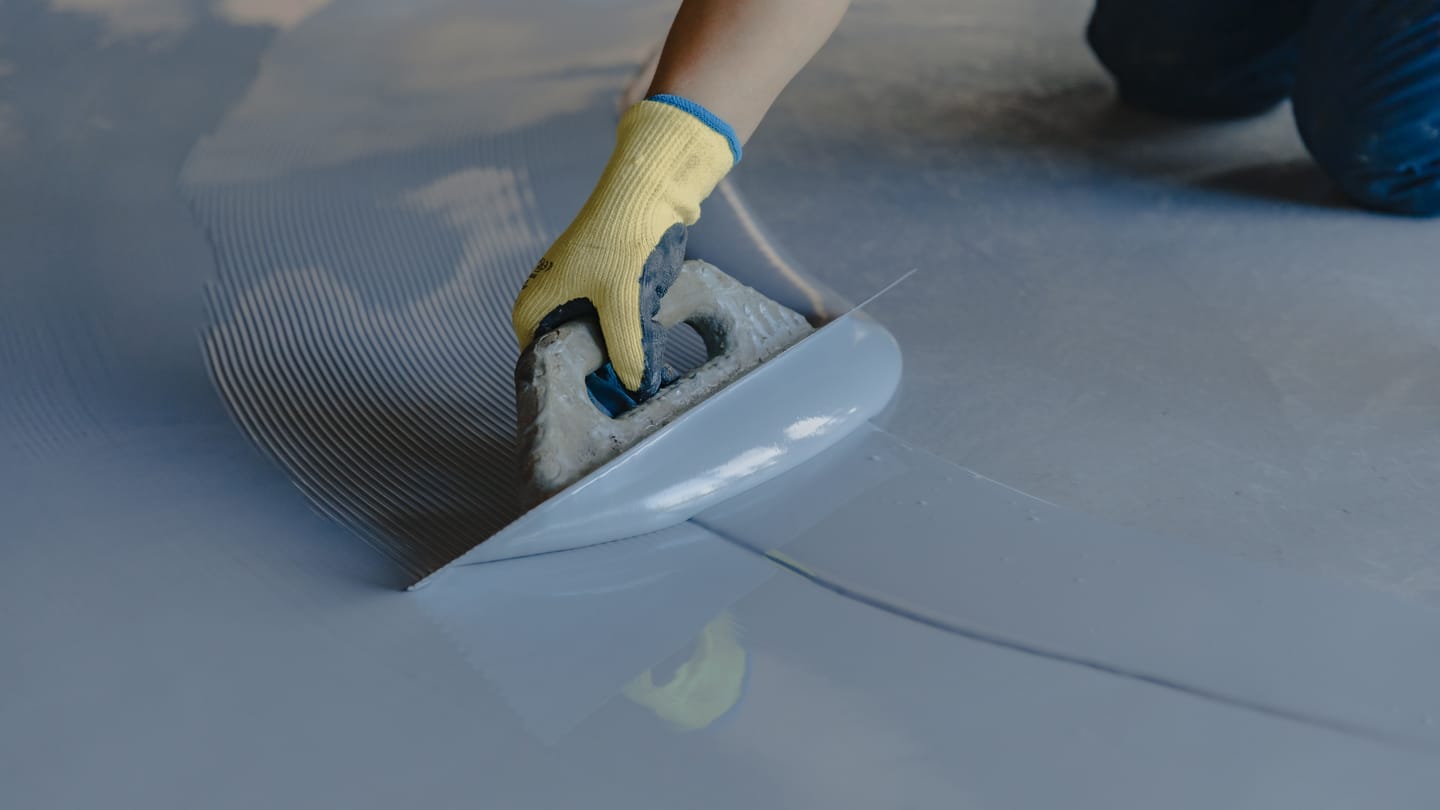
How much to charge for epoxy flooring comes down to a method, not a number: total what the job costs you to do right, add your share of the overhead that runs whether you work or not, and set a price that clears those costs on every floor. No public source prints an epoxy rate worth copying.
Why this page prints no per-square-foot rate
This page prints no rate because no source we could verify publishes an epoxy price an owner can safely borrow. Prices quoted online come from somebody else’s crew, slabs, suppliers and market, and they may not say what prep, coating system or warranty terms stand behind the number. A rate copied from a forum can be too low for a slab that needs heavy grinding and too high for a clean garage around the corner.
What public sources do print are the inputs: what labor costs in wage terms, what the IRS allows for business miles, which payroll taxes an employer pays, and how the U.S. Small Business Administration tells owners to find a break-even point. Those inputs, plus your own job records, are how you price a floor. Our epoxy flooring business insurance guide covers the insurance side of the same arithmetic.
How much to charge for epoxy flooring, input by input
The price for any floor is the sum of its direct costs, a share of the overhead that keeps the business open, a reserve for floors that come back, and whatever the market lets you add on top. Work through those inputs in the same order on every bid, so you can compare jobs with each other and see which kinds of floors carry their weight.
Start at the slab. Walk it before you quote, look for oil, old sealers, cracks and spalls, and decide what moisture testing you will run. Then choose the system the customer is buying: primer coat, body coat, flake broadcast or metallic epoxy, and the topcoat. Then estimate hours for grinding the slab, surface prep, application, cure time and cleanup. Each of those choices moves the material list and the labor hours, which is why a price set before anyone sees the floor is a guess.
Materials, waste and the coating system
Materials should be priced from your own supplier’s quote for the full system, plus the product you know you will lose. Resin and hardener that kick off in the bucket, flake that ends up on the driveway, and the extra kit you load because running short on site costs more than carrying a spare all belong in the bid.
Keep receipts by job, not just by month. After a season of floors, those receipts tell you what a flake garage or a commercial kitchen really consumed, which beats any spec-sheet coverage estimate. When a customer upgrades the system, reprice the materials and the labor together, since a different topcoat can change cure time, the number of trips and what your crew has to wear while they apply it.
Labor: the wage and what sits on top of it
Labor cost starts with the wage you pay and climbs with the taxes and coverage the law attaches to it. For a sense of the wage market, ONET OnLine reports for “Floor Layers, Except Carpet, Wood, and Hard Tiles” national “Median wages (2025) $27.15 hourly, $56,460 annual”, with the note “Source: Bureau of Labor Statistics 2025 wage data”. For the helpers who carry, sweep and mix, ONET OnLine reports for construction laborers “Median wages (2025) $22.66 hourly, $47,120 annual”, and its duty list ends with “May assist other craft workers.”
Those medians are not your labor cost. They are national employee medians for occupations the O*NET floor layer summary and the O*NET construction laborer summary do not tie to epoxy, and they leave out what an employer pays on top. The IRS says on understanding employment taxes that “Employers must deposit and report federal employment taxes.” On unemployment tax it tells the employer, “You pay FUTA tax only from your own funds.” If you work alone, the IRS describes “Self-Employment Tax (SE tax) is a Social Security and Medicare tax primarily for individuals who work for themselves.”
Add workers compensation, asking your agent what it is rated on where you work, and ask your CPA what state unemployment and other payroll costs add where you work. Then price labor in hours per job, including the hours your crew waits on cure time.
Drive time and the miles between floors
Travel is a cost on every job, and an unpriced drive is labor and fuel you give away. Count the hours your crew spends in the truck, the trips back for a second coat, and the run to the supplier when a kit comes up short.
For the vehicle itself, treat mileage as an input: the miles from your shop to each slab and back, for every trip the job takes. The IRS publishes a standard mileage rate for tax deductions, but a deduction rate is not the cost of running your truck and trailer, and not a fee you are told to bill. Track your real vehicle costs, and ask your agent how commercial auto is rated on the vehicles you use, since that premium is part of what each mile costs you.
Set a service area or a travel charge for distance outside it, and write it into the estimate so the customer sees it before the job starts.
Fixed costs and the SBA break-even method
Fixed costs are the bills that arrive whether you coat a floor this week or not, and every price has to carry a share of them. The U.S. Small Business Administration says on its business guide that “Fixed costs are costs incurred during a specific period of time that do not change with the increase or decrease in production or services.” It adds that “Examples of fixed costs include rental lease payments, salaries, property taxes, insurance, interest, and depreciation.” It also flags a middle category: “Examples of semi-variable costs include monthly telephone services, repairs, indirect materials, indirect labor, fuel, and power.”
The SBA ties those lines to price directly: “Finding your break-even point will help you price your products smarter.” Its formula reads “Fixed Costs ÷ (Price – Variable Costs) = Break-Even Point in Units”, and it defines a related term: “Contribution Margin is the difference between the price of a product and what it costs to make that product.” For an epoxy shop, treat a typical floor of a given kind as the unit, your materials and job labor as the variable costs, and your monthly overhead as the fixed costs. The SBA also advises, “It’s also a good idea to throw a little extra, say 10%, into your break-even analysis to cover miscellaneous expenses that you can’t predict.”
Run the formula with your own records, or have your CPA run it. If the break-even count of floors is more than your crew can realistically coat in a month, the price is too low, the overhead is too high, or the job mix needs to change. Our start-up cost post covers the purchases that become those fixed costs.
Callbacks, coverage and the reserve behind every bid
A price that assumes every floor goes perfectly will lose money on the floors that do not, so hold a reserve for callbacks and price your insurance in. A coating that lifts near a garage door, a topcoat that hazes, or a slab that pushes moisture months later can send your crew back on your own time and your own materials.
Real-World Scenario: An owner bids a homeowner’s garage floor by copying a rate a friend in another town charges, without walking the slab first. On site, the crew finds an old sealer and oil stains that take hours of extra grinding, and the homeowner declines moisture testing. The floor goes down, the owner absorbs the extra grinding time, and a section near the door lifts the following winter. The redo wipes out what the job earned. The owner rewrites the estimate form to require a slab walk, a priced prep scope and a signed line recording whether the customer accepted moisture testing.
Insurance belongs in the same layer. General liability answers for injury and property damage claims, including some that arrive after you leave, and its cost has to be carried by the jobs you run. Our posts on epoxy floor failure and what to promise customers cover how to cut down on callbacks and how to word the promise you make.
Checking your price against the local market
Once your cost-based price is built, check it against the market, but do not let the market set your costs. The SBA lists the outside forces: “Important factors to consider include level of competition, threat of new competitors or services, and the effect of suppliers and customers on price.” Ask what competitors include for their price, what system they install, whether they test for moisture and what they promise afterward.
If your price sits well above the market, look for waste in your process before you cut the number. If it sits well below, ask what you are leaving out. A competitor who skips prep or carries no coverage has a lower cost, and also a different risk.
Garage estimates and commercial bids weigh the inputs differently
Residential and commercial floors use the same inputs, but each weighs them differently. On a garage, look hard at the slab condition, the drive between small jobs and the cost of finding each customer, since each can move the price. Our page on residential epoxy flooring contractor insurance covers how that side of the business is insured.
On a commercial job, read the contract as closely as you walk the slab, since its terms can move the price. Night and weekend work, occupied buildings, additional insured requests, higher limits that may call for umbrella liability, retainage and pay-when-paid terms all cost money before the grinder starts. Our page on commercial epoxy flooring contractor insurance walks through those demands. When your inputs are ready, request a quote so the insurance line in your bids reflects your real program.