
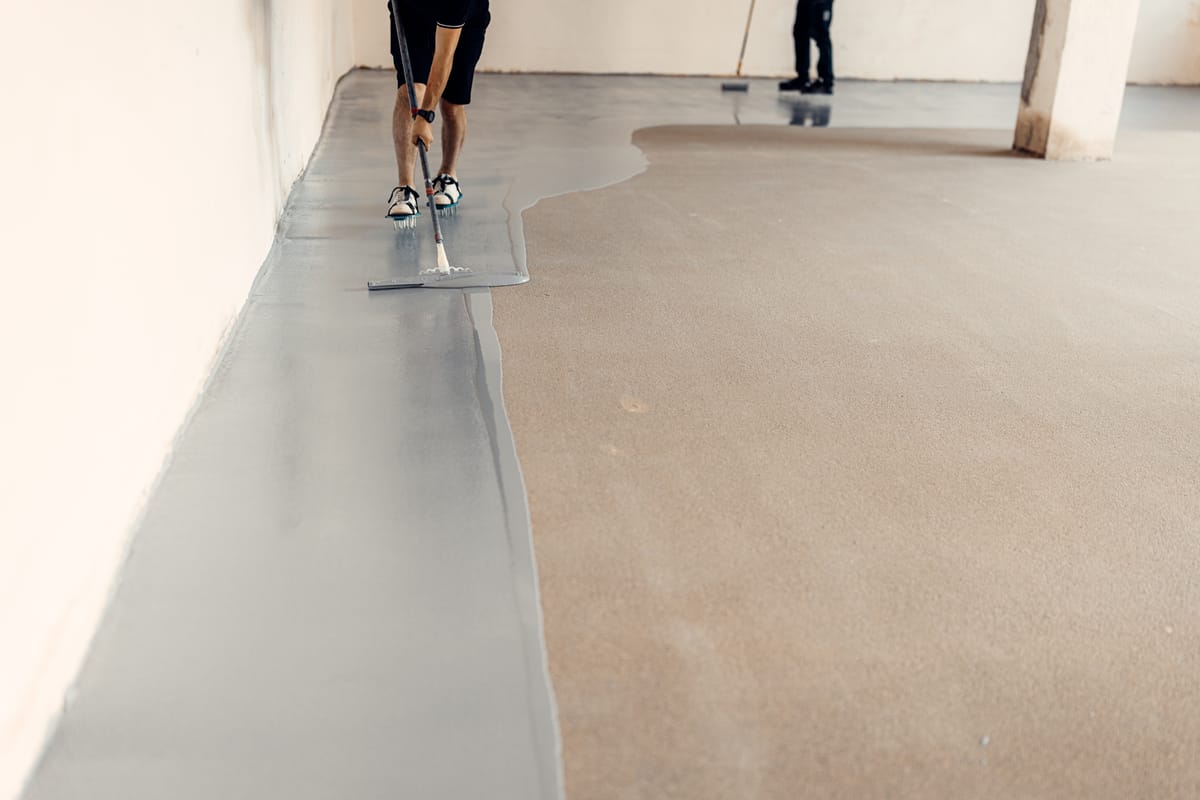
Registration with the Department of Inspections, Appeals, and Licensing is the credential an Iowa epoxy contractor needs: the state registers construction contractors, and the definition of construction behind that registration names epoxy application contractors by name, beside floor laying, scraping, finishing and refinishing. The rule draws no line between homes and commercial buildings, and contractors who earn below the state’s yearly threshold from construction, or who work only on their own property, are outside it. Registration is conditioned on proof of workers’ compensation coverage, and a contractor based outside Iowa also files a surety bond or a statement of transportation-department prequalification. Beside it sit a comp law that requires employers to insure with an approved insurer, a safety plan the state runs itself, and a federal table of approved air rules with no coatings entry.
A registration card settles who may bid; it settles nothing when a floor fails. A coat that lifts off a garage slab in Dallas County, a solvent smell that empties a Cedar Rapids break room, a shot blaster that vanishes from a Waterloo jobsite overnight: those are claims, and the sections below put each Iowa rule next to the policy that answers for the loss.
Floor finishing on the list Iowa registers
Iowa requires construction contractors to register with the state, and the state’s list of work it counts as construction names floor finishing and epoxy application: the Department of Inspections, Appeals, and Licensing registers every contractor that earns at least a small yearly amount from construction, and the registration rule draws no line between work on homes and work on commercial buildings. Registration is conditioned on proof of workers’ compensation coverage, and an out-of-state contractor must also file a surety bond or a statement of transportation-department prequalification. The code states the duty to register this way:
“A contractor doing business in this state shall register with the director and shall meet all of the following requirements as a condition of registration:”
The definition of construction that the registration borrows names epoxy work directly:
“Epoxy application—contractors”
The same definition lists the floor trades under this entry:
“Floor laying, scraping, finishing and refinishing—contractors”
The department’s registration page describes the reach of that definition plainly:
“The definition of construction is very broad. Carpenters, electricians, plumbers, roofers, painters and many others must register.”
Registration is renewed every year, a subcontractor is not covered by the general contractor’s registration and must register on its own, and the department tells contractors to check with the city or county for each project’s local requirements. Contractors who earn below the state’s yearly threshold from construction, or who work only on their own property, do not have to register.
For an epoxy business the reach is direct: epoxy application sits on the construction list by name, so plan on registering. If you have a question about a particular job, such as a coating applied over a floor another contractor poured, put it to the Department of Inspections, Appeals, and Licensing before the work and keep its answer. Register under your own company name even when you work under a general contractor, since its registration does not cover a subcontractor, and keep the renewal on your calendar so the registration does not lapse in the middle of a busy month.
Proof of insurance travels with the registration. Registration requires the contractor to show evidence of workers’ compensation coverage every year, or relief from the insurance requirement, or a statement that it is not required to carry the coverage; the insurer must notify the department if the policy is canceled. An out-of-state contractor must also file a surety bond with the department, or show that it is prequalified to bid state transportation work. The code puts the comp condition in these words:
“The contractor shall be in compliance with the laws of this state relating to workers’ compensation insurance and shall provide evidence of workers’ compensation insurance coverage annually”
And the department’s page gives the bond figure for contractors based elsewhere:
“each contractor with a principal place of business outside of Iowa must file a $25,000 bond in order to register”
That makes workers’ compensation part of the registration and not a separate errand. Arrange the comp policy before the application goes in, keep evidence of it ready for every renewal, and remember that the insurer has to tell the department if the policy is canceled, so a missed premium can reach the registration file before it reaches you. If your business is based outside Iowa, arrange the surety bond, or confirm your transportation prequalification, ahead of the application rather than after a bid request arrives.
Cities and counties are a separate layer. The department points contractors to the city or county for each project’s local requirements, and this page reads no local rule, so call the building office in each new town and ask what it expects from a contractor before a floor job starts.
Homes and commercial buildings under the same registration rule
Iowa’s registration rule draws no line between work on homes and work on commercial buildings, so the split an epoxy business feels here is in the insurance, not the credential. The buyers ask for different things, and the claims arrive at different times.
Homeowners hire for garage floors, basement floors and shop slabs, and if a homeowner does not ask for a certificate, plan for any claim to arrive after the crew is gone. A coat laid over a slab that was not ground deep enough can let go, a crack in the concrete telegraphs through the finish, and moisture moving up through an older basement slab raises blisters under the system. Those losses fall to the completed operations part of general liability, and our residential epoxy flooring contractor insurance page explains how that part of the policy responds.
Commercial customers put their terms in writing before the work starts. A warehouse in Polk County, a manufacturing plant in Linn County or a clinic in Johnson County can ask for additional insured status, primary and noncontributory wording, a waiver of subrogation and limits matched to their own exposure. The job can run overnight or across a weekend in a building that stays partly in use, which is where odor complaints and traffic on a coat that has not cured turn into claims. We cover those contract terms on our commercial epoxy flooring contractor insurance page.
If your company takes work on homes and commercial floors alike, tell us roughly how revenue divides when you apply. A program built for garage work may not meet a plant’s contract, and a program built for plant contracts may carry endorsements a garage crew pays for without ever drawing on them.
Approved insurers, posted notices and Iowa comp
Iowa places the duty to insure on the employer, and the comp chapter states it in these words:
“shall insure the employer’s liability under chapter 10A, subchapter III, this chapter, and chapters 85, 85A, and 85B, in some corporation, association, or organization approved by the commissioner of insurance.”
Relief from that duty comes from the insurance commissioner, on proof that the employer can pay the benefits itself. An employer that fails to insure has to tell its workers so, by a posted notice that begins:
“You are hereby notified that the undersigned employer has failed to insure the employer’s liability to pay compensation as required by law”
The chapter also leaves that employer answerable to an injured worker under the common law:
“the employer shall be liable in case of injury to any worker in the employer’s employ under the common law as modified by statute.”
The system itself is run by a division of the licensing department:
“DIAL’s Workers’ Compensation Division (WCD) administers the workers' compensation system.”
Nothing in the sources read for this page names a state fund, so comp in Iowa comes from an insurer the commissioner approves, and we arrange it through such an insurer. What raises the stakes for a coating business is the link to registration: comp evidence is a condition of the registration every year, so a gap in coverage is a registration problem as well as a claims problem. Bind the policy before your next hire starts, and if you run without employees and file a statement that coverage is not required, revisit that statement the day you add a helper.
Iowa’s definition of an independent contractor was not read for this page, so we describe no test here. Put any plan to pay a helper as a contractor instead of an employee to the Workers’ Compensation Division, ask how the comp law treats the arrangement, settle it in writing before the work starts, and tell us how you pay each person who works your jobs.
Subcontracted crews deserve the same care. Each sub registers on its own, so ask a sub for its registration and its comp certificate before it arrives on a job, check that the policy is in force on the job dates, and keep the papers in the job file. Your own policies’ response to a sub whose coverage turns out to be missing depends on the wording, so ask us before you hand off the work.
A dispute with an insurer over how it handles your comp or liability policy belongs with the Iowa Insurance Division, the state’s insurance regulator.
IOSHA, the labor commissioner and silica on Iowa slabs
Iowa’s plan is on the federal list of approved state plans, among the plans that cover private-sector employers as well as state and local government. The federal regulation that holds that list is titled:
“List of Approved State Plans for Private-Sector and State and Local Government Employees”
Its Iowa entry describes whom the plan covers:
“The plan covers all private-sector employers and employees, with several notable exceptions, as well as State and local government employers and employees, within the State.”
The plan is Iowa OSHA, run by the Department of Inspections, Appeals, and Licensing, and its enforcement page states the job plainly:
“IOSHA enforces safety and health standards to prevent workplace injuries and illnesses.”
The state’s construction rule brings the federal construction standards under state enforcement:
“shall apply and be interpreted to apply to enforcement by the Iowa labor commissioner, not the United States Secretary of Labor or the Federal Occupational Safety and Health Administration”
The silica standard came into that rule through a rulemaking the labor commissioner adopted and filed, which explains the step this way:
“has amended general industry and construction standards concerning respirable crystalline silica, eye and face protection, and work performed near electrical equipment. The Iowa Labor Commissioner must adopt the federal standards by reference.”
The upshot for a coating crew: on a private Iowa construction site, the respirable crystalline silica standard is the state’s adopted version, enforced by the Iowa labor commissioner and not by federal OSHA. Grinding and shot blasting an Iowa slab therefore answer to that state standard, and IOSHA is the program that checks it. Before a grinding-heavy job, ask IOSHA what written exposure plan and records it wants from a crew your size. The plan’s note on exceptions is still worth a call: if a job sits on a site where you are unsure who holds jurisdiction, settle it before the crew mobilizes.
IOSHA offers free and confidential on-site consultation to both public and private employers. For a small coating company, a consultation visit is a way to have the dust plan reviewed before an inspection would review it. Either way, run shrouded grinders on a vacuum with a filter rated for fine dust, fit test respirators for everyone near the grinding, and log the controls used on each site.
Lungs exposed to slab dust, skin burned by an amine hardener, a knee wrecked kneeling on a broadcast floor, a back strained lifting a grinder head: workers’ compensation exists for those injuries. Training and dust control make them less frequent; the policy answers when they happen anyway.
No coatings entry in Iowa’s approved air rules
As approved into Iowa’s federal air plan, Iowa has no architectural coatings rule: the current federal table of the state’s approved air rules, which also carries the local air rules of Linn County and Polk County, lists no rule for architectural, maintenance or floor coatings, and no coating rule of any other kind. The federal table is headed:
“EPA-Approved Iowa Regulations”
The state’s emission standards appear in it under this entry:
“Chapter 23—Air Emission Standards”
And a local program appears in it as well:
“Linn County Air Quality Ordinance, Chapter 10”
No state or local coatings rule in the federal table reaches the person applying a floor coating. The state’s own air rule text was not read for this page, and the Iowa Department of Natural Resources’s air quality page, which was, does not mention coatings. If a customer or a specifier presses on the point, ask the Iowa Department of Natural Resources, or the county program where the job sits, before you answer for a product.
Day to day, the product question goes to your supplier. Get the limits each product in your system is sold under in writing, keep the technical data sheet and safety data sheet in the job file, and if a commercial customer holds its own air permit, ask whether anything you bring into the building affects it.
An odor claim does not wait for an air rule. A coat can meet every limit it is sold under and still push a smell into an apartment above a garage, a restaurant kitchen or a clinic waiting room, and a claim from that smell is where the pollution exclusion in general liability gets tested. Check whether the policy carries a pollution endorsement written for the products you apply, or whether a contractors pollution policy suits your commercial work better.
The license is not the coverage — the program is.
- A license or registration is a condition the state sets on the work or its permits, not insurance, so no line is drawn from it.
- No line is drawn from the coatings row: ask whether your general liability excludes pollution, and about a pollution endorsement.
A panel for Iowa in rows. Each row sets a requirement of the state beside the exposure that requirement leaves open and the coverage line that answers it. Contractor licensing: State contractor registration with the Department of Inspections, Appeals, and Licensing. It leaves open a coating that fails, or damage to the customer’s property, which General Liability and Umbrella Liability answer. Workplace safety: Its own OSHA-approved state plan, run by the Department of Inspections, Appeals, and Licensing. It leaves open a crew member hurt by silica, chemicals or the grinder, which Workers Compensation answers. Coatings VOC rules: No state VOC rule found that reaches floor coatings. No connector is drawn for this row. Workers’ compensation: Compulsory; bought from an authorized insurer. It leaves open an injured employee, which Workers Compensation answers. Notes: A license or registration is a condition the state sets on the work or its permits, not insurance, so no line is drawn from it. No line is drawn from the coatings row: ask whether your general liability excludes pollution, and about a pollution endorsement. The conclusion reads: The license is not the coverage — the program is. No figures are shown.
From these rules to your insurance program
Registration, the comp law and the safety plan set the terms of the work; the insurance program answers for what goes wrong inside those terms. Here is each policy line with the Iowa detail that shapes it.
General liability answers for a floor that fails after the crew leaves, a slip on a finish that cured too slick, and a customer’s vehicle or stock damaged while the crew worked. Its pollution wording governs an odor complaint, so read it before any job in an occupied building, and match its additional insured wording to what your commercial contracts ask for.
Iowa workers’ compensation is written by an insurer the insurance commissioner approves, and the evidence of it goes to the department with every registration renewal. We arrange the policy, keep that evidence in hand, and help you collect certificates from the subs who work your jobs.
An Iowa coating business buys umbrella liability as an extra layer over general liability, commercial auto and the employers liability part of the comp policy. If a commercial contract asks for limits above your underlying policies, ask us about an umbrella before you sign.
Iowa trucks and trailers hauling grinders, resin and flake between Des Moines garages, Cedar Rapids plants and Sioux City jobs need commercial auto. Keep every work truck off personal auto policies, since that gap tends to surface on the day of a crash.
Your grinders, blasters, dust collectors and mixing drills go on inland marine — contractors tools and equipment, which follows the equipment on the trailer, inside a customer’s garage or parked overnight at a commercial site. When a grinder disappears the schedule stops, and this coverage pays to replace it.
Commercial property protects a shop you own or rent along with the resin, hardener and flake inventory kept there. Cold can ruin resin left in an unheated building through the winter, so ask how your property policy treats ruined stock, and if the business runs out of a home garage, say so, because a homeowners policy can leave business property out.
The whole program, and the questions an insurer asks before quoting, are laid out on our page about business insurance for epoxy flooring.
Iowa metro areas and the counties behind them
Census Bureau definitions put Iowa counties inside the metros below, which rank among the largest that do. Alongside each metro sit its Iowa counties and the change an epoxy business should plan for there.
Des Moines-West Des Moines, IA
Dallas County, Guthrie County, Jasper County, Madison County, Polk County and Warren County make up this metro, which lies wholly inside Iowa. Polk County’s local air rules appear in the federal table of Iowa’s approved rules, and the table lists no coatings rule for them. If a customer in the county asks how your coating squares with local air rules, put the question to the county rather than answering from memory, and if your work here runs to occupied office floors, check that your general liability’s pollution wording reaches an odor claim.
Davenport-Moline-Rock Island, IA-IL
Scott County is the Iowa side of a metro the Census Bureau extends into Illinois. If your company is based on the Illinois side and bids Iowa jobs, registration asks a contractor whose principal place of business is outside Iowa for a surety bond or a statement of transportation-department prequalification, so line that up before the bid. If your crews are Iowa-based and work Illinois jobs, tell us before we quote, so your comp policy and certificates fit the work across the line.
Cedar Rapids, IA
Benton County, Jones County and Linn County make up this metro. Linn County’s air quality ordinance appears in the federal table of Iowa’s approved rules, with no coatings rule listed for the county program. If a manufacturing customer in Linn County runs its own air permit, ask its environmental contact whether your work inside the building touches that paperwork, and expect a plant contract to ask for additional insured status and limits sized to its own operation.
Iowa City, IA
Johnson County and Washington County make up this metro. If your work here includes floors for a public employer, the state plan covers state and local government employers and employees as well as private ones, so the public staff around your crew fall under the same safety plan; read the public contract’s certificate wording closely, because a government buyer can set its own.
Waterloo-Cedar Falls, IA
Black Hawk County, Bremer County and Grundy County make up this metro. If your book in these counties runs to manufacturing floors and equipment bays where forklifts return as soon as the coat allows, agree on the return-to-service time in writing, since early traffic on a coat that has not cured is a completed operations claim waiting to happen, and tell us the share of your revenue that comes from heavy-traffic industrial floors so the program is rated on the work you do.
Sioux City, IA-NE-SD
Woodbury County is the Iowa piece of a metro that the Census Bureau extends into Nebraska and South Dakota. If your crew is based in Woodbury County and takes jobs across the state line in Nebraska or South Dakota, raise it before we quote, since how workers are covered for those jobs is a question to settle with us before the crew crosses, and a contractor on the other side will want a certificate that fits its own subcontract.
Taking a job in an Iowa town not listed here? The registration, the comp law, IOSHA and the air table above apply across the state. What changes from place to place is the city or county office, so call it before you start in a new town. For pricing built on your Iowa work, request a quote.