
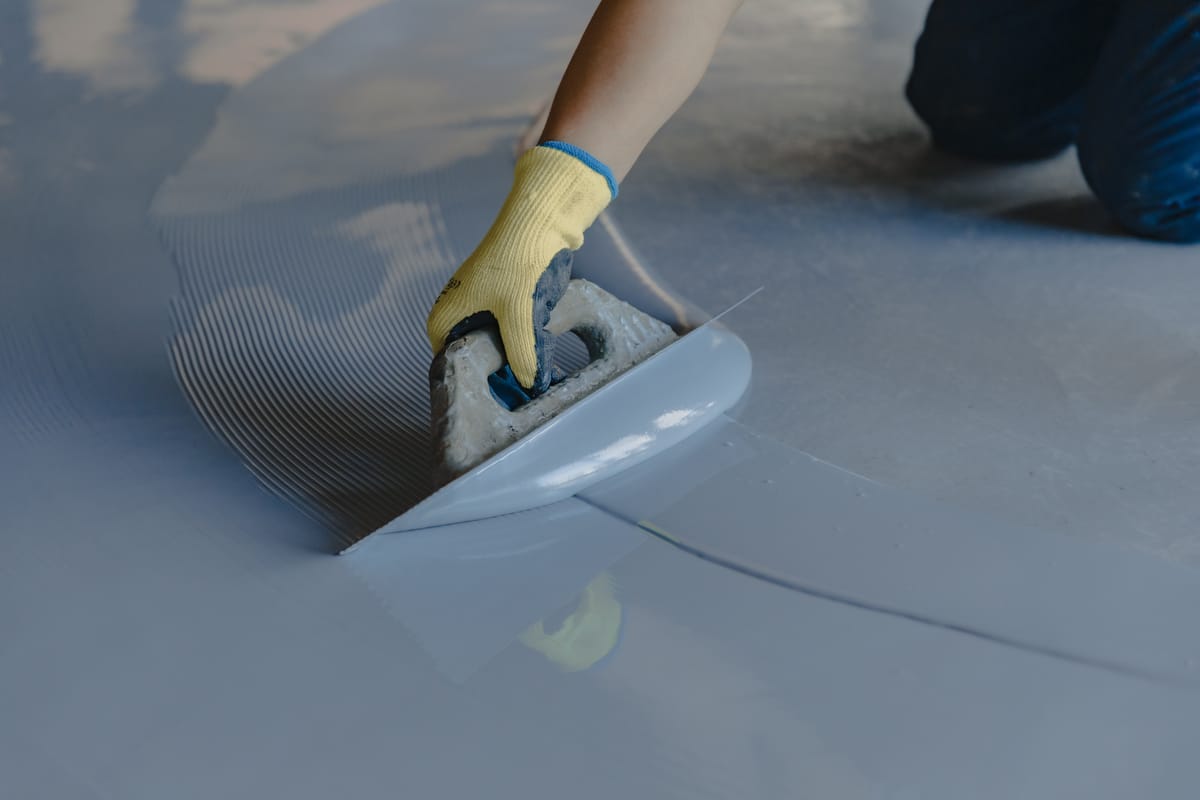
South Dakota has no trade license for epoxy floor coating, yet an epoxy contractor still needs a license there: the contractor’s excise tax license from the South Dakota Department of Revenue, required for any contract to build, install or repair fixtures to real property. It is a tax license, not a test of the trade, and the department’s own guide lists epoxy flooring among the work its contractor’s excise tax reaches. Beside that license sit a workers’ compensation law that requires no employer to buy coverage but leaves the uninsured open to suit, federal OSHA on private jobsites, and approved air rules with no coatings chapter.
The tax license proves you registered; it proves nothing about the floor. A garage coating that lifts in Sioux Falls, a solvent smell drifting through a Rapid City office, a trailer of grinders gone from a Union County jobsite: each is a question for insurance, and this page sets every South Dakota rule beside the coverage that takes it up.
A tax license, not a trade license, for South Dakota floor work
In the department’s framing, South Dakota issues no trade license for epoxy floor coating, but it does require a contractor’s excise tax license from the Department of Revenue, for any contract to build, install or repair fixtures to real property: the department says anyone contracting to build, install or repair fixtures to real property must hold one, and it names epoxy flooring among the work subject to the contractor’s excise tax. It is a tax license, not a test of the trade. The guide sets out who must hold the license:
“must have a South Dakota contractor's excise tax license. This includes repair or remodeling of existing real property or the construction of a new project.”
Floor coverings get their own paragraph in the guide, and epoxy is named in it:
“All other types of flooring, such as ceramic tile, terrazzo work, and epoxy flooring are subject to contractor's excise tax.”
That sentence settles the question for an epoxy crew. Whatever the guide says about other floor coverings, the floors you pour and roll are contractor’s excise tax work, and the excise tax license is the registration that goes with them. Apply to the South Dakota Department of Revenue before you bid, and talk with your accountant about how the tax affects the way you price a job, because the license and the tax arrive together.
Next comes the permit side. The tax license number goes with the job: every contractor must show it with the building permit, and, except on projects for a qualified utility, a prime contractor issues each subcontractor an exemption certificate for the project. On the trade side, the index of programs licensed by the South Dakota Department of Labor and Regulation carries electrical and plumbing licensing but no general, flooring or coating contractor license. The guide puts the display rule this way:
“All contractors must display their contractor's excise tax license numbers with their building permits.”
The department adds the prime contractor’s duty toward subs:
“it is the prime contractor’s responsibility to issue prime contractor's exemption certificates to all subcontractors for each project”
If you run a job and bring in another crew for the grinding or the flake broadcast, the exemption certificate is your paperwork to issue, project by project, unless the project is for a qualified utility. If you work under a general contractor, expect that contractor to hand you the certificate, and ask for it before you start.
As for insurance, the tax license makes no demand. None found: the Department of Revenue’s pages read attach no insurance or bond condition to the contractor’s excise tax license. Read that finding for what it is, a statement about the department’s pages, and do not read it as permission to work bare: commercial customers, general contractors and property managers set their own insurance terms in the contract, and those terms can decide whether you get the job. No city page was part of our reading, so ask the building department in each city where you work whether it keeps its own contractor list or insurance requirement before a permit.
Installer training from a resin manufacturer is worth holding when a specification names that maker’s system and your customers ask for it. It is the manufacturer’s credential, though, separate from the state’s tax license.
Garage jobs, plant floors and the real-property test
The excise tax license follows the contract, not the building type: the department requires it for any contract to build, install or repair fixtures to real property. The line that matters to an epoxy business runs through the customers and the claims instead.
On the residential side, think garages, basements and shop buildings, sold to homeowners who may not think to ask for a certificate. Their claims show up after the crew has gone. A coating over a poorly profiled slab peels where hot tires stop, winter salt and slush tracked in by vehicles wear at the finish, and vapor rising through an older basement slab can push a system up in blisters. Those losses come back through the completed operations part of general liability; our residential epoxy flooring contractor insurance page lays out how that part answers.
Commercial jobs move the insurance conversation to the front of the deal. A warehouse in the Sioux Falls metro, a medical office in Rapid City or a processing plant near Sioux City can ask for additional insured status, wording that makes your policy respond first, and limits fitted to its own risk. The work may run overnight in a building that stays partly open, which is where fume complaints and early traffic on an uncured finish turn into claims. We walk through those contract terms on our commercial epoxy flooring contractor insurance page.
A business that takes work on each side should tell us roughly how its revenue splits when it applies. A garage-centered program can miss what a plant contract demands, and a plant-centered program may carry endorsements a garage crew pays for without using.
Public work deserves a separate look. A floor in a school, a county shop or a state building can come with the public owner’s own insurance terms and certificate wording, so read the bid documents for them before you price the job, and send us the insurance section if any of it is unclear.
Going without comp in South Dakota leaves you open to a lawsuit
As the state presents it, South Dakota’s Department of Labor and Regulation says no law in the state requires an employer to carry workers’ compensation insurance, though it strongly recommends it: an uninsured employer can be sued in civil court by an injured worker. The department’s home page says it plainly:
“There is no law in South Dakota requiring any employer to carry workers’ compensation insurance. However, it is highly recommended.”
“An uninsured employer may be sued in civil court by an injured worker.”
The statute adds a presumption and a condition. Under state law every employer is presumed to accept the workers’ compensation system, but only an employer that secures it, with a private insurer or as an approved self-insurer, is treated as having accepted it. The presumption reads:
“Every employer and employee shall be presumed to have accepted the provisions of this title, and shall be thereby bound”
And the condition that gives the presumption its teeth:
“No employer other than the state, a municipality, or other political subdivision of this state may be deemed to have accepted the provisions of this title unless the employer has complied with the provisions of”
Read together, those passages describe a choice with a cost attached. A South Dakota employer that buys comp, or is approved to self-insure, stands inside the system. An employer that skips it stands outside, and the department warns that an injured worker may then sue it in civil court. For an epoxy crew, where a grinder kickback, a hardener burn or a fall from a loading ramp can put a worker off the job, that civil suit is the exposure to weigh. Our advice is to carry the policy.
Weigh the decision against the work you chase, too. A commercial customer or a general contractor may make proof of comp a condition of the contract whatever the state requires, so ask before you bid whether the job calls for a comp certificate. If your crews cross into Minnesota, Iowa or Nebraska, talk with us before that job about how those workers are covered there, and do not assume a choice made under South Dakota law carries over the line.
We can arrange South Dakota comp through an insurer authorized to write it in the state. The statute names private insurers and approved self-insurance as the ways to secure it. An employer can be approved by the South Dakota Department of Labor and Regulation to self-insure; for a small coating business, plan on an insured policy.
Subcontractors bring their own exposure. A principal or intermediate contractor is liable for compensation to an injured employee of a subcontractor working on the contract, to the same extent as the immediate employer, when the injury happens on premises where the principal contractor has undertaken to execute work or that are otherwise under its control. The statute’s words:
“A principal, intermediate, or subcontractor is liable for compensation to any employee injured while in the employ of any subcontractor and engaged upon the subject matter of the contract, to the same extent as the immediate employer.”
If you hand part of a large floor to another crew on premises where you have undertaken the work, or that are otherwise under your control, its injured worker can become your claim. Ask each sub for a certificate showing comp coverage in force for the job dates before it arrives, keep the certificate with the job file, and write current coverage into the subcontract.
Who counts as an independent contractor is a separate question. On that point, South Dakota’s comp law leaves out a person whose work is not in the usual course of the employer’s trade or business, and the Department certifies truck owner-operators as independent contractors on written proof of listed factors. Decide each helper’s status before the work begins, and ask the South Dakota Department of Labor and Regulation when a case is close.
South Dakota’s insurance regulator is the South Dakota Division of Insurance.
Federal inspectors hold the private South Dakota jobsite
On jobsite safety, the jurisdiction is settled: South Dakota has no OSHA-approved state plan: the federal list of approved state plans names none for South Dakota, so private jobsites in the state, an epoxy crew’s included, fall to federal OSHA. The list behind that finding is titled:
“List of Approved State Plans for Private-Sector and State and Local Government Employees”
South Dakota appears nowhere on it, for private employers or for public ones, and that absence is why your crew’s safety questions go to the Occupational Safety and Health Administration, whether you are coating a garage in Meade County or a shop floor in Turner County.
Where silica is concerned, the answer is the same agency. The construction standard on respirable crystalline silica is a rule of the Occupational Safety and Health Administration, and with South Dakota off the approved plan list, that agency enforces it on a private construction site. Grinding and shot blasting a South Dakota slab therefore answers to the federal standard, so phone the agency to learn what written exposure plan and records it expects from a small crew. On each job, run shrouded grinders on a vacuum with a filter rated for fine dust, fit-test and document respirators for everyone close to the grinder, and keep a written dust plan for each job.
Lungs full of concrete dust, skin burned by an amine hardener, a blast hose whipping loose, a back wrenched lifting a planetary grinder onto a trailer: these are the injuries that workers’ compensation pays, and in South Dakota the policy is how an employer keeps those injuries inside the comp system rather than in a courtroom.
An approved air plan with no chapter on coatings
As approved into South Dakota’s federal air plan, South Dakota’s rules carry no coatings rule: the approved chapters cover permits, ambient standards, emissions from fuel-burning and process units, visible emissions, and dust and street sanding in the Rapid City area, so no South Dakota rule sets a coating VOC limit for the crew applying a floor system. Among the chapters in the federal table is this entry:
“74:36:06. Regulated Air Pollutant Emissions”
The table also lists the chapters tied to the Rapid City area:
“Regulations for State Facilities in the Rapid City Area”
“Rapid City Street Sanding and Deicing”
None of the approved chapters addresses coatings; the Rapid City chapters govern street sanding and dust from state facilities and from state contractors doing construction work in that area. The air program sits with the South Dakota Department of Agriculture & Natural Resources. So the approved rules we read set no VOC limit on a floor coating or on the crew applying it. If you take state construction work in the Rapid City area, ask the agency letting the contract how the dust chapter for state contractors applies to your grinding. Product questions still deserve an answer: ask the resin supplier what limits each product in your system is sold under, keep the product data sheet and safety data sheet in the job file, and when a plant customer holds its own air permits, ask whether your work inside the plant needs to fit its paperwork.
Air rules aside, odor is still an insurance matter. A low-solvent coating can carry a smell into a dental office, an apartment over a garage or a restaurant that opens the next morning, and a complaint from that smell is where the pollution exclusion in your general liability policy gets tested. It pays to learn whether your policy carries a pollution endorsement written for the products you apply, or whether contractors pollution coverage suits your commercial work better.
The license is not the coverage — the program is.
- A license or registration is a condition the state sets on the work or its permits, not insurance, so no line is drawn from it.
- No line is drawn from the coatings row: ask whether your general liability excludes pollution, and about a pollution endorsement.
A panel for South Dakota in rows. Each row sets a requirement of the state beside the exposure that requirement leaves open and the coverage line that answers it. Contractor licensing: State contractor registration with the South Dakota Department of Revenue. It leaves open a coating that fails, or damage to the customer’s property, which General Liability and Umbrella Liability answer. Workplace safety: Federal OSHA inspects private jobsites. It leaves open a crew member hurt by silica, chemicals or the grinder, which Workers Compensation answers. Coatings VOC rules: No state VOC rule found that reaches floor coatings. No connector is drawn for this row. Workers’ compensation: Not compulsory; bought from authorized insurers by employers who carry it. It leaves open an injured employee, which Workers Compensation answers. Notes: A license or registration is a condition the state sets on the work or its permits, not insurance, so no line is drawn from it. No line is drawn from the coatings row: ask whether your general liability excludes pollution, and about a pollution endorsement. The conclusion reads: The license is not the coverage — the program is. No figures are shown.
From these rules to your insurance program
Paying for a loss is outside what any South Dakota rule above does. Here each gap meets a policy in an epoxy flooring program, with the South Dakota detail that shapes it.
Claims after the job land on general liability: the floor that fails once you leave, the slip on a glossy finish, the car or shelving damaged while the crew worked. The tax license asks nothing of it, but your commercial customers may, so keep certificates ready and read the pollution wording before any job in an occupied building.
South Dakota leaves workers’ compensation to the employer’s choice, and the choice not to buy it opens the door to a civil suit. We arrange it through an insurer authorized in the state, and we help you collect certificates from the subs who work your jobs.
Stacked over general liability, commercial auto and the employers liability part of a comp policy is umbrella liability. Contract limits set by a hospital, a school district or a food plant come from the contract, not from South Dakota law, and an umbrella is built to reach them.
Hauling grinders and resin between Sioux Falls, Rapid City and Union County jobs calls for commercial auto. Insure a work truck under a personal auto policy and the gap surfaces on the day of the accident.
Equipment coverage comes through inland marine — contractors tools and equipment, which follows grinders, shot blasters, dust collectors and mixing stations on the trailer, in a customer’s garage or parked overnight on a plant floor. A missing grinder halts the schedule, and this coverage replaces it.
Whether you own or lease the shop, it and the resin, hardener and flake stock in it belong on commercial property. Ask how your policy treats resin spoiled by cold in an unheated building, and tell us if the business runs from your home garage, since a homeowners policy can leave business property out.
Visit our epoxy flooring business insurance page to see how these policies fit together and what an insurer wants to know before quoting.
The South Dakota metros an epoxy crew works in
South Dakota counties fall inside the metro areas below, as the Census Bureau draws them, and together they are every metro area the bureau draws with a South Dakota county. Under each heading are the South Dakota counties involved and what changes for a coating business working there.
Sioux Falls, SD-MN
Within South Dakota this metro reaches across Lincoln County, McCook County, Minnehaha County and Turner County, and the Census Bureau runs it on into Minnesota. If a Minnehaha or Lincoln County crew picks up floors over the Minnesota line, talk with us before that job about how those workers are covered there and whether your general liability lists Minnesota work, and settle those points before the crew crosses.
Rapid City, SD
Around the city, the metro covers Custer County, Meade County and Pennington County. The state’s approved air rules carry chapters for the Rapid City area, covering street sanding and dust from state facilities and from state contractors doing construction work there. Those chapters set no coating limit, but if you take state construction work in the area they cover, ask the agency letting the contract what dust controls it expects during grinding, and keep the answer in the job file.
Sioux City, IA-NE-SD
Of this metro, South Dakota holds Union County; the rest lies in Iowa and Nebraska. A crew based in Union County that takes jobs across those lines should tell us which states it works in before we quote, so the liability certificate lists them and the comp question for each state is settled before the crew crosses.
Working somewhere else in South Dakota? The excise tax license, the elective comp law, the federal safety basis and the air plan above apply statewide. Call the building department before a job in a town you have not worked. You can request a quote whenever you are ready.