
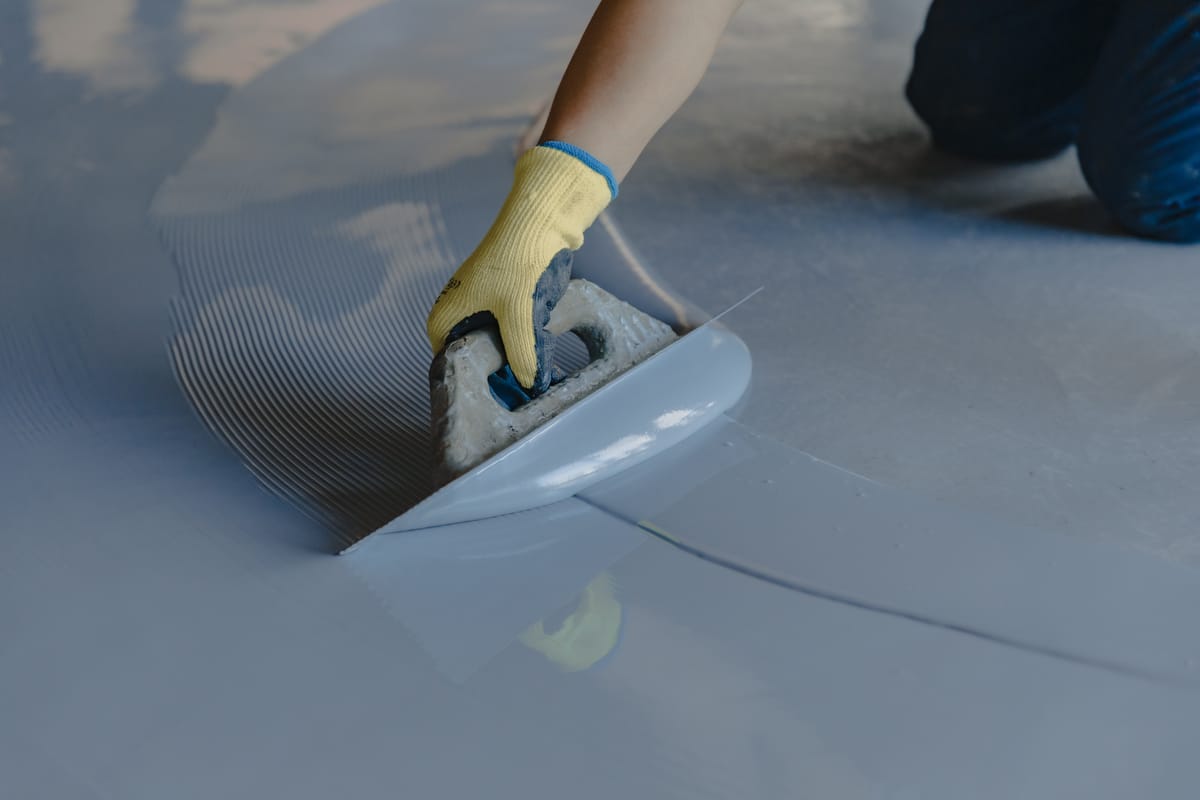
The Office of Professional and Occupational Regulation issues no license for epoxy floor coating in Maine, whether the floor belongs to a house or a business: the list of professions that office licenses carries no general, building, home improvement, flooring or coating contractor license. Residential floors still come under a state rule of a different kind, because Maine’s home construction contract law decides what a written contract to build, remodel or repair a residence must contain, and its definition of a residence takes in garages. Beyond the contract, a coating business in Maine meets a comp law that reaches every private employer, a state safety plan that the federal list of approved plans places among public-employee plans, with private jobsites under federal OSHA, and a statewide coatings rule that names floor coatings and binds the crew applying them.
Contracts and compliance set the terms of a job; they do not pay for what goes wrong on it. A written warranty does not rebuild a garage floor that delaminates, a closed solvent can does not stop a fume complaint in an occupied office, and a helper’s independent contractor statement does not settle every injury claim. The sections that come next take each Maine rule in turn and set it against the coverage that carries the cost it leaves behind.
Maine’s professions list and the floor-coating contractor
Maine’s professional licensing office issues no license for epoxy floor coating, on homes or on commercial buildings: the Office of Professional and Occupational Regulation’s list of the professions it licenses carries no general, building, home improvement, flooring or coating contractor license. That finding is about the state office’s list; it says nothing about what a town may ask of a contractor working inside its limits, which is taken up below.
Without a state license, no state source read sets an insurance condition a coating contractor must prove before working. The standard comes instead from your customers. Some customers never ask; a property manager, a general contractor or a school district will, and the limits and endorsements on their certificate request become the real benchmark. Size your general liability to the largest job you want to accept rather than to the smallest a customer would tolerate.
Towns are a separate check. A Maine town may run permit rules for work inside its limits, and we did not read any, so this page states none. Call the code enforcement office in each town before bidding there, describe the floor work, and ask whether a permit applies and whether the office wants a certificate of insurance on file.
If a home job pulls a licensed trade into the scope, such as moving a floor drain or wiring a heated slab before the coating goes down, check with the board that licenses that trade and hand the piece to a holder of its license. Collect that contractor’s certificate before the work and keep it in your job file.
Home floors run on a written contract in Maine
Maine reaches residential work through what the contract says rather than who holds a license. The home construction contract law defines its subject broadly:
“"Home construction contract" means a contract to build, remodel or repair a residence, including not only structural work but also electrical, plumbing and heating work; carpeting; window replacements; and other nonstructural work.”
Its definition of a residence brings the garage in and leaves commercial property out:
“"Residence" means a dwelling with 3 or fewer living units and garages, if any. Buildings used for commercial or business purposes are not subject to this chapter.”
Above a set price, the law also governs the form of the deal:
“Any home construction contract for more than $3,000 in materials or labor must be in writing and must be signed by both the home construction contractor and the homeowner or lessee.”
The written contract must carry the warranty, dispute and change-order wording the law prescribes. The written-contract law reaches home construction contracts only; it is a contract rule, not a license. The practical effect for a coating business is a template contract for garage and basement work, reviewed against the statute by your own attorney and signed before the crew arrives. Write the surface preparation, the moisture test and the cure time into it, so the homeowner knows what the warranty promises and what it does not.
A warranty in a contract and a liability policy answer different problems. If a floor fails and the only damage is to the coating itself, the cost of redoing your own work may sit outside a general liability policy, while damage the failure causes to other property, or an injury from a slick finish, is what the policy is built to answer. Ask us how your policy treats the redo cost before you write a long warranty into the contract. Plan for residential claims to surface late, as hot-tire pickup, blistering over moisture or a fall on a glossy floor, and our residential epoxy flooring contractor insurance page explains how a program handles them.
Commercial floors sit outside the home construction contract law, since its definition excludes buildings used for commercial or business purposes. The customer’s own contract fills that space, and it arrives with demands a homeowner never makes: additional insured status, coverage that answers ahead of the owner’s own, a waiver of subrogation and limits well above anything residential. The schedule moves to nights and weekends in buildings that stay open, which is where odor complaints and early-traffic damage start. Those terms are laid out on our commercial epoxy flooring contractor insurance page.
If your Maine business takes garage floors and commercial accounts in the same season, tell us how the work divides. A program built around homes can fall short of a warehouse contract, and a program built for commercial work can carry endorsements a residential crew pays for without using.
Comp for a Maine payroll, and the insurer of last resort
Every private employer in Maine, including a contractor who hires and pays employees, must secure workers’ compensation by buying a policy or qualifying to self-insure. The statute words the obligation this way:
“Every private employer, including an independent contractor who hires and pays employees, is subject to this Act and shall secure the payment of compensation with respect to all employees by purchasing a workers' compensation policy or self-insuring”
The Legislature created an insurer of last resort, which also competes in the voluntary market, and other insurers are authorized to write the coverage. The Maine Bureau of Insurance described that insurer’s position this way:
“actively competes in the voluntary market and is the insurer of last resort in Maine”
That leaves a coating contractor with a market of authorized insurers, the insurer of last resort among them. Comp for floor-coating crews is a line we place with authorized insurers that write the trade, through our workers’ compensation program, and we compare them on the classification your crew is rated under and how claims are handled, not on price alone. Self-insurance is the statute’s other route; plan on a policy unless your business has the scale to carry its own claims.
Independent contractor status is the question that catches small crews. A person who wants a rebuttable presumption of independent contractor status can file an independent contractor statement with the Maine Workers’ Compensation Board; the Board no longer reviews or approves predetermination applications. The Board’s notice puts the filing in these words:
“an individual who wants to create a rebuttable presumption of independent contractor status may file a statement”
A rebuttable presumption is a starting point, not a final answer, and it can be challenged after an injury. Ask any helper you pay as a contractor whether a statement is on file with the Maine Workers’ Compensation Board, keep a copy, and if the working arrangement looks like employment, carry that person on your policy. Any business that takes part of a large floor should hand you its comp certificate before it starts, and in-force coverage should be a condition of the subcontract.
Public buildings follow a state plan; private crews answer to OSHA
Maine’s OSHA-approved state plan covers only state and local government workplaces: the federal list of approved state plans names Maine’s plan in its public-employee subpart, and the Maine Department of Labor enforces it in public workplaces, while its own page sends private-sector enforcement to OSHA. A private epoxy contractor’s jobsites fall to federal OSHA. The department describes its public-sector reach this way:
“The Maine Department of Labor enforces occupational safety and health regulations in public sector workplaces, including: state, county and municipal workplaces; public schools, colleges and universities; and quasi-government agencies such as water districts.”
Maine’s plan sits in the public-employee subpart of the federal list of approved state plans, under this heading:
“List of Approved State Plans for State and Local Government Employees”
Maine’s entry on that list reads in part:
“The Maine State Plan for State and local government employees received initial approval from the Assistant Secretary on August 5, 2015”
For private-sector enforcement, the department’s page points to the federal agency with a link labeled:
“Private Sector Enforcement (OSHA)”
Picture a floor in a public school, a town garage or a water district building. The public employees working there fall under the Maine Department of Labor’s plan, while your own crew, as a private employer, falls to the Occupational Safety and Health Administration. Ask the facility manager before the job what safety plan, training records and certificates the public employer expects from a contractor on its premises.
On silica, the federal line holds too: the construction standard on respirable crystalline silica is federal OSHA’s to enforce on a private Maine site. Put your record-keeping questions to that agency: what exposure records and respirator documentation it expects you to keep for slab grinding and shot blasting.
Dust control belongs on every job before any inspector arrives. Shroud the grinders and connect them to a vacuum rated for concrete dust, fit-test and document every respirator, write a dust plan for each site and train the crew on it. An insurer quoting a Maine crew will ask about those same controls, because they change how often workers’ compensation pays for irritated lungs, splashed eyes, a hand caught when a grinder grabs or a back strained loading the trailer.
Floor coatings, thinner cans and Maine’s AIM rule
Volatile organic compounds in architectural and industrial maintenance coatings are limited in Maine through its Architectural and Industrial Maintenance (AIM) Coatings rule, and that rule reaches the person who applies a coating as well as the seller and the maker. Here is whom the Maine Department of Environmental Protection rule covers:
“this regulation applies to any person who supplies, sells, offers for sale, or manufactures any architectural coating for use within the State of Maine and to any person who applies or solicits the application of any architectural coating within the State of Maine”
The applicator is named outright, so the rule binds the crew on the slab as well as the store that sold the product. Floor coating gets a definition that fits the pigmented layers of a garage or shop system:
““Floor coating” means an opaque coating that is labeled and formulated for application to flooring, including, but not limited to, decks, porches, steps, and other horizontal surfaces which may be subjected to foot traffic.”
That definition says opaque. A clear sealer or topcoat, by contrast, may be classed in another category with another limit, so ask the manufacturer in writing which category each product in your system is labeled under. Under the rule, floor coatings carry their own limit, industrial maintenance coatings carry another, and an applicator may not thin a coating past its limit. A rust-preventive coating for industrial use must meet the industrial maintenance limit, while aerosols and small containers sit outside the rule. A housekeeping duty comes from the painting-practices section:
“Containers of any VOC-containing materials used for thinning and cleanup shall also be closed when not in use.”
On site, that means mixing to the manufacturer’s ratio rather than stretching a batch with solvent, keeping lids on thinner and cleanup cans between uses, and filing the product data sheet with each job. Every crew member who handles solvent needs training on those rules; the rule reaches the person holding the roller, so the habit has to sit with each of them.
Compliance with a VOC limit does not prevent a complaint. A floor laid over a weekend can carry odor into an office upstairs, a dining room beside a kitchen or a classroom wing that reopens after the job, and a fume claim is where the pollution exclusion in a general liability policy gets argued. Have us check, ahead of a commercial job in an occupied building, whether your policy carries a pollution endorsement for the products you apply, or whether a separate contractors pollution policy suits your commercial work.
The license is not the coverage — the program is.
- A license or registration is a condition the state sets on the work or its permits, not insurance, so no line is drawn from it.
- No line is drawn from the coatings row: ask whether your general liability excludes pollution, and about a pollution endorsement.
A panel for Maine in rows. Each row sets a requirement of the state beside the exposure that requirement leaves open and the coverage line that answers it. Contractor licensing: No state license or registration found that reaches floor coating. It leaves open a coating that fails, or damage to the customer’s property, which General Liability and Umbrella Liability answer. Workplace safety: Federal OSHA for private jobsites; a state plan for public employers. It leaves open a crew member hurt by silica, chemicals or the grinder, which Workers Compensation answers. Coatings VOC rules: A state limit on VOCs in architectural and industrial maintenance coatings. No connector is drawn for this row. Workers’ compensation: Compulsory; bought from an insurer. It leaves open an injured employee, which Workers Compensation answers. Notes: A license or registration is a condition the state sets on the work or its permits, not insurance, so no line is drawn from it. No line is drawn from the coatings row: ask whether your general liability excludes pollution, and about a pollution endorsement. The conclusion reads: The license is not the coverage — the program is. No figures are shown.
From these rules to your insurance program
No rule above pays a claim. The program, line by line, with the Maine detail that bears on each:
General liability answers the coated floor that fails after you leave, a fall on a glossy finish and a customer’s car or shelving damaged during the work. Read it beside your written home contract, since the warranty you promise and what the policy pays are not the same thing, and check its pollution wording before you coat in occupied buildings.
Comp is compulsory for every private employer in Maine, and the workers’ compensation policy comes from authorized insurers, the insurer of last resort the Legislature created among them. We place it with insurers that write floor-coating crews and keep certificates moving to the schools, towns and contractors that ask.
Contracts for hospitals, schools and distribution floors can ask for limits above what general liability carries on its own, and umbrella liability is how a coating business meets them. Umbrella coverage stacks on general liability, commercial auto and the employers liability part of workers’ compensation.
The truck and trailer hauling grinders from Cumberland County garages to Penobscot County commercial jobs belong on commercial auto, listed where they are garaged overnight. A work truck written on a personal auto policy is a gap that shows on the day of an accident.
Your grinding machines, shot blasters, dust extractors and mixers move with the crew, and inland marine — contractors tools and equipment moves with them: on the trailer, in a customer’s garage or locked overnight in a building under construction. Replacing a stolen machine quickly is what keeps the next job on schedule.
Commercial property protects the resin, hardener and flake stock in a leased bay or a shop behind the house. A business run from your home garage deserves a word with us, because a homeowner’s policy might be written to leave business property out.
How the lines fit together, and what insurers ask before quoting, is on our epoxy flooring business insurance page.
Maine’s metro areas, from Portland to Bangor
Shown here are the U.S. Census Bureau metropolitan areas that take in Maine counties, and this list leaves none out. Every card here shows the Maine counties in that metro and what changes for a coating business working there.
Portland-South Portland, ME
Cumberland County, Sagadahoc County and York County. Spread over those counties, this metro can send a busy crew to a different town code office from one job to the next, each with its own view of what a floor contractor files. Ask each town before the job, use a written home contract wherever a residential job crosses the statute’s threshold, and if a customer here hands you a job in New Hampshire, call us before the crew crosses so comp and liability are arranged for it.
Bangor, ME
Penobscot County. If your Penobscot County crews cover long distances between jobs, the truck and trailer spend much of the week on the road with the grinders aboard, which makes commercial auto and inland marine the lines to get right here. Ask us to list every vehicle where it is garaged overnight, and schedule each machine on the equipment form so a theft from a trailer parked at a distant job is covered.
Lewiston-Auburn, ME
Androscoggin County. The metro carries the names of Lewiston and Auburn, so a crew working here should ask the code office for each place separately what it wants on file before a permit. If your accounts here include older mill or warehouse buildings, test every slab for moisture before you quote, since a coating that lifts over vapor becomes a completed-operations claim long after the job.
Working a floor outside these metros? The contract, comp, safety and coatings rules above apply statewide. What varies by town is the code office and its paperwork, so call before the crew starts. When your details are ready, ask for a quote.