
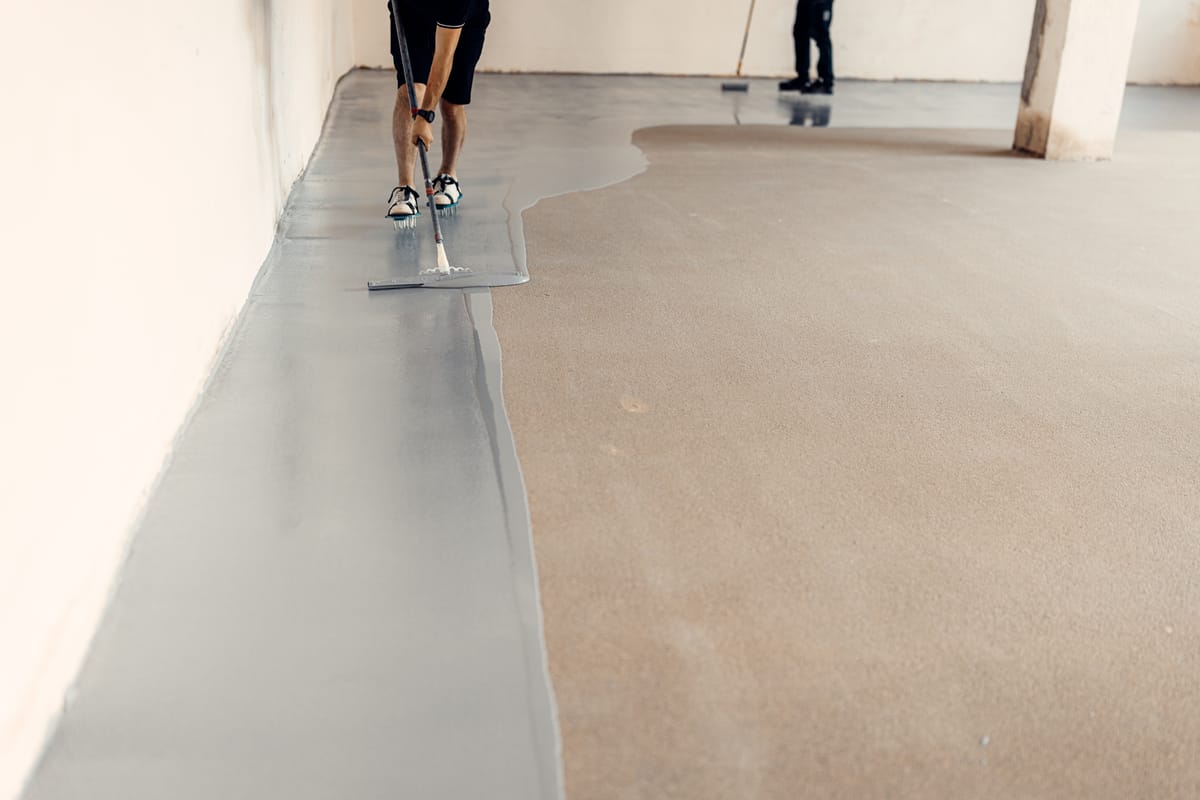
Yes: epoxy floor work in Nevada calls for an active contractor’s license from the Nevada State Contractors Board, whether the floor is a family’s garage or a commercial kitchen, and the law makes it unlawful to work as a contractor or bid on a job in the state without that license. The Board’s regulations place floor finishing in a specialty license whose covering-floors subclassification reaches polyurethane and other materials contractors generally accept as coatings, though which classification a given resin system goes under is for the Board to decide. Around the license sit a bond or cash deposit, proof of industrial insurance, compulsory workers’ compensation, a safety plan the state runs itself and a general air rule on how paints and solvents are handled.
Licensing in Nevada is not a formality that ends with a card in the truck. The Board ties the license to a bond and to proof that your employees are insured, so the insurance program and the license stand or fall together. In the sections that follow, every Nevada rule we could source is set out in the state’s own words where we quote it, followed by the policy that covers what that rule leaves to you.
Nevada’s contractor license and the floor-covering subclassification
Nevada’s contractor law starts from a broad prohibition:
“It is unlawful for any person or combination of persons to: (a) Engage in the business or act in the capacity of a contractor within this State”
The law’s definition of a contractor takes in anyone who undertakes to build, alter, repair or improve any building or structure, or to do any part of that work, on homes and commercial buildings alike. Grinding a slab, priming it, broadcasting flake and rolling a clear topcoat is work on a building, so a coating company falls inside that definition from its earliest job. Among the exemptions the law lists is small repair or maintenance work under a dollar line it sets, with no building permit and not part of a larger project; ask the Board before relying on any of them, and plan on holding the license before you bid. The law also lets a county or city impose additional requirements on a contractor’s license, so check with the licensing office in each county and city where you take work.
Which license is the harder question. Under the Board’s classification rules, the covering-floors subclassification of the finishing-floors specialty reaches the materials described here:
“The installation and application to floors of fabrics, carpet, polyurethane and other materials, excluding ceramic tile and marble, generally accepted by contractors as coatings or coverings used to finish floors, including the preparation of the floors for the finishing.”
That subclassification’s reach is tied to its own wording: polyurethane and other materials contractors generally accept as coatings or coverings used to finish floors, with the preparation of the floor included. An epoxy or polyaspartic floor system can be described as a coating that finishes a floor, but the Board has not said on any page we read where it places a given resin system. Painting and decorating is a separate classification in the same rules. Whether your system goes under covering floors, under painting, or somewhere else is the Board’s call, so describe your products and your process to the Nevada State Contractors Board and get its answer before you apply.
Settle the classification before you apply, and keep the Board’s answer in writing. An underwriter reviewing a claim on a commercial floor will ask what your license covered, and the Board’s answer is the record that shows it.
Bond, deposit and industrial insurance before the license issues
Holding the license takes more than passing the Board’s review. Before it issues a license, the Board requires a surety bond or cash deposit, and before it grants a license or a renewal, it requires proof of workers’ compensation coverage for your employees, a self-insurance certificate, or a sworn statement that you have no employees and do not work for other contractors. The bond condition comes in the statute’s own words:
“Before issuing a contractor’s license to any applicant, the Board shall require that the applicant: (a) File with the Board a surety bond”
The statute lets a cash deposit stand in for the bond, and the Board expects the bond or deposit still in force when you renew. The insurance condition is just as direct:
“Proof of industrial insurance and insurance for occupational diseases which covers the applicant’s employees”
Industrial insurance is Nevada’s statutory term for workers’ compensation. Failing to maintain the bond or the coverage is cause for the Board to deny, suspend or revoke the license, which means a lapse in your comp policy is a licensing problem as well as an insurance problem. Setting the comp renewal date well clear of the license renewal date is worth asking us about; keep proof of coverage where the person who handles your Board filings can reach it.
The bond is not insurance for you. A surety bond answers to the people it protects, and the surety expects to be repaid for what it pays out. It is the general liability policy that answers a customer’s claim that your coating damaged their property or that someone slipped on your finish. Ask us whether placing the bond and the liability program together would keep your license file and your certificates in step.
Customers will want paperwork of their own. Expect a general contractor on a Henderson tenant improvement or a property manager in Reno to ask for a certificate of liability coverage, possibly naming them as additional insured, and a copy of your license. Have the license number and the certificate ready on the day the bid is accepted.
Garage jobs and commercial jobs under a Nevada license
The license condition does not change with the customer. Nevada’s definition reaches homes and commercial buildings alike, so the difference between residential and commercial epoxy work here is about contracts, timing and the kind of claim that follows.
Residential buyers in Nevada mostly want garages, patios and workshop floors, and they rarely ask to see a certificate. Claims from those jobs arrive after the crew has left: a flake system that lifts because the slab was too smooth or too damp, a topcoat that softens under hot tires, a color that yellows where daylight reaches it. Your liability policy handles such losses as completed operations, and the way that coverage answers is laid out on our residential epoxy flooring contractor insurance page. Homeowners also hire on referrals and reviews, so a coating that fails in public carries a cost no policy pays; budget the slab testing that prevents it.
Commercial work starts with the contract. A warehouse near Las Vegas, a restaurant kitchen in Henderson or a showroom in Reno may require additional insured status, ask your policy to respond ahead of theirs and set limits sized to their own exposure. Overnight installs in a building that reopens at dawn turn odor and early foot traffic into claims. The contract terms a commercial floor brings are worked through on our commercial epoxy flooring contractor insurance page.
When your Nevada crew sells to homeowners and businesses, tell us roughly how revenue divides between them. Rating a garage crew as a warehouse contractor wastes premium, and rating a warehouse contractor as a garage crew leaves contract requirements unmet.
Comp coverage for Nevada coating crews, subcontractors included
With few exceptions, every Nevada employer with an employee in the state must obtain and keep workers’ compensation coverage. The state’s notice puts it plainly:
“Nevada law requires business owners with one or more employees in the State of Nevada to obtain and maintain workers’ compensation coverage.”
Coverage comes through the routes the Workers’ Compensation Section lists: a private insurer authorized by the Nevada Division of Insurance, or self-insurance, alone or through an association, with that Division’s approval. Its notice describes the insured route this way:
“Employers may obtain workers’ compensation insurance from a private insurance carrier authorized by the Division of Insurance (DOI) to provide workers’ compensation in Nevada.”
For a coating business with a modest payroll, an insured policy is the route to plan on, and it is the coverage we place. Self-insurance asks more of an employer than a small crew may be able to show; ask the Division what it would require of you before you rule it in or out.
Subcontracting is where Nevada epoxy owners get caught. Under the Section’s guidance, subcontractors and independent contractors are treated as the prime contractor’s employees unless they pass an independent enterprise test. In the words of the Nevada Attorney General’s Workers’ Compensation Fraud Unit, the prime contractor must make sure its subcontractors have and keep coverage, and its notice closes the door on construction work:
“The “independent enterprise” exception does not apply to construction projects. There are no exceptions when the work being performed requires a contractor’s license.”
Floor coating needs a contractor’s license here, so treat every installer you send to a job as someone your comp program must answer for. Put them on your payroll and your policy, or collect a current comp certificate from their company before they arrive and check its dates. A sub who shows up uninsured can become your claim and your audit charge.
Insurance in Nevada is regulated by the Nevada Division of Insurance, which authorizes the insurers that write this coverage and approves self-insurance.
Nevada OSHA, silica and the slab grinder
Workplace safety here is a state program. Nevada OSHA sits inside the Division of Industrial Relations, and its own page records the plan’s approval:
“Nevada OSHA was initially approved as a state plan on January 4, 1974, then ultimately received its final approval on April 18, 2000.”
Its stated measure is the federal program:
“ensuring state OSHA programs, such as Nevada, are at least as effective as federal OSHA”
The federal regulations keep the roster of those plans under this title:
“List of Approved State Plans for Private-Sector and State and Local Government Employees”
That federal list says the Nevada plan covers private-sector employers, with several notable exceptions, as well as state and local government. For private epoxy work, then, the agency your crew should expect is Nevada OSHA. If a job sits on a site with its own federal rules, ask the owner before you mobilize which agency covers the work there.
Silica is settled in the plan’s own records. Among the enforcement programs on its regulations page is this entry:
“National Emphasis Program – Respirable Crystalline Silica”
Its adoption log also lists the federal final rule on respirable crystalline silica, for general industry and for construction, as adopted identical to the federal rule. Treat grinding and shot blasting concrete as work that rule reaches. Shroud every grinder and run it on a vacuum with a filter suited to fine dust, fit-test respirators and keep the records, train the crew on the written exposure control plan, and keep a copy of that plan in every truck.
Resin chemistry brings its own injuries: amine hardeners burn skin, and solvent-borne primers fill an enclosed space fast. Those injuries, along with a back strained wrestling a grinder off a trailer, are what workers’ compensation pays for. Expect questions about dust collection, respirator fit, ventilation and training from any insurer quoting a Nevada epoxy crew, because the answers drive how often claims happen.
Solvent handling under Nevada’s air rules
As approved into Nevada’s federal air plan, Nevada has no architectural coatings rule that limits the volatile organic compounds in paints and floor coatings: the federal table of the rules approved for the state, for Clark County and for Washoe County lists none. The state does have a general rule on solvents and other volatile compounds, which says paints and similar materials must be stored and used in a way that keeps them from evaporating into the air. The state rule is listed in the federal table under this name:
“Organic solvents and other volatile compounds”
In the state’s own code it reads this way:
“Solvents or other volatile compounds such as paints, acids, alkalies, pesticides, fertilizers and manure must be processed, stored, used and transported in such a manner and by such means as to minimize the tendency to evaporate”
No limit on coatings content reaches a floor crew here. The general rule speaks to anyone who stores or uses paints and solvents: they must be handled to minimize evaporation, and control methods the rule’s director finds available and feasible become mandatory, and the rule’s definitions let a county or city designate its own enforcer. For a floor crew that means the rule speaks to how paints and solvents are stored and used on the job, not to how much volatile content the product may carry. Keep containers closed between pours, mix in the quantity the crew will use, and keep thinning and clean-up solvents capped and labeled.
Clark and Washoe Counties complicate the picture. The federal table lists approved rules for each of them separately, and the state environmental agency’s air page sends Clark County readers to the county’s own website for air-quality information:
“View the Clark County Department of Environment and Sustainability's website for information about air quality in Clark County.”
Whether the state’s general solvent rule applies inside Clark and Washoe Counties is not stated on any page we read, and the counties’ local rulebooks were not part of what we read. Consider that question open, and ask the county air office where you work how it applies its own rules, and the state’s, to resin floors laid on a jobsite.
Ask your supplier for the technical data sheet and the safety data sheet for every component, and file them with the job. Whatever the air rules say, an odor that drifts into an occupied office, a guest corridor or a dining room can become a claim, and that is where the pollution exclusion in a general liability policy gets tested. Before you accept work in occupied buildings, let us review your policy for a pollution endorsement covering the products you apply, or a separate contractors pollution policy if your commercial book calls for it.
The license is not the coverage — the program is.
- A license or registration is a condition the state sets on the work or its permits, not insurance, so no line is drawn from it.
- No line is drawn from the coatings row: ask whether your general liability excludes pollution, and about a pollution endorsement.
A panel for Nevada in rows. Each row sets a requirement of the state beside the exposure that requirement leaves open and the coverage line that answers it. Contractor licensing: A state contractor license, issued by the Nevada State Contractors Board. It leaves open a coating that fails, or damage to the customer’s property, which General Liability and Umbrella Liability answer. Workplace safety: Its own OSHA-approved state plan, run by the Division of Industrial Relations of the Department of Business and Industry. It leaves open a crew member hurt by silica, chemicals or the grinder, which Workers Compensation answers. Coatings VOC rules: No state VOC rule found that reaches floor coatings. No connector is drawn for this row. Workers’ compensation: Compulsory; bought from an authorized insurer. It leaves open an injured employee, which Workers Compensation answers. Notes: A license or registration is a condition the state sets on the work or its permits, not insurance, so no line is drawn from it. No line is drawn from the coatings row: ask whether your general liability excludes pollution, and about a pollution endorsement. The conclusion reads: The license is not the coverage — the program is. No figures are shown.
From these rules to your insurance program
The rules set the conditions; the policies pay the losses. This is how each part of an epoxy flooring program covers what Nevada’s rules leave to the business owner.
Coatings that fail after the crew leaves, falls on a slick finish, a customer’s car or inventory damaged mid-job: general liability answers these, and it supplies the certificate a Nevada general contractor demands before your trailer pulls in. How a vapor complaint in an occupied building is handled depends on the policy’s pollution wording, so read it before working indoors around the public.
Compulsory for a Nevada employer, workers’ compensation is also part of what the Nevada State Contractors Board checks before it grants or renews your license. Because subcontractors can count as your employees under the comp rules, it is also the policy that may absorb an uninsured sub’s injury. Our placement is the insured route, and we help you collect certificates from any crew you hire.
Contract limits beyond your base policies are what umbrella liability is for, layered over general liability, commercial auto and the employers liability part of your comp policy. When a property owner, a hospital system or a large general contractor writes higher limits into a contract, ask us about an umbrella before you sign it, so the limits match what the contract demands.
Las Vegas garages, Reno warehouses and jobs in smaller towns all mean hauling grinders, vacuums and resin, and the vehicles doing it belong on commercial auto. Parking a business vehicle on a personal auto policy invites a gap that tends to surface on the day of the accident.
Theft of or damage to grinders, shot blasters, dust collectors and mixers, on the trailer, at a customer’s garage or parked overnight at a commercial site, falls to inland marine — contractors tools and equipment. Replacement of a stolen grinder, which otherwise stalls the schedule, is what this coverage pays for.
Resin, hardener and flake stocked at a shop you own or rent, along with the building itself, fall under commercial property. Run the company out of your home garage? Mention it on the application, because a homeowners policy may exclude business property.
How these policies work together, and what an insurer asks before quoting, is laid out on our page about insurance for an epoxy flooring business.
Where Nevada’s coating crews work: the Census metros
Listed below, largest first, are the metropolitan areas the Census Bureau draws around Nevada counties, and together they are every metro the state has. Beside every metro you will find its counties and what they mean for an epoxy business working there.
Las Vegas-Henderson-North Las Vegas, NV
Clark County makes up this metro on its own. A Clark County table of its own appears in the federal list of approved air rules, and the state environmental agency’s air page sends readers to the county department’s website for air-quality information there. Where your crews coat floors in occupied commercial buildings here, put the solvent question to that county office and send us its answer, so the pollution wording on your liability policy can be read against what the county expects.
Reno, NV
Lyon County, Storey County and Washoe County form this metro. Washoe County has a table of its own in the federal list of approved air rules, and the state’s general solvent rule lets a county or city designate its own enforcer, so the office that answers a solvent question may change at a county line inside the metro. If your Reno-based crews work across those counties, ask each office separately and keep the answers with your job files for an underwriter to see.
Carson City, NV
Carson City is a county-equivalent and a metro of its own. The state’s general solvent rule lets a county or city designate its own enforcer, so ask Carson City’s offices and the Nevada Division of Environmental Protection which of them answers a solvent question here. If your Carson City jobs run on solvent-borne primers, write closed-container storage and mixing into your crew procedures, since an underwriter looking at a vapor complaint will ask what the crew actually did.
Got a job in a Nevada town outside these metros? The state license, the bond, comp and the safety plan go with you, but a county or city may add requirements to a license, and the office that answers a solvent question may depend on where the job sits. To price the program, request a quote.