
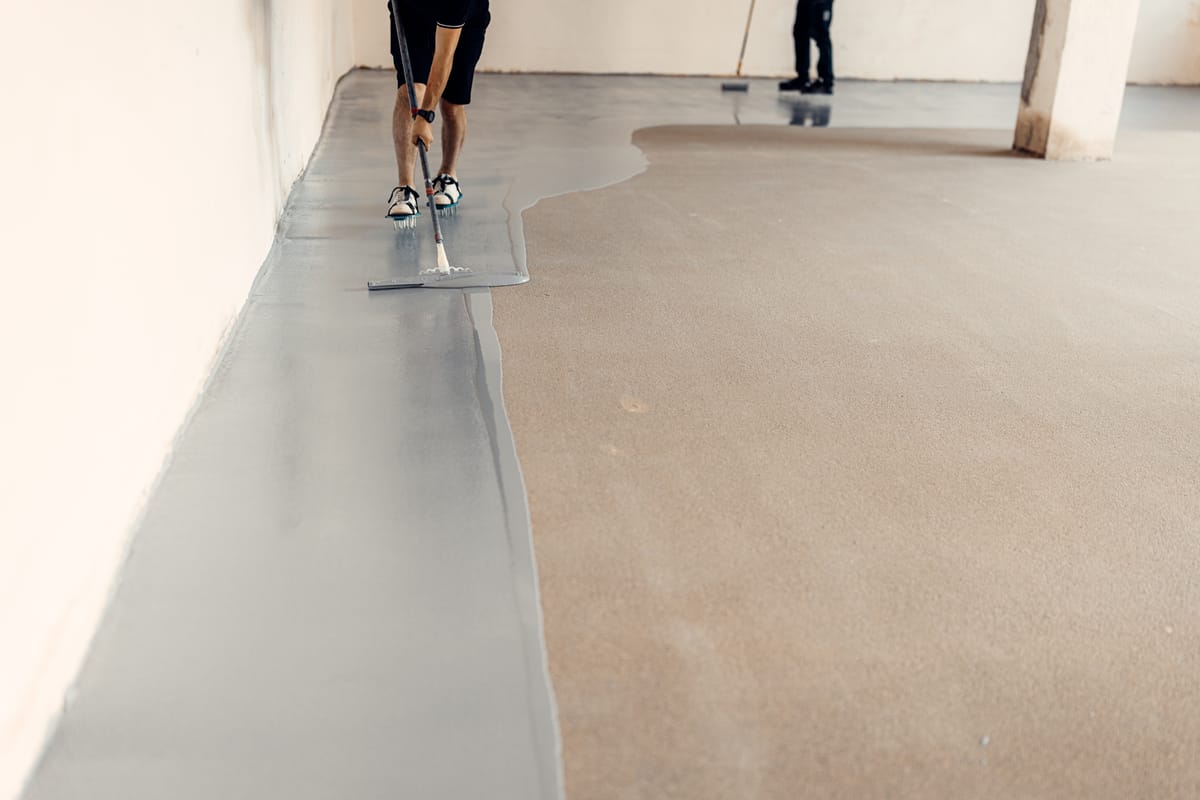
Wyoming sets no state license for epoxy floor coating, on homes or on commercial buildings: the professions and occupations title of its statutes carries no general, building, flooring or coating contractor chapter, and the contractor chapter it does carry covers water well drilling and pump installation. Licensing for a floor job therefore comes from cities, which state law lets license business within their limits; Casper licenses general and sub contractors, and Cheyenne restricts certain trades to contractors its board licenses. What reshapes an epoxy business here is workers’ compensation, which an employer on the law’s extrahazardous list buys from a state fund, alongside a state-run OSHA plan and air rules built around permitted sources.
A quiet state licensing picture still leaves every claim in place. Claims keep arriving anyway: a garage coating lifting where the slab was sealed, a slip on a glossy showroom aisle, a hardener splash on a helper’s forearm, a grinder taken from a trailer overnight. The rules below decide who must license, insure and inspect, and the policies beside them decide who pays. We quote Wyoming’s own sources wherever we can.
Wyoming’s extrahazardous list and the state fund
This is where a Wyoming epoxy business buys insurance differently. Stated in full, the regime works like this: Wyoming is a monopolistic workers’ compensation state: an employer in a line of work the law calls extrahazardous must get its coverage from the state fund run by the Wyoming Department of Workforce Services before work begins, and may not self-insure. Construction is on the law’s extrahazardous list as a whole sector, regardless of each worker’s job. Employers outside the list may elect state coverage or buy from a private insurer. The law’s list of covered employments opens with a clause that reaches past job titles:
“Regardless of individual occupation, all workers employed in the following sectors, subsectors, industry groups and industries”
And among the sectors it lists:
“Construction, sector 23;”
Construction appears on that list as a whole sector, regardless of individual occupation. In which sector the state places a business that grinds and coats floors is not something our sources say, so do not settle that for yourself. Ask Wyoming Department of Workforce Services, Workers’ Compensation Division how it classifies an epoxy floor business before you hire, and get the answer in writing.
For employers inside the list, the timing is fixed by the state:
“Workers’ Compensation coverage through DWS is required before work begins in Wyoming.”
Open the employer account before a hire starts, not after a crew is already on a slab. Comp bought from the fund is not a policy we place, and a private insurer cannot sell it in place of the fund for an employer the law requires to be covered. Our part is the liability, auto, equipment and property side of the program, built around your fund account.
Self-insurance is closed to those employers as well. The Legislature’s staff memo on the comp account puts it this way:
“Wyoming and North Dakota are the only two states that do not allow employers required to have coverage to self-insure or join a self-insurance group.”
Employers outside the extrahazardous list sit in a different place. The state’s insurance department says of them:
“These exempt employers may purchase workers' compensation insurance from private insurers on the open market”
Do not move your business into that group on your own reading. If you believe your work falls outside the list, put the question to the division, keep its written answer, and talk to us before you drop or skip a fund account. Private insurers writing coverage for employers exempt from the fund are regulated by the Wyoming Department of Insurance, which matters only once that exemption is settled.
Helpers raise the next question. Read for an owner deciding who is on payroll, the law says this: Wyoming’s comp law leaves an independent contractor out of the definition of employee, and counts a person as an independent contractor only when the person is free from control over the details of the work, offers the services to the public as self-employed, and may send someone else to do the work. Those criteria are the ones to walk through for every helper, so settle each person’s status with the division before the work starts, not after an injury.
Employers liability is worth a conversation with us. The sources we read for Wyoming do not address employers liability for work in the state, and the fund’s account answers your employees’ compensation, not every suit an employer could face. Whether employers liability, known as stop-gap, can be added to your general liability program is a question to bring to us. Whether an insurer will add it, and what it would answer, depends on the insurer and the policy wording, so read any offer with us before relying on it.
Casper, Cheyenne and the city license question
Without a state credential, the licensing question moves to city hall. Wyoming’s statute on city powers lets a city or town do this:
“License, tax and regulate any business whatsoever conducted or trafficked in within the limits of the city or town”
Casper shows how a city uses that power. The City of Casper, Building Inspection Division licenses general and sub contractors in classes set by the size and type of the work, and its broadest class reads:
“CLASS I authorizes the contractor to construct, repair, or alter any structure.”
Casper’s page sets minimum public liability and property damage insurance for the general and sub contractor license categories it marks as requiring proof of insurance. The page flags those categories with a marker explained like this:
“Indicates license categories which require proof of insurance.”
The page lists no floor-coating category, so which class an epoxy job falls in is a question for the division, not something to guess at the counter. Ask which class fits your residential and commercial floors, whether that class needs proof of insurance, and how the certificate should name the license holder. That license speaks for the City of Casper, not for every town in Natrona County.
Cheyenne runs its licensing through a board. Its page describes the rule this way:
“requiring that only contractors, licensed by the contractor licensing board, and persons actively supervised by licensed contractors may engage in those certain trades”
The board’s own licensing regulations show where an epoxy job lands. Cheyenne’s licensing regulations say no one may do construction, alteration or repair work on a building in the city without the required licenses. Their Class D license covers every contractor outside the other categories who does any type of work on a building, and it names floor and wall covering and painting. The rules don’t name floor coating as such, so an epoxy contractor would hold a Class D license in the specialty the board assigns. The city issues no license until it has the contractor’s certificate of insurance and a workers’ compensation letter of good standing. Gather both documents before you apply, and ask the City of Cheyenne Contractor Licensing Board which specialty it will list, so the license matches the floors you actually bid inside the city.
Other Wyoming towns may license, tax or regulate contractors in their own way, or not at all, and the sources behind this page do not list them. Call the clerk or building office in each town before you take a job there. A manufacturer’s installer certification can still matter when a commercial specification names a product system, but it is the maker’s credential, not a credential Wyoming issues.
Garage floors and commercial contracts with no state license in play
With no state license reaching floor coating on homes or commercial buildings, the residential and commercial sides of a Wyoming epoxy business differ in their buyers, their paperwork and their claims, and in whatever a city license asks.
Residential jobs are mostly garages, basements and shop buildings sold straight to homeowners, who seldom ask for a certificate. Problems surface once the crew has gone: a flake system that peels where the slab was not profiled, a topcoat lifting under hot tires before it fully cured, or moisture rising through an older slab and pushing up blisters. Completed operations coverage within general liability is what answers those losses, and our residential epoxy flooring contractor insurance page explains how it responds.
Facility buyers write their demands into the contract. A warehouse in Casper, a vehicle service bay in Cheyenne or a restaurant kitchen can ask to be named as an additional insured, want your policy to answer ahead of theirs and set limits for their own exposure. Overnight work in a building that reopens at dawn is where odor complaints and early traffic on a soft coating become claims. Each of those demands gets its own treatment on our commercial epoxy flooring contractor insurance page.
Should your Wyoming book mix garages and facility work, tell us roughly how revenue divides between them. A program sized for garage floors can fall short of a commercial contract, and a program sized for warehouses can carry endorsements a garage crew never uses.
Safety inspections under Wyoming’s state plan
Wyoming has its own OSHA-approved plan, Wyoming OSHA, run within the Wyoming Department of Workforce Services. Its own page describes the job:
“the Wyoming OSHA team provides for the administration of rules and regulations aimed at the prevention of accidents and occupational diseases”
Its reach, exceptions included, is set out on the federal list of approved plans:
“The plan covers all private-sector employers and employees, with several notable exceptions, as well as State and local government employers and employees, within the State.”
On private Wyoming work, then, the agency a crew should expect is Wyoming OSHA, keeping in mind that the federal list notes several exceptions it does not spell out. If your work takes you onto a site where you are unsure which inspector applies, ask the plan’s office before the job.
On standards, the plan’s page says this:
“Wyoming OSHA follows many of the Federal General Industry and Construction Industry Standards.”
Silica is where that following becomes specific. Wyoming’s own construction rules, in their toxic and hazardous substances chapter, take in by reference the run of federal sections that ends with the construction silica section, which the federal code titles respirable crystalline silica. The Wyoming Department of Workforce Services reports that its OSHA commission voted to adopt an update to that chapter, and the older and newer texts reach the same sections. For a private grinding job in Wyoming, then, Wyoming OSHA is the enforcer of the silica standard, subject to the exceptions noted on the federal list. Work every grinding and shot blasting job to that standard: run shrouded grinders on a vacuum with a fine-dust filter, wet the slab where the system allows, fit-test and document respirators for everyone near the grinder, and keep a written dust program in each job folder.
Help is offered outside enforcement. The plan’s consultation and compliance assistance service gives private and public employers safety and health technical assistance at no charge, identifying hazards without a fine or penalty. A visit before a large commercial floor is a sensible way to find what an inspector would notice.
Dust-irritated lungs, an amine hardener burn, a grinder that kicks on a rough joint, a back strained hauling a machine up a ramp: those are the injuries workers’ compensation answers, and in Wyoming that coverage sits with the fund. Your safety record still shapes the rest of the program, because liability and equipment insurers ask about dust collection, respirator fit and training too.
Wyoming air rules built around permits and flares
As approved into Wyoming’s federal air plan, Wyoming’s rules carry no coatings rule: the state’s volatile organic compounds standard limits emissions from permitted sources through the best available control technology set in their air permits, with flare rules for oil and gas operations, and nothing in the approved table sets a VOC limit for a coating or reaches the crew applying a floor system. The section in that federal table carries this title:
“Section 06 Emission Standards for Volatile Organic Compounds”
And the state text we read sets its method in this sentence:
“VOC emissions shall be limited through the application of Best Available Control Technology (BACT) in accordance with Chapter 6, Section 2 of these regulations.”
The volatile organic compounds standard works through air permits for emission sources and through flare rules for oil and gas operations; nothing in it reaches a person applying a floor coating. Our reading uses the state text filed with the Legislature in an earlier rule package, and the federal table lists a later version of the same section that we did not read, so if a large commercial job raises an air question, describe the work to the Wyoming Department of Environmental Quality and keep its answer. National limits on architectural coatings were outside our reading as well; ask your supplier whether each product in your system meets them.
Hold on to the technical data sheet and the safety data sheet for every product you apply, mix and thin only as the maker directs, and file the sheets with the job, so the record of what went down on each floor is complete if anyone asks.
Odor is an insurance question whatever the air rules say. Even low-solvent resin can send vapor drifting into an office over a garage, a school wing or a dining room, and a claim from that vapor is where the pollution exclusion in a general liability policy gets argued. Let us read your policy before you take work in an occupied building, so we can look for a pollution endorsement covering the products you use, and ask whether a separate contractors pollution policy fits your commercial work better.
The license is not the coverage — the program is.
- A license or registration is a condition the state sets on the work or its permits, not insurance, so no line is drawn from it.
- No line is drawn from the coatings row: ask whether your general liability excludes pollution, and about a pollution endorsement.
- Workers’ compensation there comes from the state fund, or self-insurance where the state allows it, never from a policy we place, so no line is drawn from this row.
A panel for Wyoming in rows. Each row sets a requirement of the state beside the exposure that requirement leaves open and the coverage line that answers it. Contractor licensing: No state license found for this work; local licensing or registration may apply. It leaves open a coating that fails, or damage to the customer’s property, which General Liability and Umbrella Liability answer. Workplace safety: Its own OSHA-approved state plan, run by the Wyoming Department of Workforce Services. It leaves open a crew member hurt by silica, chemicals or the grinder, which Workers Compensation answers. Coatings VOC rules: No state VOC rule found that reaches floor coatings. No connector is drawn for this row. Workers’ compensation: Compulsory for covered employment; the state fund, or self-insurance where the state allows it — not a private insurer. No connector is drawn for this row. Notes: A license or registration is a condition the state sets on the work or its permits, not insurance, so no line is drawn from it. No line is drawn from the coatings row: ask whether your general liability excludes pollution, and about a pollution endorsement. Workers’ compensation there comes from the state fund, or self-insurance where the state allows it, never from a policy we place, so no line is drawn from this row. The conclusion reads: The license is not the coverage — the program is. No figures are shown.
From these rules to your insurance program
What follows is the program, policy by policy, set against the gaps Wyoming’s rules leave open.
In Casper some license categories require proof of insurance, and customers across Wyoming ask for a certificate of general liability too. The same policy answers a floor that fails after you leave: a coating that peels, a fall on a finish that cured slick, a customer’s vehicle or shelving damaged mid-job. The policy’s pollution wording settles how a fume complaint is handled.
Workers’ compensation for an employer on the extrahazardous list comes from Wyoming Department of Workforce Services, Workers’ Compensation Division, not from us. We help you keep each helper’s status straight, collect fund certificates from the crews you hire, and ask about employers liability on your general liability program where an insurer will offer it.
Higher limits than general liability and commercial auto carry on their own come from umbrella liability. If a contract from a hospital, a school district or a large general contractor calls for higher limits, ask us before you sign how those limits compare with what you carry and whether an umbrella closes the difference.
Cheyenne-to-Casper hauling of grinders, vacuums and resin, and every other run across the state, rides on commercial auto. Leave the work truck off any personal auto policy, since that gap shows up on the day of an accident.
Owned equipment, from the grinder to the dust collector and mixer, belongs on inland marine — contractors tools and equipment, which follows the gear on the trailer, in a customer’s garage or parked overnight at a commercial site. Should a grinder go missing, this coverage pays to replace it so the job can restart.
Resin, hardener and flake inventory, and the shop that holds it, owned or rented, fall under commercial property. A home-garage operation should be flagged on the application, because business property can sit outside a homeowners policy.
Pulling these policies together, our page on insurance for an epoxy flooring business also lists what an insurer asks before quoting.
Wyoming’s metro markets for resin floor work
Listed below in order of size are the Census Bureau’s metropolitan areas around Wyoming counties; the list is complete for the state. Each note names the county inside the metro and what changes for an epoxy business working there.
Cheyenne, WY
Laramie County forms this metro in the Census Bureau’s tables. Inside the City of Cheyenne, building work runs through the contractor licensing board, so settle the city license before you bid a city job; elsewhere in Laramie County, ask each town. A commercial customer may ask to see that license next to your liability certificate.
Casper, WY
This metro is Natrona County. Inside the City of Casper, contractor licenses come in classes by the size and type of the work, and some categories call for proof of liability insurance at a minimum the city sets, so ask the building office which class fits your floors and send it a certificate in the exact license name. Towns elsewhere in Natrona County are separate questions to ask.
Outside these metros, the comp, safety and air rules above still run statewide, while licensing is each town’s own business, so call its clerk or building office before the job. Ready for numbers? Request a quote.