
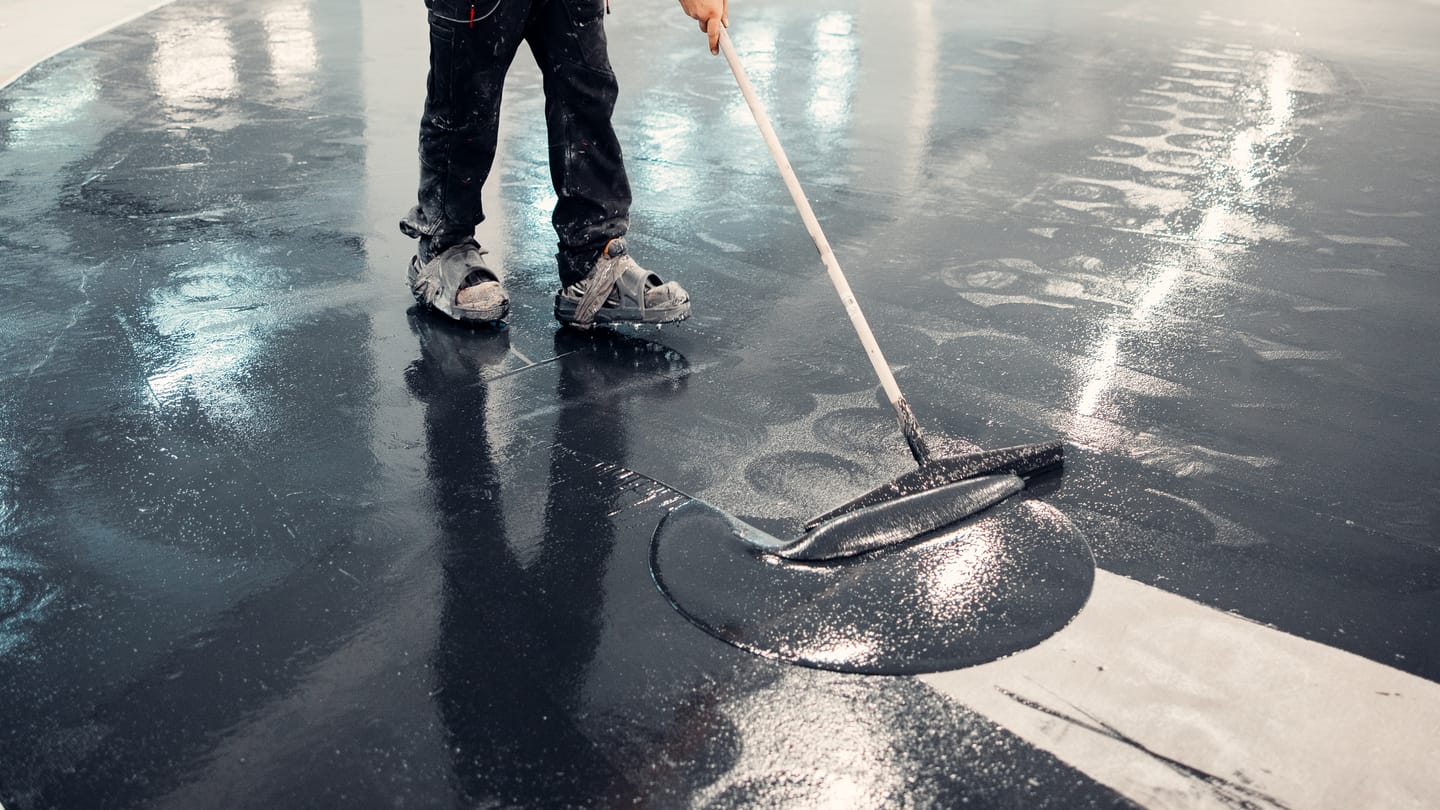
The epoxy flooring business opportunities worth weighing are the service lines you can staff, equip and insure well: flake broadcast floors, metallic and decorative finishes, an added topcoat system, industrial and food plant floors, and recoat work on floors already down. Each line asks something different of your crew, your gear, your license and your policy.
Epoxy flooring business opportunities, line by line
Each opportunity is a line of work with its own demands, and the right pick is the line your business can deliver again and again. This post describes every line by what the work involves and what it asks of the owner. We found no public source that measures demand or earnings for flake, metallic, plant or recoat floors separately, so nothing here ranks them by money.
The Small Business Administration’s business planning guide gives a useful lens for the choice: “Your competitive analysis should identify your competition by product line or service and market segment.” Read your market the same way. A town can be crowded with crews selling garage flake and still have nobody who will strip and recoat a worn shop floor on a weekend.
Lists of epoxy business ideas tend to blur these lines together, as if any crew could sell any finish. In practice each line pulls on a different skill, a different set of tools and a different kind of customer. The sections below take them in turn, then cover licensing classes, how to weigh a niche, and what a new line does to your insurance.
Flake broadcast floors as a base line of work
Flake floors are a sensible base because the steps repeat from job to job and a crew can learn them as a routine. The work is grinding the slab, laying a base coat, broadcasting colored chips into it, scraping the excess and sealing with a clear topcoat. The finish forgives small variations in color, which lets a crew focus on prep.
What the line asks of you is mostly equipment and discipline. A grinder, dust collection, mixing gear and a trailer to move them are the core of the rig, and our list of the tools needed for the work walks through what to buy and in what order. Because the rig travels from house to house, think about how you will protect it on the road and overnight; coverage for tools and equipment you haul is written for that exposure.
The insurance side of flake work centers on the finished floor. A coating that peels or a surface that turns slick when wet is the complaint that reaches you after the crew has left, and the way a policy treats it depends on its wording. Read how general liability for coating work is described, and see how we approach garage and home floor coating risks before you build the line around homeowners.
Metallic and decorative finishes reward hand skill
Metallic and decorative floors are a craft line: the finish is worked by hand, and the result is judged by eye. Where a flake floor hides small variations, a metallic floor shows every pass of the tool, so the skill sits in the installer rather than in the equipment.
The nearest federal occupation description gives a sense of the craft. O*NET’s summary for construction and maintenance painters lists the task “Cut stencils and brush or spray lettering or decorations on surfaces.” It also says on-the-job training for that occupation “Ranges from a few days to one year of on-the-job training.” Decorative floor work is not named there, so treat the description as a neighbor of the craft, not a definition of it.
The line asks for practice before it asks for gear. Pour practice boards, work a garage floor under someone who has done the finish, and keep photos of what you produce. Our post on what epoxy classes are worth paying for covers how to judge a course before you spend on it.
Customers buying a decorative floor are buying a look, and a dispute over the look is different from a claim over damage. Agree on samples, colors and the expected variation in writing. Ask your agent how your policy reads a complaint about appearance compared with a complaint about injury or property damage.
Adding a second coating system to the menu
A crew that already installs epoxy can add another coating system, and the work it adds is mostly safety and process rather than new equipment. One add-on is a fast-cure topcoat, and our comparison of polyaspartic and epoxy systems covers what changes for the crew and the customer.
The hazard question starts with the product’s safety data sheet, not with its brochure. An archived NIOSH page on isocyanates says those chemicals “are widely used in the manufacture of flexible and rigid foams, fibers, coatings such as paints and varnishes, and elastomers”. That page warns that “Isocyanates can also sensitize workers, making them subject to severe asthma attacks if they are exposed again.” Whether a given product contains them is a question for its data sheet.
The same NIOSH page says “Engineering controls such as closed systems and ventilation should be the principal method for minimizing isocyanate exposure in the workplace.” Plan airflow, respirators and skin protection before the first job with a new product. A hurt worker is a workers compensation question, and vapors drifting into an occupied building are the subject of our post on coverage for fumes and solvent vapors.
Industrial and food plant floors put the operator’s rules beside yours
Plant floors are a contract line: the floor has to fit a set of rules that belong to the plant, and your job is to deliver a floor that lets the operator meet them. The federal rules we read do not mention epoxy or any coating product, and they place their duties on the plant operator, not on the crew that coats the floor.
The Food and Drug Administration’s plant and grounds rule says a plant must “Be constructed in such a manner that floors, walls, and ceilings may be adequately cleaned and kept clean and kept in good repair.” Its grounds paragraph names the operator: “The grounds about a food plant under the control of the operator must be kept in a condition that will protect against the contamination of food.” It also calls for ventilation “to minimize dust, odors and vapors (including steam and noxious fumes) in areas where they may cause allergen cross-contact or contaminate food”, which matters when you grind and coat in or near a working plant.
Meat and poultry plants inspected by the Department of Agriculture answer to a sanitation rule for establishment facilities. It says “Walls, floors, and ceilings within establishments must be built of durable materials impervious to moisture and be cleaned and sanitized as necessary to prevent adulteration of product or the creation of insanitary conditions.” Ask the operator, in writing, what the floor must meet; the system choice should follow from their answer.
The line asks for paperwork and scheduling as much as skill. Expect contracts that require certificates, specific insurance terms and work in short shutdown windows. Our page on insurance for commercial coating contracts describes what those contracts tend to ask before you start.
Real-World Scenario: An owner who has built a steady run of garage flake work is asked by a regional bakery to coat a production room over a holiday shutdown. The plant manager sends a contract asking to be named on the owner’s policy, a written schedule, and a promise that no vapors will reach the packaging line next door. The owner has never run fans and containment in a food plant and has never been asked for those insurance terms. He calls his agent before signing, learns which parts of the contract his policy can answer, and asks the plant for its floor requirements in writing.
Recoat and upkeep work on floors already down
Recoat work turns existing floors into repeat jobs, and its risk lies in the coating you did not install. Every floor you recoat carries someone else’s prep and someone else’s product underneath your topcoat.
The O*NET summary for construction and maintenance painters lists the task “Remove old finishes by stripping, sanding, wire brushing, burning, or using water or abrasive blasting.” That is the heart of a recoat: taking off or roughening what is there before anything new goes down. It asks for grinding and blasting equipment, dust control, and the patience to test before you promise.
Before you quote a recoat, check how the old coating holds, photograph the floor, and write down what you found. If the old layer lifts after your topcoat cures, the record shows what you inherited. Tell your agent that recoat work is part of what you sell, because a complaint about a failed floor will ask whose work failed.
Matching a line to your state’s contractor classes
The license you hold may not stretch to every line you want to sell, and the answer comes from your state, not from a national rule. California shows how a state can divide the work. The Contractors State License Board’s list of licensing classifications includes “C-15 - Flooring and Floor Covering Contractors”, “C-33 - Painting and Decorating Contractor” and “C-8 - Concrete Contractor” among its specialty classes.
That list speaks for California alone, and it does not say which of those classes an epoxy coater holds. Treat it as an example of the question to ask, not as an answer. Other states use different structures or none at the state level. Our state by state guide to epoxy licensing collects what each state’s rules say, and your state’s licensing office is the place to confirm which classification covers each line you plan to bid.
Weighing a niche before you commit
Weigh a niche by whether your business can enter it cleanly, not by what someone else says it earns. The Small Business Administration lists factors to examine in a market, among them “Your window of opportunity to enter the market” and “Any barriers that may hinder you as you enter the market.” For an epoxy owner, the barriers are concrete: a skill your crew lacks, a machine you would have to buy, a classification you do not hold, or a contract term your policy cannot meet.
The same guide asks: “Market saturation: How many similar options are already available to consumers?” Answer it by counting the crews near you who already sell each finish and noting which lines nobody advertises. It also says “Market research blends consumer behavior and economic trends to confirm and improve your business idea”, which is a reminder that a niche you pick on paper still has to be tested on real customers.
Once you settle on a line, let it show in how you present the business. If the name is still open, our post on choosing and registering a company name covers names that fit the work you sell.
How a new service line reaches your policy
Every new line changes what your insurance has to answer for, so the policy has to hear about it before the first paying job. The Small Business Administration notes that “For example, knowing your NAICS code could help you with market analysis, insurance, and taxes.” The way your work is described and classified can shape how your business is rated and what your policy expects you to do.
When you add a line, send your agent a plain description of the work, the products involved, the equipment you will add and the places you will work. Ask whether the description on your policy still matches what you do, whether your equipment schedule needs new items, and whether plant or commercial contracts will ask for terms you do not carry. Our overview of insurance for an epoxy flooring business shows how the parts of a program fit together, and you can request a quote for the lines you sell once you know which ones they are.